
The Paper Shortage

Updated: Jul 19
Ancient coins from auctions always have a dealer's attribution, sometimes tucked into the flip in tidy abbreviations. It can sometimes be dressed up to be very authoritative-looking and very often unreliable. Auction houses vary in their expertise, and even the best of them cannot be specialists in every series; everyone, eventually, makes a mis-call. The ticket is a starting point, as today's coin will illustrate.
Here's what the dealer described
Greek Mysia, Pergamon, AE , 200-133 BC; Weight: 9,4 gr Diameter: 22,7 mm
Obv: Helmeted head of Athena right, below name of magistrate
Rev: ΠEΡΓAMHNΩN, Nike walking right, holding wreath and palm branch.
Ref: SNG Cop 365 var (magistrate).
At 9.4 grams it is among the heaviest examples of its type, and a satisfyingly chunky bronze. But read the ticket closely and it gets three things wrong, and each wrong thing, once corrected, opens a door to some interesting stories about the time of this coin and a competition between great libraries in Pergamon and Alexandria.
The Coin

Greek Mysia, Pergamon, AE , 200-133 BC; Weight: 9.4 gr Diameter: 22.7 mm
Obv: Helmeted head of Athena right, ΠEΡΓAMHNΩN "of the Pergamenes".
Rev: ΠEΡΓAMHNΩN, Nike walking right, holding wreath and palm branch.
Ref: SNG Cop 365, SNG France 1785
Here's what isn't right
The date is the first slip. "200-133 BC" quietly implies a royal issue of the Attalid kings, struck while the dynasty still ruled. The kingdom ended, abruptly, in 133 BC, and this coin was almost certainly struck after the Attalid bequest of 133 BC (not 200-133 BC). The ethnic shows a civic issue, and the find evidence assembled by Chameroy places this type after the end of the kingdom, about 133-127 BC. This coin was issued when Pergamon was under Roman Republican Rule 133-127 BC which puts this coin squarely in the early days of the lifetime of Sulla and in the midst of a genuine crisis.
The second slip is the interpretation of Pergamenes. The obverse, the ticket says, that the coin carries the "name of magistrate." This is incorrect. It reads ΠEΡΓAMHNΩN, the same word as the reverse: the genitive-plural civic ethnic, ΠEΡΓAMHNΩN "of the Pergamenes." The coin names the city.
The third slip is more subtle. SNG Copenhagen 365 var (magistrate) is a serviceable reference, but this suggests a magistrate variant that this coin doesn't need. A cleaner fit is SNG France 1785 , essentially this coin, with the obverse legend either truncated or off-flan (ΠEΡΓAMHN[ΩN] corr.).

A close variant is also illustrated in 1906, in the plates of the Corolla Numismatica - the volume of numismatic essays published in honor of Barclay V. Head.

So, a civic bronze, struck by the Pergamenes in their own name, in the first years after the kings were gone.
A kingdom in a will
In 133 BC the last Attalid king, Attalus III, died at thirty-six and bequeathed his entire kingdom to the Roman Republic. Why he did it is still debated. Ancient writers reached for the easy slander that he was mad; modern historians suspect that he saw Rome's habit of swallowing allies and enemies alike and tried to make the inevitable as bloodless as possible, perhaps concerned about his ambitious neighbors in Bithynia and Pontus. Rome had never before acquired a province by inheritance.
Tiberius Gracchus, who was focused on his land reforms, moved to use the Pergamene treasury to fund them. And in Pergamon itself, not everyone accepted being inherited. A man named Aristonicus, claiming to be an illegitimate son of an earlier king, Eumenes II, refused the will and took the royal name Eumenes III. Aristonicus recruited from the rural poor, the dispossessed, and above all slaves, to whom he promised freedom. He called his followers the Heliopolitai, "Citizens of the Sun-city", Heliopolis. At his side stood the Stoic philosopher Blossius of Cumae, who had also been the teacher and ally of Tiberius Gracchus. Sixteen centuries before Thomas More coined the word, here was a real attempt at a utopia built on emancipation and equality. The revolt was a major disturbance: Aristonicus's forces destroyed a Roman consul, Publius Licinius Crassus Mucianus, consul 131, defeated, captured, and killed in 130 before Rome finally ground the rising down by 129 BC. Aristonicus was hauled to Rome, paraded, and strangled in the Tullianum.
The goddess on the coin
Athena was Pergamon's patron as Athena Polias Nikephoros, Athena "of the city" and "bringer of victory." The cult was a royal creation: Attalos I founded a temple of Athena Nikephoros, and his son Eumenes II expanded it into the great festival of the Nikephoria, "crowned" games celebrated after his victory over king Prusias. The Nike on the reverse, striding with wreath and palm is the same victory; language carved in marble on the Great Altar. The frieze shows Athena and Nike tearing the giant Alkyoneus from the earth as his mother Gaia rises in grief.
An inscription describes the Nikephoria established by Eumenes II, the editorial summary at Attalus.org gathers the evidence:
"Attalos I built a temple of Athena Nikephoros at Pergamon (Polyb_16.1), but it was his son Eumenes II, after his victory over king Prusias, who expanded the cult by establishing the Nikephoria as 'crowned' games; for other inscriptions announcing these games, see Syll_630 and RC_49-50.   The claim of inviolability for the temple of Athena Nikephoros is discussed by K.J.Rigsby, "Asylia: Territorial Inviolability in the Hellenistic World", pp.362-377.
-Attalus: Syll 629 : summary and translation
The Galatians were Celtic tribes who invaded Anatolia in the 270s BC after raiding Greece and Delphi, eventually settling in central Anatolia (the region called Galatia) and extracting tribute from surrounding Hellenistic states, including Pergamon. Around 237 BC, Attalos I broke with this practice, refused to pay tribute, and defeated the Galatians in battle near the sources of the river Caicus. It was after this victory that he took the title "king" (basileus) for the first time. Before this, the rulers of Pergamon had been mere dynasts.
The Attalids then built their entire royal image around this victory. They commissioned famous sculptures (the "Dying Gaul," the "Gaul Killing Himself and His Wife," originally part of victory monuments at Pergamon) and later the Great Altar of Pergamon which is widely read as an allegory for Greeks (Pergamon) triumphing over barbarian chaos (the Galatians), echoing the older Greek trope of Persian Wars as civilization versus barbarism.
A related variety, SNG France 1786, even refers to a time before Attalos I with a reference to the founder-hero, with the legend ΕΠΙ ΠΕΡΓΑΜΟΥ ("in the time of Pergamos"). Pergamos, son of Neoptolemus (Pyrrhus) and the Trojan widow Andromache, came from Greece to Anatolia, killed the king of Teuthrania, took his throne, and gave the hill his name. Pausanias preserves the genealogy:
"Now Pyrrhus was the first who after the capture of Troy disdained to return to Thessaly, but sailing to Epeirus dwelt there because of the oracles of Helenus. By Hermione Pyrrhus had no child, but by Andromache he had Molossus, Pielus, and Pergamus, who was the youngest. Helenus also had a son, Cestrinus, being married to Andromache after the murder of Pyrrhus at Delphi."
-Pausanias, 1.11.2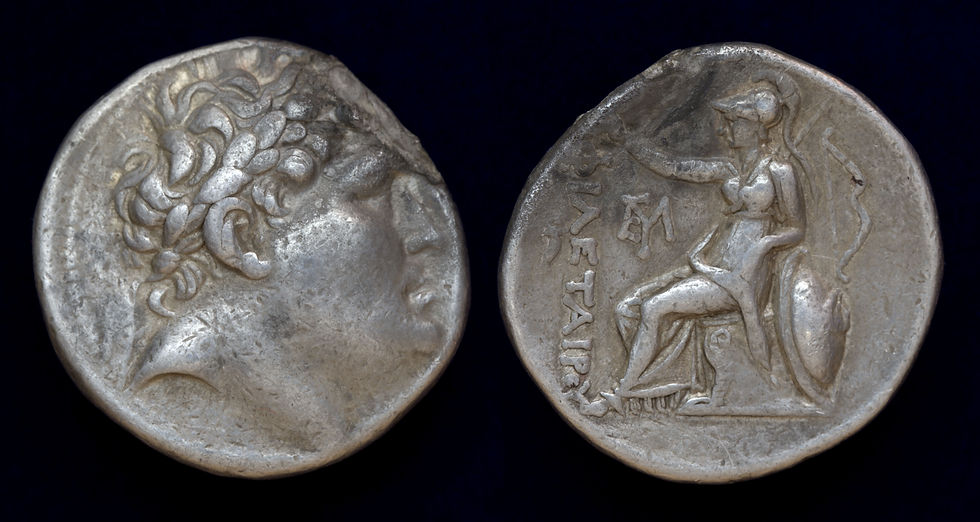
The Paper Shortage
The word pergamon or pergamos (notably utilized by Homer to describe the citadel of Troy) functioned as a generic noun denoting a high fortress or crag. The site of ancient Pergamon (modern Bergama, Turkey) was a steep, terraced ridge of volcanic rock. For centuries, the city was completely confined to the summit. The constraints of the hill required all the large development, including the Library of Pergamon, to be heavily terraced into the steep slopes using massive retaining walls.

Pergamon under the Attalids built the library to rival Alexandria's. The library had about 200,000 volumes at its height (Plutarch, Antony 58), the second great book collection of the ancient world. The rivalry turned ugly: according to Pliny the Elder and Varro, the Ptolemies cut off the export of Egyptian papyrus to starve their competitor of writing material. Pergamon answered by perfecting the treated animal skins that the Greeks called pergamēnē. The Romans came to call this paper charta pergamena ("Pergamon paper"). The modern English term derives from the Middle English parchemin, an evolution of the Latin pergamena.
Writing on skin was an old practice in the Near East, Pergamon gave parchment its name across the European languages.
On a separate note: the Great Altar so dominated the skyline that some readers of the Book of Revelation have identified Pergamon's "throne of Satan" with that very monument which now stands, reassembled, in a museum in Berlin named for it.
The reward of distrust
The ticket flattened all of this into eight words: 200-133 BC, name of magistrate. A wrong century-bracket, a city mistaken for a man, a reference chasing a variant that isn't there. When you are going through hundreds of coins, a busy cataloger doesn't have time to look too closely. That's why you shouldn't trust the slip or you might miss the dying kingdom, the king who willed away his country, Aristonicus' slave-army and their City of the Sun, the goddess of victory borrowed from the dead kings, and the hill that gave its name to parchment.
References
Ancient sources
Pausanias. Description of Greece. Translated by W. H. S. Jones. Loeb Classical Library. Cambridge, MA: Harvard University Press, 1918. [1.11.1-2, on Pergamos son of Neoptolemus.]
Pliny the Elder. The Natural History. Translated by John Bostock and H. T. Riley. London: Taylor and Francis, 1855. [13.21.68-70, on the papyrus embargo and parchment at Pergamon.]
Plutarch. Life of Tiberius Gracchus. Translated by Bernadotte Perrin. Loeb Classical Library. Cambridge, MA: Harvard University Press, 1921. [14, on the Pergamene treasury and the land law.]
Polybius. The Histories. Translated by W. R. Paton. Loeb Classical Library. Cambridge, MA: Harvard University Press, 1922-27. [16.1, on the temple of Athena Nikephoros.]
The Revelation to John 2:12-13. [The "throne of Satan" addressed to Pergamon.]
Strabo. The Geography of Strabo. Translated by Horace Leonard Jones. Loeb Classical Library. Cambridge, MA: Harvard University Press, 1917-32. [13.4.1-2, on Pergamon and the Attalids; 14.1.38, on Aristonicus and the Heliopolitai.]
Modern scholarship
Allen, R. E. The Attalid Kingdom: A Constitutional History. Oxford: Clarendon Press, 1983.
Bohn, Richard. Das Heiligtum der Athena Polias Nikephoros. Altertümer von Pergamon II. Berlin: Spemann, 1885.
Casson, Lionel. Libraries in the Ancient World. New Haven: Yale University Press, 2001.
Chameroy, Jérémie. "Chronologie und Verbreitung der hellenistischen Bronzeprägungen von Pergamon: der Beitrag der Fundmünzen." Chiron 42 (2012): 131-81.
Chameroy, Jérémie, and Bernhard Weisser, eds. Fundmünzen von Pergamon. Interaktiver Katalog des Münzkabinetts. Berlin: Münzkabinett, Staatliche Museen zu Berlin, Preußischer Kulturbesitz, 2015-.
Fritze, Hans von. "Zur Chronologie der autonomen Prägung von Pergamon." In Corolla Numismatica: Numismatic Essays in Honour of Barclay V. Head, edited by G. F. Hill, 47-62. London: Henry Frowde, Oxford University Press, 1906.
Fritze, Hans von. Die Münzen von Pergamon. Abhandlungen der Königlich Preussischen Akademie der Wissenschaften. Berlin: Verlag der Königlichen Akademie der Wissenschaften, 1910.
Hansen, Esther V. The Attalids of Pergamon. 2nd ed. Ithaca, NY: Cornell University Press, 1971.
Magie, David. Roman Rule in Asia Minor to the End of the Third Century after Christ. 2 vols. Princeton: Princeton University Press, 1950. Vol. 1; vol. 2.
Sylloge Nummorum Graecorum, Denmark: The Royal Collection of Coins and Medals, Danish National Museum. Part 19, Mysia. Compiled by Niels Breitenstein. Copenhagen: Einar Munksgaard, 1945.
Sylloge Nummorum Graecorum, France 5: Département des Monnaies, Médailles et Antiques, Mysie. Paris: Bibliothèque nationale de France; Zurich: Numismatica Ars Classica, 2001.
Westermark, Ulla. "Bronze Coins of Pergamon." Numismatica e Antichità Classiche (Quaderni Ticinesi) 20 (1991): 147-59.
Westermark, Ulla. "On the Pergamene Bronze Coins in the Name of Athena Nikephoros." Studii şi Cercetări de Numismatică 11 (1995): 29-35.
One monograph from Ulla Westermark that I have not yet located:
Westermark, Ulla. Das Bildnis des Philetairos von Pergamon: Corpus der Münzprägung. Uppsala: Almqvist & Wiksell, 1961.


Comments