
The Asklepeion
- sulla80

- Jun 7
- 7 min read
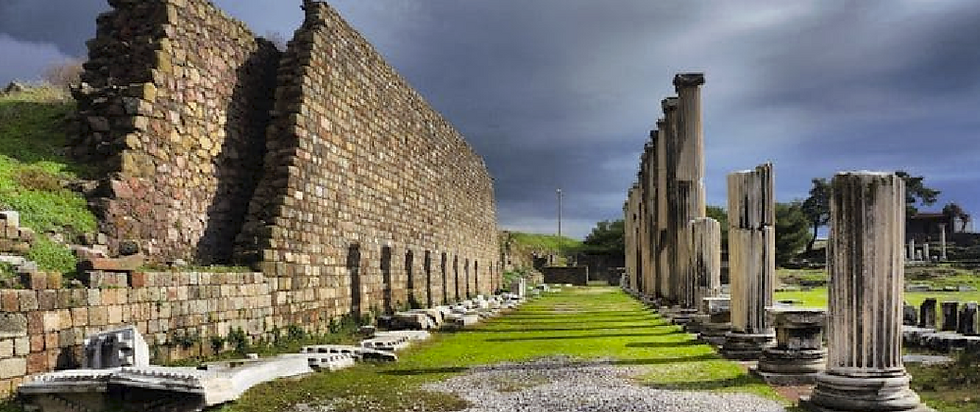
The Asklepieion was the sanctuary and healing complex of Asklepios (Latin Aesculapius), the god of medicine. It was located just outside the city of Pergamon on the plain below the acropolis. It functioned as something between a temple, a spa, a sanatorium, and a teaching hospital. Along with the sanctuaries at Epidauros, the cult's "mother" site in the Peloponnese, and on the island of Kos, Hippocrates' home, it was one of the three most famous Asklepieia in the Greek world, and in the Roman Imperial period it arguably eclipsed the others in prestige.
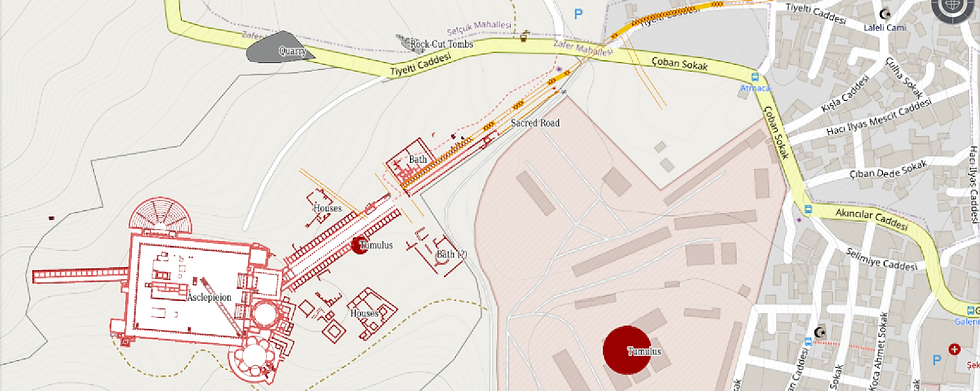
The Site
The cult was reportedly brought to Pergamon in the 4th century BCE by a citizen named Archias, son of Aristaechmus, who is said to have been healed at Epidauros and then established the god's worship at home. This is the standard "founding by a grateful patient" story attached to many Asklepieia. The sanctuary remained relatively modest through the Hellenistic period, even under the wealthy Attalid kings who made Pergamon a great capital.
Its heyday came in the 2nd century AD, under Hadrian and the Antonine emperors. A vast building program, funded substantially by the Pergamene senator and consul Lucius Cuspius Pactumeius Rufinus (consul AD 142), gave the sanctuary the grand architectural face whose ruins survive today.
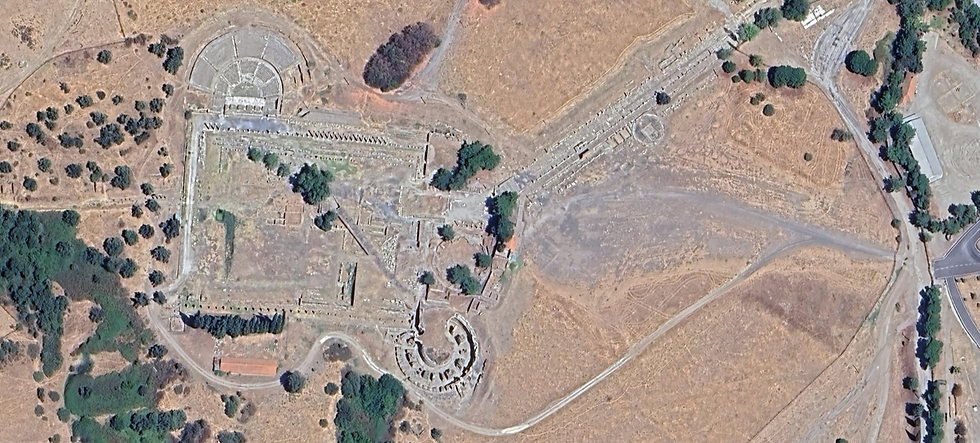
Many more photos of the archeological site can be found at DAI: Heiligtum des Asklepios (Asklepieion).
A long colonnaded sacred road, Via Tecta, on the order of 800+ meters, ran from the city to the sanctuary to arrive at a monumental propylon (gateway) dedicated by Rufinus.
The main precinct was a large rectangular courtyard framed by colonnaded porticoes (stoas) on several sides. The principal structures included:
A round Temple of Zeus-Asklepios (Asklepios Soter, "the Savior") dedicated around the 140s–150s AD - visible bottom middle in the photo
A separate two-story round treatment/incubation building in the southeast corner, with rooms radiating off a central space.
A remarkable underground vaulted passage (cryptoporticus), roughly 80 meters long
A library, underscoring the intellectual culture of the place.
A small theater seating roughly 3,500, used for performances that were considered part of the therapeutic and festival life of the sanctuary - visible left of the photo.
Sacred springs and wells at the center of the courtyard. Water therapy was fundamental — drinking, bathing, and mud treatments using the mineral-rich water, which was credited with healing properties.
The Coin
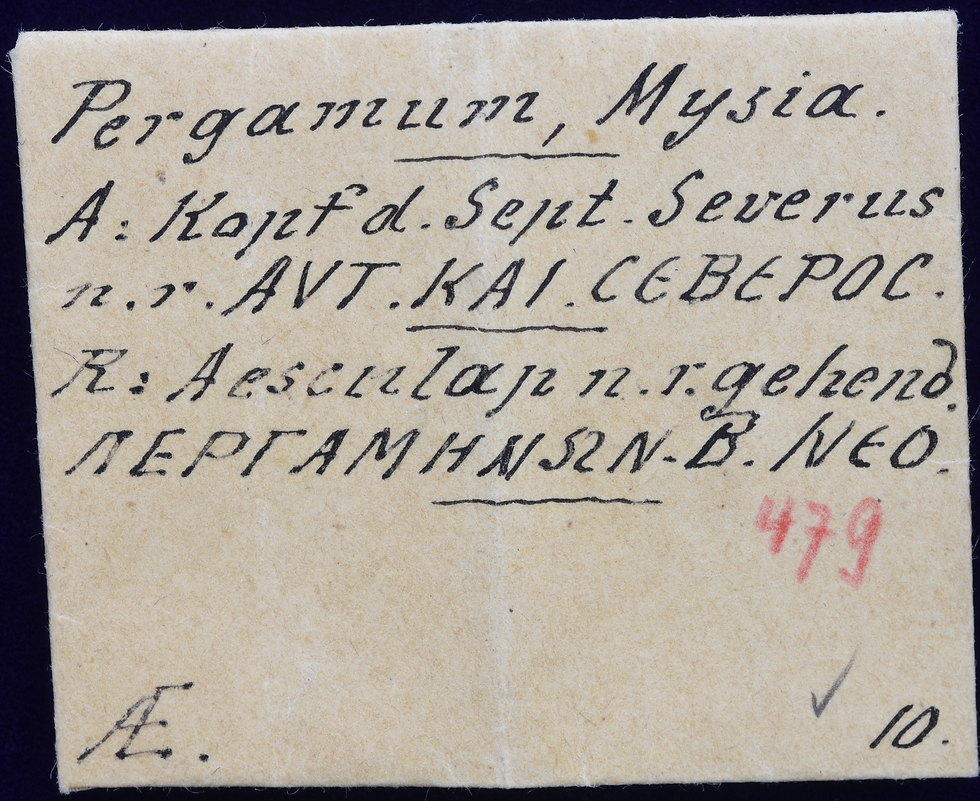
Of course there should always be a relevant coin with entries on this blog - so here we have it: Asklepios from Pergamon.

Greek, Mysia, Pergamon under Roman rule, Septimius Severus, 193–211 AD. AE (19.0mm, 3.06g)
Obv: AVT KAI CEBEPOC, head with laurel wreath facing right.
Rev: ΠEPΓAMHNΩN B NEO, Asklepios standing facing, head left, hoilding a serpent entwined staff.
Notes: SNG Paris 2195; from an old German private collection, 1st half of the 20th century with an old collector's envelope.
How the healing worked
A suppliant who came seeking a cure would first go through preparation: ritual purification (katharsis) from a state of miasma (Greek μίασμα, "stain" or "defilement"). Purification could involve bathing in the sacred springs or sea, and often a period of fasting or dietary restriction, prayers, and a preliminary sacrifice or offering to the god. They would then be admitted at nightfall to the abaton - a special portico or hall reserved for the purpose of incubation (Greek: enkoímēsis) and lie down to sleep. The lamps were extinguished, and the patient waited for the god.
The dream encounter. What the suppliant hoped for was an epiphany - a direct visitation from Asklepios in a dream. (Option A) The god might miraculously cure the patient: touching the afflicted part, applying a salve, lancing or operating, or having a snake lick the wound - and the patient woke healed. (Option B) Alternatively the god would prescribe a course of treatment in the dream: a diet, a regimen of exercise, particular remedies or bathing - which the patient then carried out, sometimes with the priests' help, in the following days.
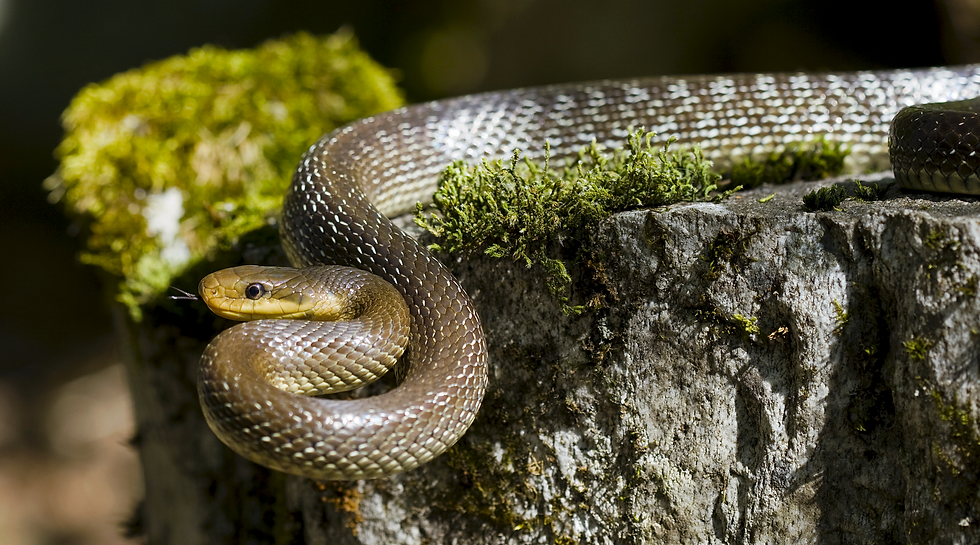
The non-venomous sacred Aesulapian snakes kept in the precinct were manifestations of the god and central to the rites. The serpent-entwined staff on this coin's reverse survives today as the Rod of Asclepius on ambulances and medical logos.
Treatment was strikingly holistic for the ancient world, blending the religious with what we'd recognize as regimen-based medicine: prescribed diets and fasting, exercise and long walks, bathing in the sacred springs, mud applications, herbal remedies, bloodletting, and dream interpretation, alongside theater, music, and rest. The atmosphere itself was understood as part of the cure.
Two ritual-purity rules are characteristic of Asklepieia and reported for the cult: no one was permitted to die and no woman to give birth within the sacred precinct - the dying and those about to deliver were turned away, to keep the sanctuary ritually clean from death & birth. Note: death and birth are both crossing boundaries between this world and somewhere else - and there was plenty of blood and risk of death in childbirth so perhaps not surprising that they end up closely linked.
Aelius Aristides, a key source
Aelius Aristides (c. AD 117–181), a chronically ill sophist spent extended periods at the Asklepieion in Pergamon in the 140s-150s and remained devoted to the god for years. His Sacred Tales (Hieroi Logoi) is a first-person diary of his ailments, his dreams, and the often bizarre cures Asklepios dictated to him to manage problemes such as stomach ailments, exhaustion, and respiratory issues.
He describes a prescription that involved a freezing river bath in winter - which was witnessed by a mix of concerned friends and temple staff:
"These things again in Pergamum, in winter, and while my body was remarkably weak, so that for a long time I did not at all leave the room where I lay. He ordered me to wash in the river which flows through the city - but it was rising high from the rains"
-Aelius Aristides, Behr 1968 Translation p.233-234
Aristides cast off his garments, dove into the middle of the freezing river which churned violentely and yet, he says, "the water was calmer than any crystal stream, and I dallied for as long as possible". When he emerged on the bank, a warmth went through his whole body, steam rose up, and he was red all over.
Galen and the Pergamene medical tradition
Galen of Pergamon (AD 129 - c. 216) - after Hippocrates (after whom the oath is named), he was the most influential physician in Western history. His theories dominated European and Islamic medicine for some fourteen centuries - was a native son, and the Asklepieion was woven through his career:
He was born in Pergamon in 129 AD, son of Aelius Nicon, a wealthy architect and mathematician.
According to Galen, his father was directed by Asklepios in a dream to have the teenaged Galen study medicine - so the god of the sanctuary literally set his career in motion (around 145 AD).
He began his medical education at the Pergamon Asklepieion before traveling for advanced study to Smyrna, Corinth, and the great medical center of Alexandria.
Returning home around 157 AD, he was appointed physician to the gladiators of the High Priest of Asia at Pergamon. Treating their wounds gave him an unmatched practical education in anatomy and trauma and he boasted that very few gladiators died under his care.
He then moved to Rome (c. 162 AD) and rose to become court physician to the emperors Marcus Aurelius, Lucius Verus, Commodus, and Septimius Severus.
Galen was alive and serving in court of the emperor when this coin was minted. Galen repeatedly described Asklepios as his patron and ancestral god (patrios theos), crediting the god with personally curing him of a dangerous abscess.
Decline and rediscovery
The sanctuary suffered badly in the disturbances of the mid-3rd century AD. An earthquake and the Gothic raids around 262 AD damaged Pergamon and although the cult lingered into late antiquity, it faded as Christianity rose.
In the 20th Century, the ruins were systematically excavated by German archaeologists, the Asklepieion specifically from the late 1920s onward, within the larger Pergamon excavations begun by Carl Humann in 1878. The site in modern Bergama, Turkey is part of the Pergamon UNESCO World Heritage site.
References
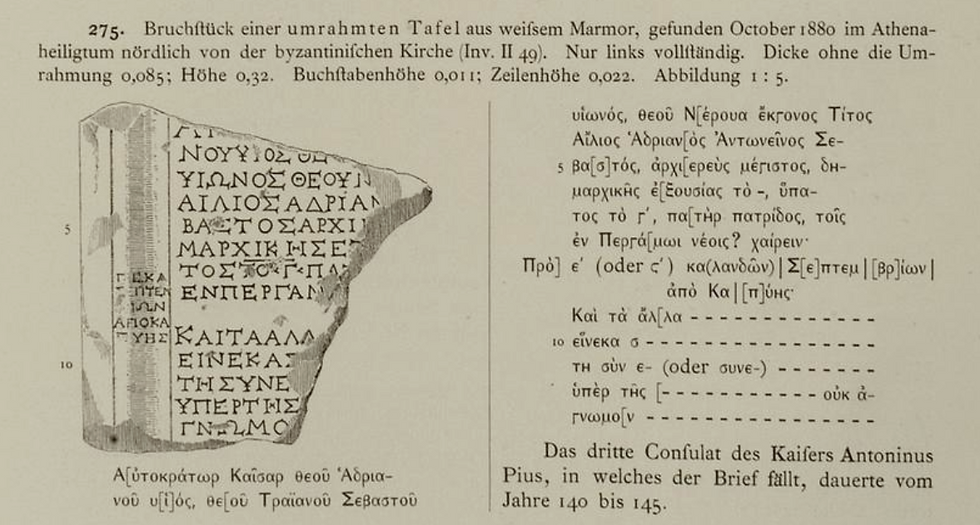
Altertümer von Pergamon (Band VIII, Band 2): Die Inschriften von Pergamon - Berlin, 1895.
Altertümer von Pergamon (Band I, Text 1): Stadt und Landschaft - Berlin, 1912.
Aristides, Aelius. The Sacred Tales. Translated by Charles A. Behr. In Aelius Aristides and the Sacred Tales, by Charles A. Behr. Amsterdam: A. M. Hakkert, 1968.
Aristides, Aelius. The Sacred Tales (Hieroi Logoi). In Aristides, The Complete Works, vol. 2, translated by Charles A. Behr. Leiden: Brill, 1981.
Edelstein, Emma J., and Ludwig Edelstein. Asclepius: A Collection and Interpretation of the Testimonies. 2 vols. Baltimore: Johns Hopkins University Press, 1945. Reprint, 1998.
Galen. Selected Works. Translated by P. N. Singer. Oxford: Oxford University Press, 1997. Vol1 & Vol 2
Gill, Mary Louise. "Galen." In The Stanford Encyclopedia of Philosophy, edited by Edward N. Zalta. Accessed May 31, 2026. https://plato.stanford.edu/entries/galen/.
Pausanias. Description of Greece. Translated by W. H. S. Jones. Cambridge, MA: Harvard University Press, 1918–1935.
Renberg, Gil H. Where Dreams May Come: Incubation Sanctuaries in the Greco-Roman World. 2 vols. Leiden: Brill, 2017.
Theoi Project. "Asklepios." Accessed May 31, 2026. https://www.theoi.com/Ouranios/Asklepios.html.
UNESCO World Heritage Centre. "Pergamon and its Multi-Layered Cultural Landscape." Accessed May 31, 2026. https://whc.unesco.org/en/list/1457.
Williamson, Christina. "Dream Travels in Aelius Aristides' Sacred Tales: Spatial Narratives from the Asklepieion in Pergamon." StoryMaps. ESRI.

Sulla, you outdid yourself this time 🤩! The in-depth research, explanation of the history & mythology are truly impressive 😂 . The coin is a great example too; the fine engraving & high relief for a coin that only weighs 3.06 gm is amazing 🤔.