
Marius & Marius


Being a Roman emperor in the half-century after 235 did not promise a long and profitable career. The empire ran through some twenty-six emperors, nearly all of whom died by violence, most at the hands of their own soldiers. In 260, Valerian was taken alive by the Persian king Shapur, the only Roman emperor ever captured by a foreign enemy, and the empire split three ways: a Palmyrene East under Zenobia, a Gallic West under Postumus, and a shrunken center. Postumus was murdered by his men when he denied them the sack of Mainz. Laelianus, who had risen there, lasted a month or two; and the face on today's coin of interest, Marius, was next.
Marcus Aurelius Marius came to power in 269 in the Imperium Galliarum, the breakaway Gallic Empire that had governed Gaul, the Rhineland, Britain, and Spain since Postumus revolted.

A Vile Workman
Karl Marx (1852) comes to mind:
Hegel says somewhere that all great historic facts and personages recur twice. He forgot to add : "Once as tragedy, and again as farce."History provides the name "Marius" twice: first as tragedy, in Gaius Marius, whose civil wars with Sulla shattered the Republic; and second as farce, in the Emperor of 269 AD, a two-day usurper whom ancient sources dismissed with derision. Polybius’ theory of Anacyclosis describes a cycle where democracy decays, the rule of law vanishes, and strongmen rise and fall at the whim of the mob—in the Imperial context, the army. Gaius Marius stands at the threshold of descent into ochlocracy or mob rule, while the second Marius occupies its terminal phase (ochlocracy) with the military representing the mob. Here's a concise view of Polybius' framework:

To Eutropius he was vilissimus opifex, a most vile workman, who took the empire and was dead by the second day.
The author of the Historia Augusta (H.A.) turned the speed of it into a borrowed joke:
"Marius, who on the first day was made emperor, on the second seemed to rule, and on the third was slain". H.A. supplies another detail: a blacksmith by trade, run through by a soldier who had once labored in his forge, with the taunt that the blade was one Marius himself had made.
He was slain by a soldier whom, because he had once been a worker in his smithy, he had treated with scorn either when he commanded troops or after he had taken the imperial power. His slayer is said to have added the words, "This is a sword which you yourself have forged."OK - we know Historia Augusta was not exactly high on historical reality, so this story is almost certainly fabricated to make a good tale.
Aurelius Victor wallows in the thought Marius illustrates the degenerate state of Roman politics.
At his death (Postumus), therefore, Marius, a former blacksmith who was not even then particularly well-known to the military, seized power. Accordingly everything had degenerated so far that imperial powers were bestowed on such individuals and the dignity of all noble qualities was an object of derision. Indeed it was because of this that the joke was told that it was hardly surprising if a Marius was attempting to restore the Roman state, since a Marius of the same trade and the founder of the family and name had consolidated it.A very dry joke: people quipped that there was nothing remarkable about a Marius trying to restore the Roman state, since another Marius, the famous Republican general and Sulla's rival, had once done so before. Although the earlier Marius was a novus homo (new man), Victor's additional claim that the earlier Marius had shared the same trade as the usurper is unattested in earlier sources.
The Coin
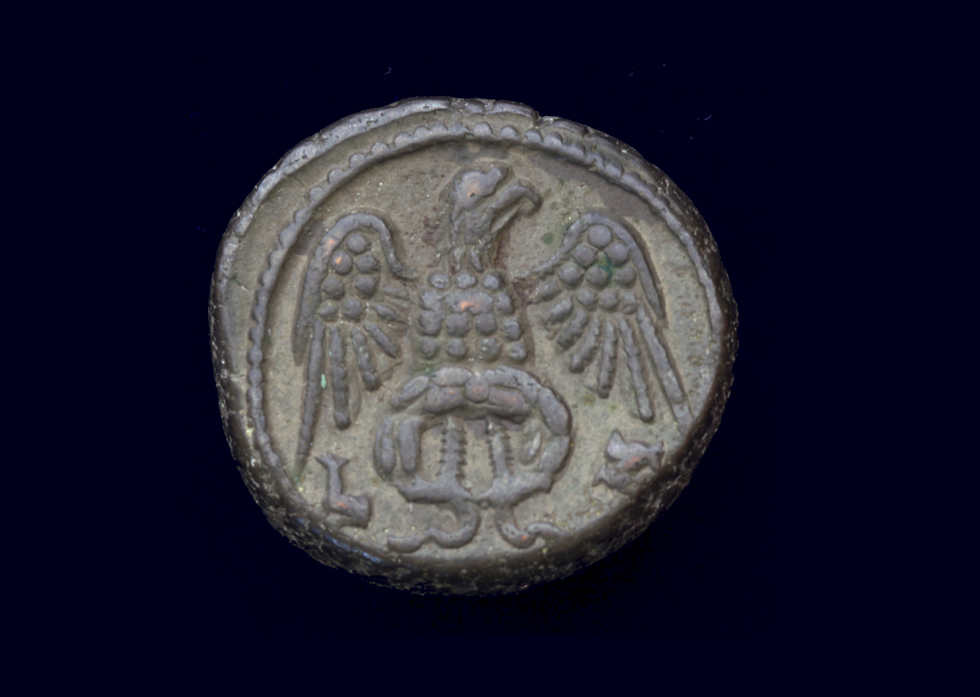
This antoninianus and the many others that exist are a witness that tells a different story of the reign of Marius.

Roman Imperial, Gaul, Trier, Marius (Romano-Gallic emperor), BI Antoninianus (3.24g, 21.2mm), AD 269.
Obv: IMP C MARIVS P F AVG, radiate, draped and cuirassed bust right.
Rev: CONCORDIA MILITVM, two clasped right hands.
Ref: RIC V.2 7; Elmer 632; Mairat 543.
Mairat’s 2014 study, built on hoards and on the links between dies, moves it to Trier, the principal mint, and assigns it to one of the two workshops there.
By 269 the silver coin was a copper core under a thin wash that wore away in the hand. Marius’s first radiates are on the debased standard set in mid-268, around six percent silver sinking across the year toward the three percent of his successor’s first issues. At 3.24 grams this is, if anything, a generous example: Mairat’s tables put the average weight of every one of Marius’s issues below three grams.
Two right hands are clasped in the dextrarum iunctio, the oldest Roman sign of fidelity and of the rejoining of what has been broken, above the legend CONCORDIA MILITVM - the concord of the soldiers. The deaths of Postumus and of his rival Laelianus had fallen within weeks of one another and had left the armies of the Rhine divided between two mint-cities: Cologne, which Laelianus had seized, and Trier, which had stayed loyal to Postumus. Marius struck at both, and Mairat reads that as the work of a man trying to reconcile the factions that had destroyed Postumus and Laelianus. The clasped hands are certainly a wish and not a declaration.
How long was his reign?
In 1971, André Chastagnol showed that the two days was probably a misread of Aurelius Victor "Hoc iugulato post biduum Victorinus deligitur" - to 2 days referring to the interval before Victorinus was chosen; not the duration of Marius' reign. Jérôme Mairat (2014) follows Paschoud in arguing the error was already present in the common source Victor was copying.
One cannot engrave dies and strike a substantial coinage in two or three days, and Marius’s coinage is substantial. Mairat's own corpus records some 695 surviving specimens of Marius, ninety of them of this very type — and behind every coin lie hand-cut dies. The closely related coinage of Laelianus, whose reign the sources also compress, was struck from an estimated fifty-six obverse dies, each one cut by hand.
The engravers at both mints had Marius’s true likeness from his very first dies, whereas Victorinus’ portrait did not reach the Trier workshop until later. For a man supposedly dead inside seventy-two hours, an accurate likeness had somehow traveled to, and been carved at, two separate mints. The coins do not describe a reign of days. They describe months of ordinary minting and a reign of a few months or so, somewhere in the summer of 269. A reign long enough to open two mints, cut scores of dies, strike the coins by the thousand, and leave enough of them in the ground that one can rest in the palm seventeen centuries later for the price of a good dinner.
Marius' Sword
The soldier’s parting line "this is a sword you yourself have made", is almost certainly an invention, the tidy sort of irony the Historia Augusta loved to manufacture. But it is the right invention for this coin. Here is an emperor raised by the army’s violence, proclaiming the concord of the soldiers in clasped hands and silvered bronze, and undone in the end by the very men whose unity he had so anxiously advertised. The written stories lie about how long he lasted. The coin tells a longer story.
References
Eutropius, Breviarium 9.9; Historia Augusta, Tyranni Triginta 8; Aurelius Victor, Liber de Caesaribus 33.12.
André Chastagnol, “L’empereur gaulois Marius dans l’Histoire Auguste,” in Bonner Historia-Augusta-Colloquium 1971 (Bonn, 1974), 51–58.
Jérôme Mairat, “The Coinage of the Gallic Empire” (DPhil thesis, University of Oxford, 2014), 17–18.
P. H. Webb, The Roman Imperial Coinage (RIC), vol. 5, pt. 2 (London, 1933).
Edward Besly and Roger Bland, The Cunetio Treasure: Roman Coinage of the Third Century AD (London, 1983).
Roger Bland, “Coin Hoards and Hoarding in Britain (3): Radiate Hoards,” British Numismatic Journal 85 (2015): 59–100, drawing on Gilljam’s die study.
Ingemar König, Die gallischen Usurpatoren von Postumus bis Tetricus (Munich, 1981), 140.
Bishop, M. C. The Spatha: The Roman Long Sword. Oxford: Osprey Publishing, 2020.

Comments