
Why is a river delta a delta (Δ)?

Updated: Jul 19
"When the Nile is in flood, it overflows not only the Delta but also the lands called Libyan and Arabian, in places as far as two days’ journey from either bank, and sometimes more than this, sometimes less. Concerning its nature, neither from the priests nor from any others could I learn anything."
-Herodotus, The Persian Wars, II.19 
Perhaps it isn't rocket science to answer the question - it certainly isn't hard to see an upside-down upper case uppercase Δ in this NASA photo of the Nile River where it empties into the Mediterranean (Public Domain via Wikimedia Commons).
The name "Delta" for the Nile region is genuinely Greek and genuinely comes from the triangular letter Δ, however it began as a place-name, not a technical term. Herodotus refers often to "the Delta" (one specific place) as illustrated with my opening quote. The broader use "a delta" (a general landform category) came much later and from someone else.
Why is it called the Nile Delta?
An alluvial island is land formed from alluvium i.e. the silt, sand, and clay that a river carries and deposits when its current slows. At a river's mouth, the water spreads out and loses speed as it meets the sea, so it drops its sediment load, gradually building up islands and banks.
At the Nile, this process created the entire Nile Delta, one of the largest alluvial formations in the world. The delta is laced with channels, and the wedges of deposited sediment between and around those channels form alluvial islands and bars. Greeks looked at the triangular alluvial island at the Nile's mouth and saw the shape of their letter delta (Δ), an equilateral triangle. That visual is the origin of the name.
An article by Francis Celoria from 1966 digs deep into this topic and calls this an "almost witty comparison" and stresses it was a Greek achievement given that the Egyptians' hieroglyphic signs for the region contained no triangular form that could have prompted it.
So who actually invented this?
Herodotus, writing in the 5th century BC, tells us that the Ionians already called it the Delta by the time he was writing:
"I hold rather that the Egyptians did not come into being with the making of that which Ionians call the Delta: they ever existed since men were first made; and as the land grew in extent many of them spread down over it, and many stayed behind. Be that as it may, the Theban province, a land of six thousand one hundred and twenty furlongs in circuit, was of old called Egypt."
-Herodotus, The Persian Wars, II.15
And Celoria shows that the Delta region was well known to Greeks for generations before him by traders, mercenaries, and settlers at Naucratis where archeologists find evidence of early Greek contact with Egypt, reaching back to the Odyssey.
Dating of Delta: The letter delta itself, triangular in form, was borrowed by the Greeks from the Phoenicians around 850 BC so the place-name can't predate that.
How did we get from Nile Delta to any delta?
Herodotus refers to "The Delta", a proper noun, one specific Egyptian place. He does this fourteen times. A generic land form, a delta, is the technical term we use today for any triangular alluvial river-mouth deposit anywhere in the world, can be first found a century later. Strabo is the first reference:
"Onesicritus reckons each of the two sides of the included island, which is triangular in shape, at two thousand, and the width of the river, where it branches into the mouths, at about two hundred; and he calls the island Delta, and says that it is equal in size to the Aegyptian Delta, a statement which is not true."
-Strabo, Geography, 15.1.33
Onesicritus of Astypalaea (later 4th century BC)) was a philosopher-historian-sea captain - not a common job title today - who sailed with Alexander the Great and his admiral Nearchus on the eastern voyages. He was describing the triangular island of Pattalene at the mouth of the Indus, transferring the Egyptian place-name to a comparable feature far away. That is the first evidence of the proper name being used as a technical concept. The catch, and Celoria flags it honestly, is that we only know this through Strabo quoting Onesicritus three centuries later, so there's some residual doubt about whether Strabo retro-fitted his own usage onto his predecessor.
Arrian (2nd century AD) provides a more complete and unambiguously use of the modern general meaning.
"The western part of India is bounded by the river Indus right down to the Ocean, where it runs out by two mouths, not joined together like the five mouths of the Ister, but like those of the Nile which form the Egyptian delta; an Indian delta is formed in the same way by the river Indus, as large as the Egyptian, and is called Patala in the Indian."
-Arrian, Indica, 2.5-6
Conclusion
The usage of delta for delta started with the Ionian Greeks before the 5th century BC from the shape of the letter Δ; Herodotus recorded it as a place-name; and the generic technical term "a delta" was first applied - at least in our surviving writings - by Onesicritus during Alexander's campaigns, and was a general term by the 2nd century AD, as it shows up in Arrian (AD 86-160).
All of this a good excuse to look at coins of Nilus and other River gods - from Claudius II with this less common pairing of jugate busts. Euthenia, a Greek goddess of abundance, prosperity, and plenty, in the background is paired with Nilus, the god of the Nile River, in the foreground.

And although I don't have a coin from Hadrian's 4th regnal year with Nilus I do have this one that puts a delta next to Nilus at the end of the Legend "L ƐΝΝƐΑΚ·Δ" which translated to Regnal Year 19 roughly AD 134/135.
L is the standard symbol for "year" (ἔτους)ƐΝΝƐΑΚ·Δ is the year number spelled out rather than given as a numeral, the genitive of "nineteenth": ƐΝΝƐΑ (nine) + Καί (and) + Δεκάτου (tenth).

Reference:
Celoria, Francis. "Delta as a Geographical Concept in Greek Literature." Isis 57, no. 3 (1966): 385–388.

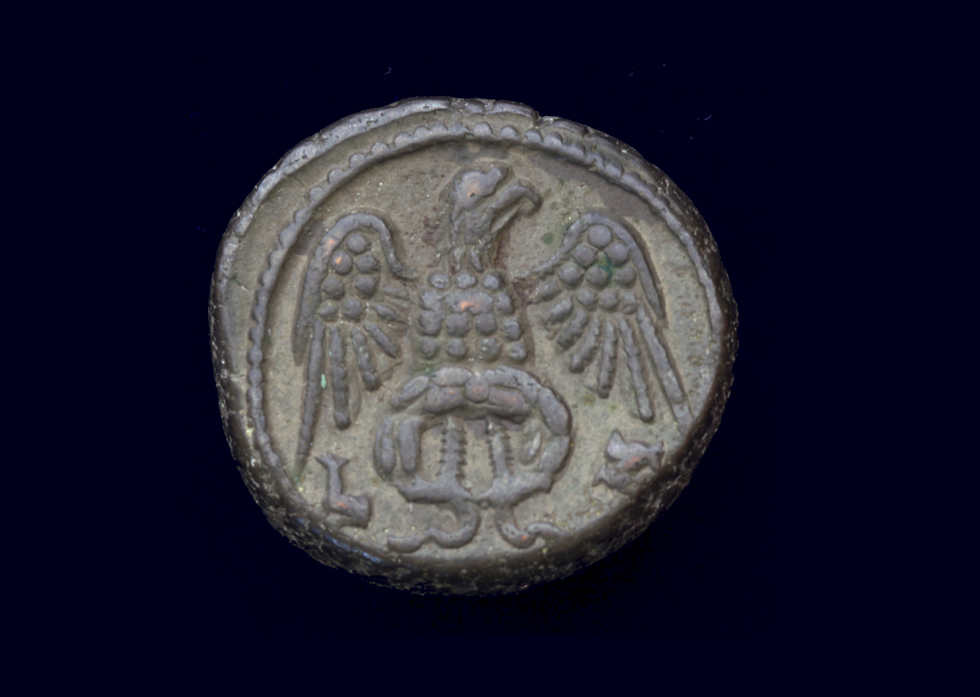
I won the coin pictured above at auction about 18 months ago. Like most people, I never gave any thought to the word DELTA applied to the Nile River 🤔. I did enjoy this in-depth explanation 😃.