
The Dioscuri

Updated: Mar 25
The year 96 BCE sat quietly between crises—but it should not be mistaken for calm. The deaths of the Gracchi brothers was still a fresh wound, and the social tensions they exposed remained unresolved. Within a few years, Italy would revolt and Sulla would march on Rome.
This denarius was struck before all of that, when the Republic still spoke confidently of order, cult, and civic memory. Yet the decade had already seen major domestic violence - the Saturninus riots of 100 BCE being the most dramatic example. Competition among senatorial factions was intensifying, in conflicts later described in terms of populares and optimates, and the Republic's governing norms were showing strain. The Italian allies grew increasingly frustrated, their resentment building toward the Social War that would erupt in 91 BCE.
The Consuls of 96 BCE
The consuls for this year were C. Cassius Longinus and Cn. Domitius Ahenobarbus. Of the two, Domitius is by far the better documented figure - and the more colorful.
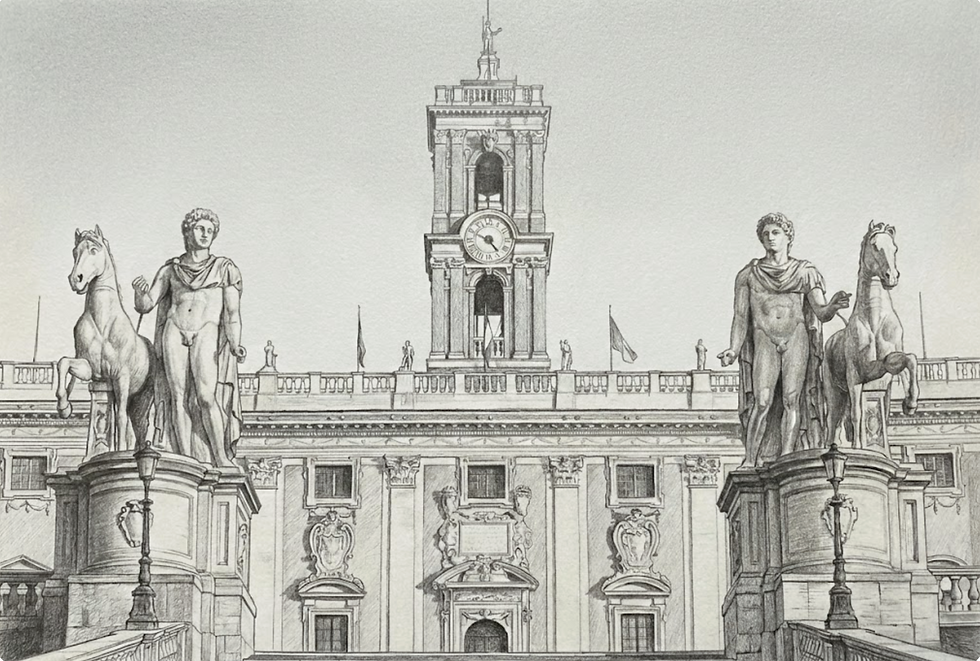
The cognomen "Ahenobarbus" (literally "bronze beard") derived from a legendary family origin story: the divine twins Castor and Pollux had allegedly appeared to an ancestor and stroked his beard, turning it red-bronze to prove their divinity. But Domitius was more than just aristocratic myth. He was a political reformer who had passed the lex Domitia in 104 BCE, transferring the election of priests from the exclusive colleges to popular vote via the comitia tributa. In a brazen display of personal ambition, he then ran for pontifex maximus under his own law - and won. His family name also recalled an older Domitian achievement in Gaul: the Via Domitia, built by his father, Cn. Domitius Ahenobarbus, consul of 122 BCE.
By contrast, C. Cassius Longinus is far less well documented in our surviving literary sources and remains comparatively obscure beside Domitius..
Rome's Expanding Reach
Beyond domestic turmoil, 96 BCE also marked a quiet expansion of Roman influence. Ptolemy Apion of Cyrene died that year and bequeathed his kingdom to Rome, though the Senate would not formally annex it until 74 BCE. Circa 95 BCE Sulla restored Ariobarzanes in Cappadocia and met the Parthian envoy Orobazus, the first recorded diplomatic contact between Rome and Parthia.

The Collector

Max Vogt (1925-2019) served as the in-house architect for the Swiss Federal Railways (SBB) from 1957 to 1989, designing approximately 200 buildings that became defining examples of Swiss railway architecture. His bold concrete structures exemplify postwar Swiss modernism. Beyond his architectural career, Vogt was an accomplished numismatist who assembled a distinguished collection of ancient coins from the 1980s onward.
The Moneyers Behind the Coin
This issue was struck by the tresviri monetales, a three-member board responsible for Rome's coinage:
C. Publicius (Poblicius) Malleolus
A. Postumius Sp. f. Albinus
L. Caecilius Metellus
The coin bears the signature of A. Postumius Sp. f. Albinus (A·ALBINVS·S·F) in the exergue. Although this specimen names A. Postumius Albinus on the reverse, the issue belongs to a joint college of three moneyers: Albinus, Malleolus, and Metellus. The notation "Sp. f." (Spuri filius) identifies him as the son of Sp. Postumius Albinus, consul in 110 BCE. He is plausibly, but not certainly, the Albinus killed at the Colline Gate in 82 BCE, when Sulla returned to seize Rome. (Appian Civil Wars, I.93) Crawford (RRC) identifies him as the father of the moneyer of Crawford denarius no. 372 in 81 BC.
C. Publicius Malleolus later served as quaestor in 80 BCE, and Cicero preserves how Verres exploited his death and the estate of his ward.
L. Caecilius Metellus is identified by Crawford as the son of Delmaticus (consul 119 BC RE: 91) and may be the same man who later served as praetor in 71 BCE (RE: Caecilius 74), though the identification remains uncertain; in RE, the praetor of 71 is treated as probably a son of Metellus Caprarius, not Delmaticus.
Reading the Obverse: Apollo, Star, and ROMA
The obverse presents Apollo's head alongside a star and the legend ROMA - can be read as a conservative, stabilizing choice. ROMA a symbol of civic authority. In a period of intensifying aristocratic competition, this emphasis on collective identity over individual ambition could be strategic.
Apollo could reinforce this message. He is a god associated with order, correct ritual, and public health - which would be ideologically relevant themes for a Republic under strain.
Reading the Reverse: The Dioscuri at Lacus Iuturnae
The reverse depicts the Dioscuri watering their horses at the Lacus Iuturnae, accompanied by a crescent and the moneyer's name in the exergue. This image deliberately invokes the Dioscuri epiphany tradition - the legendary moment when Castor and Pollux appeared after the victory at Lake Regillus at the Lacus Iuturnae in the forum to announce Rome's victory.
Conclusion
The moneyers of 96 BCE chose their types carefully: Apollo for order, the Dioscuri for divine rescue, ROMA to ground it all in civic authority. These were images of a Republic that still believed in its own stability - or at least wanted to project that belief.
It is perhaps fitting that Apollo looks nervous or upset on this coin. The Social War would shatter Italy. Sulla would march on Rome, and then face war with Mithridates VI of Pontus. The Republic's foundational myth, the Dioscuri appearing to save Rome at its darkest hour, is perhaps a painfully ironic foreshadowing.
References
Michael H. Crawford, Roman Republican Coinage, no. 335/10b.
T. R. S. Broughton, The Magistrates of the Roman Republic, vol. 2.
Eleanor Ghey, Ian Leins, and M. H. Crawford, A Catalogue of the Roman Republican Coins in the British Museum (2010).
Cicero. The Verrine Orations. Translated by L. H. G. Greenwood. 2 vols. Loeb Classical Library 221, 293. Cambridge, MA: Harvard University Press, 1928–1935. In Verrem 2.1.40 reference to Malleolus, questor in 80BC, who was killed.
Dionysius of Halicarnassus. Roman Antiquities. Translated by Earnest Cary. 7 vols. Loeb Classical Library 319, 347, 357, 364, 372, 378, 388. Cambridge, MA: Harvard University Press, 1937–1950. The appearance of the Dioscuri (Castor & Pollux) at the Battle of Lake Regillus is told in Roman Antiquities 6.13


Comments