
Mutinus Titinus


I choose to believe that there is "absolute truth" and today's notes illustrate that "absolute truth" is often unknowable. A genuine ancient coin that has survived from 90 BCE and the "Social War" serves as a truth from that time. Everything else we "know" about this coin is "knowledge": what we write down, argue about, and base decisions on - i.e. the story we tell about that truth. These stories are debated and sometimes new evidence is uncovered - the coin doesn't change, but what we know about it does. Epistemology is literally the study of how human beings acquire knowledge and how we distinguish true knowledge from mere opinion or belief.
The greek origins of the word.
ἐπιστήμη (epistēmē): "knowledge" or "understanding"
-λογία (-logia): from "logos" or "reason" meaning to "discuss" or "study"
This distinction is nowhere more palpable than in the study of the Q. Titius denarius. While the silver object is an undeniable material fact of 90 BC, the "knowledge" we project onto it - the identity of the god, the intent of the moneyer, and the location of the shrine - reveals more about our own reliance on fragmented, biased texts than it does about the Roman Republic.
Today's coin of interest from the Roman Republic comes with a weight of stories, that conflict, diverge, and leave an uncomfortable ambiguity in what we can "know". I am also intrigued by a story that doesn't seem to be explored about this coin: it seems there is just enough evidence to speculate that this is subtly illustrating an argument for “Italic/Roman” integration at a moment when Rome was renegotiating the boundary of citizenship during the Social War.
The Coin
This coin is well preserved, fine style, attractively toned. Based on a set of 98 coins of this type from ACSearch the average weight is 3.87g. The RRCO reported average is 3.82g. At 4.12g, this coin sits in the upper tail of reported weights for the type (~96th percentile in my auction-derived sample). Even in these descriptions there is a mix of fact and interpretation e.g. attractive toning.

Roman Republican, Q. TITIUS, AR Denarius (4.12g), 90 BC, Rome.
Obv: Bearded male head right, wearing a winged diadem (often identified in the literature as Mutunus Tutunus / Mutinus Titinus)
Rev: Pegasus springing right from tablet inscribed Q TITI.
Ref: Cr. 341/1, Syd. 691
Notes: ex Münzen und Medaillen AG, Basel, Lagerliste 598 (1996),35. Minted to fund Rome's immense military expenditures during the Social War.
Who was our moneyer?
Quintus Titius, the moneyer, was a member of the plebeian gens Titia. Beyond this - little is known about him outside of his coins. There is a possible connection made by Münzer suggesting that the moneyer could be Q. Titius Mutto, however the connection remains controversial because the evidence is circumstantial and non-unique. Münzer in RE: “Titius 33” ties together Cicero’s anecdote of a Q. Mutto with inscriptions showing Mutto as a cognomen among Titii, and this cointype with Mutunus / Priapus.
The coin features a striking profile portrait of a bearded man facing to the right. He is wearing a winged diadem (a jeweled crown or headband with wings attached), which is a distinctive attribute. A lock of hair is often shown falling down his neck. There are conflicting stories about this portrait.
The God Mutinus Titinus: the standard identification of the bearded figure is Mutinus Titinus (sometimes spelled Mutunus Tutunus), an obscure Roman fertility deity. This theory rests on several arguments:
Visual pun (canting type): Numismatists suggest the moneyer, Quintus Titius, placed this god on his coin as a play on his own name.
Iconography: The head is bearded and wears a winged diadem, features more consistent with a god than a mortal.
Numismatic Parallels: The pairing of this head with Pegasus on the coin's reverse mirrors coinage from Lampsacus, a city famous for the worship of Priapus.
Family deity: A foundational 1927 study by Hans Herter argued that Mutinus Titinus was not just a pun, but the actual ancestral patron deity of the Gens Titia.
Dove/Flying: Pegasus could also reinforce the sexual/avian pun on the front of the coin, "titus" (literally dove, may have been slang for penis)
The Skeptic's View (Crawford vs. Katz)
A second theory argues the head cannot be definitively identified. This view was prominently held by Michael Crawford (1974), who dismissed the Mutinus Titinus identification as "entirely arbitrary," arguing that a bearded head with a winged diadem is not diagnostic of any specific deity. However, this skepticism is increasingly viewed as hyper-cautious.
As Rebecca Katz (2015) argues, dismissing the identification ignores the convergence of numismatic practice (the pun), the attributes (wings/beard). This also ignores the Lactantius 1.20.5 writing in the 3rd-4th century and other written evidence. Lactantius admittedly ridiculing the pagan gods :
"and Tutinus, before whom brides sit, as an introduction to the marriage rites; and a thousand other fictions"Crawford's refusal to accept the canting type here seems inconsistent, given that for the very next entry in his catalog (90 BC), he readily accepts that a mask of Pan represents the moneyer Pansa.
Crawford follows W. H. Roscher (1890-94), Ausführliches Lexikon, entry for "Mutunus"
The assumption is entirely arbitrary that a bearded head with wings at the temples, depicted on a denarius of the gens Titia, represents Mutinus Titinus, whom that gens [family] placed on the coin due to the similarity of names.While I can agree with Crawford that the evidence is not definitive - it seems inconsistent with the next entry in RRC he declares "the types of 342/1-2 reflect the moneyer's cognomen", a pun between Pansa and Pan on a coin from the same year, 90 BCE.
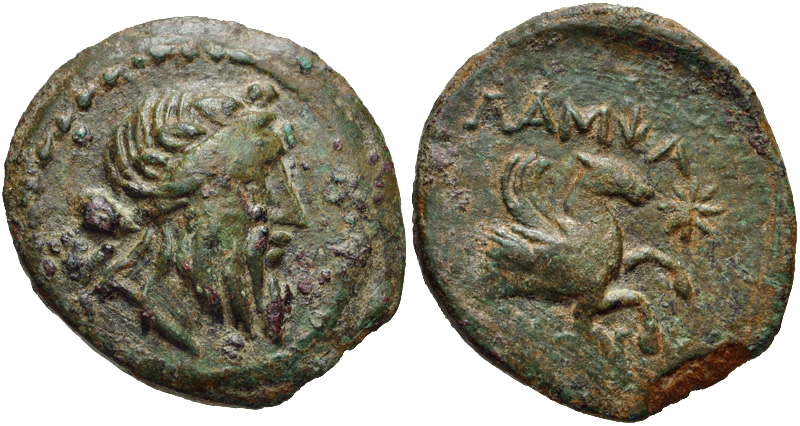
I also find this coin from Lampsacus compelling linking Priapus : Pegasus with a bearded Priapus who looks strikingly similar to our obverse. Whether you choose to connect to Priapus and a slang titus or a Roman equivalent name, Mutinus Titianus, or Mutto (as the moneyer's cognomen) - a bawdy pun is likely at work.
The debate continues: Rebecca Katz is compelling in her arguments that the long-dismissed identification of the obverse head as Mutunus Tutunus is not arbitrary but rests on established numismatic practice, linguistic punning, and prosopographic convergence, making Q. Titius Mutto a plausible - if not provable - identification for the moneyer of RRC 341/1. Cicero in Pro Scauro discusses a lawsuit and describes "Q. Muttonis, hominis sordidissimi" ("a vile man"). He mentions him again in Pro C. Fundanio.
The Pun/Canting Types
The identification of the deity relies heavily on the Roman numismatic tradition of canting types, where moneyers used visual puns to represent their cognomina. This was standard political marketing strategy for name recognition with an illiterate or semi-literate electorate. The Q. Titius / Mutinus Titinus connection fits a well-established pattern of moneyers invoking deities that phonetically echoed their names.
131 BC: L. Opeimius ↔ Ops : Goddess of abundance and agricultural resources.
105 BC: L. Thorius Balbus ↔ Taurus (Bull) : Symbol of agricultural power and strength.
91 BC: D. Junius Silanus ↔ Silenus :Elderly forest spirit and tutor of the wine god Bacchus.
90 BC: C. Vibius Pansa ↔ Pan : God of the wild, shepherds, and rustic music.
90 BC: Q. Titius ↔ Mutunus Tutunus : Phallic deity associated with marital fertility and the Greek god Priapus.
76 BC: L. Lucretius Trio ↔ Septem Triones (The Big Dipper) : The seven stars of Ursa Major (literally "seven plough-oxen").
66 BC: Q. Pomponius Musa ↔ The Muses : The nine inspirational goddesses of the arts and sciences.
19 BC: L. Aquillius Florus ↔ Flora : Goddess of flowers, vegetation, and spring.
This pattern is reinforced by Titius’s colleague in 90 BC, C. Vibius Pansa, who similarly placed the mask of Pan on his coinage to play on his cognomen Pansa. This example (not my coin) from Numismatica Ars Classica Auction 92 lot 308 in 23-May-2016:
![The Roman Republic, C. Vibius C.f. Pansa. Denarius 90, AR 3.87 g. PANSA Mask of Pan r. Rev. C·VIBIV[S·C·F] Mask of bearded Silenus r. Babelon Vibia 9. Sydenham 688. RBW 1281. Crawford 342/2. From the collection of E.E. Clain-Stefanelli.](https://static.wixstatic.com/media/62a3d9_5a47ad433a5b41e08698f164d0f2f660~mv2.png/v1/fill/w_400,h_195,al_c,q_85,enc_avif,quality_auto/62a3d9_5a47ad433a5b41e08698f164d0f2f660~mv2.png)
There is more than one way to read the pun: dual (mutto-Mutunus and titus-Titinus), or relying on on one or the other, or Mutto-Priapus.
Literary Evidence: the slang word titus.
Later Latin sources (AD 58-62) attest the use of titus (literally translated as "dove") as a sexually charged term, though the chronological distance of this evidence cautions against assuming identical connotations in the early 1st century BC - what better way to get people to keep you in mind than to make a subtle joke.
"Hic neque more probo videas nec voce serena ingentis trepidare Titos, cum carmina lumbum intrant, et tremulo scalpuntur ubi intima versu."
"Here, you would see the huge Tituses trembling - behaving neither in a modest manner nor with a calm voice - when the poems enter their loins, and when their insides are tickled by the tremulous verse."
-A. Persius Flaccus, The Satires 1.20
Numismatists assume the moneyer Titius placed a "Titus-god" on his coin as a play on his own name.
The Epistemological Challenge: Reconstructing Mutinus Titinus
Walz summarizes earlier evidence in Pauly's Realencyclopädie
"Mutīnus, also Mutūnus, a Latin Priapus, upon whose procreative member newlywed women sat in order to implore him for fertility. [skip] Because of this similarity of names, the gens Titia placed his bearded head with wings on the forehead on their denarii"
- Walz, C. (1846). Mutinus. In Pauly Real-Encyclopädie.
Babelon, E. (1886) echoes the case for Mutinus.
"On denarius no. 1, one sees the head of the god Mutinus or Mutunus Titinus, an epithet of Priapus; it is a canting type [a visual pun], alluding to the family name Titius. With the same intention, the Gallic chieftain Tatinos also reproduced this head with a wedge-shaped beard and wings on his coins. Festus reports that the god Mutinus Titinus had a temple in Rome where Roman matrons came to sacrifice, dressed in togas praetextae [bordered togas]; young brides were required to symbolically offer the tribute of their virginity to Mutinus Titinus.
The Pegasus, on the reverse of the same denarius, also relates to this same divinity: it is the standard image on the coins of Lampsacus, a city where the cult of Priapus was particularly honored."
Babelon’s Lampsacus link is not ad hoc: with evidence in the Lampsacus bronze (illustrated above) pairing a bearded head of Priapus with the forepart of a winged Pegasus.

Academic Reassessments (Herter & Palmer) Hans Herter (1927): wrote a key study is his article "De Mutino Titino," published in the journal Rheinisches Museum für Philologie. His central thesis challenges previous scholarship regarding the name "Titinus" and argues that the deity was originally a gentilic god (family deity) of the Gens Titia. Here are some of Herter’s specific arguments:
The Correct Name is Mutinus Titinus: Mutinus derives from the root mut- found in muto (penis). He argues the shift to Mutunus happened later due to vulgar pronunciation habits. He rejects the prevailing theory that Titinus was derived from titus (dove). Interesting to not that our English word derives from the lating word penis (literally = tail - See Cicero, Ad Familiares, IX.22)
Family Deity: Adopting the methodology of W. F. Otto, Herter argues that just as the god Sentinus belongs to the Sentii, Titinus is the god of the Titii. He argues that Q. Titius did not place the god on the coin merely as a "canting type," but because Mutinus Titinus was the actual patron deity of his family.
Distinct Identity: He notes the image resembles the Greek Priapus but argues that the Roman god had his own distinct identity before being overshadowed by Priapus. He concludes that while the cult was very ancient (ab urbe condita), it fell into decline in the city of Rome. He suggests the Church Fathers were likely "raising a ghost" from the books of Varro rather than attacking a vibrant, living contemporary practice.
The most comprehensive review of what is known about Mutinus Titinus in English is by Robert E. A. Palmer (1974). In his book Roman Religion and Roman Empire, Palmer devotes a specific chapter to this subject: "Mutinus Titinus: A Study in Etrusco-Roman Religion and Topography." Palmer reviews the literary fragments and argues that the cult of Mutinus Titinus was eventually merged with that of Father Liber. He argues that a denarius minted by Quintus Titius (c. 90–88 B.C.) depicts Mutinus Titinus as an aged, bearded figure.
The Damaged Text: Reconstructing the Shrine To locate this god's sanctuary in physical Rome, we rely on the grammarian Festus. However, the manuscript is physically damaged (burnt), forcing scholars to reconstruct the location using a circular logic chain. The text describes how the sanctuary was destroyed to build a private bath for Domitius Calvinus. However, the sentences connecting the god's name to the specific location or the exact nature of the sacrilege are fragmented. A damaged Festus manuscript ends a sentence with the letters ...vinus and mentions he destroyed the shrine to ...as faceret (make [baths?]).
Why fill in the space with Domitius Calvinus?
We need a Roman man whose name ends in -vinus who was wealthy enough to build a public or semi-public complex in the late Republic. Gnaeus Domitius Calvinus (Consul 53 BC) is the only major historical figure of that era with the cognomen ending in "...vinus" known for monumental building projects.
Cassius Dio (Roman History, 48.42) records that after his victory in Spain, Calvinus spent his gold triumph money rebuilding the Regia and investing in other projects. Later Roman catalogues and the poet Martial refer to the "Baths of Domitius" (Balnea Domitii).
Since the Festus fragment says the shrine was destroyed to "make baths," the "...vinus" in the text is identified as [Domitius Cal]vinus.
Why fill in the location with "Velia"?
Martial (Epigram 1.70) describes a route up the "Sacred Way" (Sacra Via) toward the Palatine. He mentions the "homes of the Domitii" as a landmark in this specific area—the Velia.
The inference: Domitius Calvinus destroyed the shrine to expand his property (baths) on the Velia. Therefore, the shrine must have been located on the Velia.
Because the evidence is both light and circumstantial, there is room to disagree on the attribution, though Palmer argues the identification is sound.
The Hostile Polemics Most of what we "know" comes from Christian apologists (Augustine, Tertullian, Arnobius) writing centuries later. They describe a "pornographic" wedding ritual where brides straddled the statue's phallus to ensure fertility. Modern scholarship views these accounts as theological propaganda campaigns. While likely based on a folk ritual, the sexual obscenity was almost certainly exaggerated to discredit paganism.
St. Augustine in City of God, VI.9, describes Liber:
"They would have Liber to have been named from “liberation,” because through him males at the time of copulation are liberated by the emission of the seed."Scholarly debate regarding Mutinus Titinus persists largely because the deity is poorly attested in contemporary Roman sources, surviving primarily through these Christian polemics that likely exaggerated his attributes to delegitimize pagan traditions. The evidence suggests Mutinus Titinus was a minor but ancient localized deity, likely associated with boundaries and fertility. The "scandalous" reputation cited in later literature is an exaggerated product of Christian polemicists reinterpreting ancient fertility rites.
Political/Allegorical Link
Claim (speculative) Beyond (or alongside) a canting/erotic program, the types on the denarius of Q. Titius, a moneyer descended from an Italian tribe, the Sabines, may be read as a visual argument that "Italic" identity is already embedded within Rome’s oldest religious and symbolic repertoire - an argument that would have been politically resonant in 90 BCE as citizenship boundaries were being renegotiated during the Social War and the Lex Iulia.
Why this reading is even on the table
This coin’s imagery is unusual. Pegasus, does not appear on any denarius before this and not again until the reign of Domitian. The obverse is also obscure. Even if the "Mutinus Titinus" identification is likely, the deity is poorly attested in contemporary sources. That ambiguity creates an interpretive opening. If the precise theological referent was not universally legible - even in antiquity - the function of the image may have relied less on doctrinal precision and more on broader semiotic cues: "old", "native", "Italic", "Roman before it was fully Roman", and therefore compatible with "incorporation".
Integration Signal
An integrationist signal would not require the coin to "endorse" rebel allies. It would need only to normalize incorporation for audiences still inside Roman control - citizens, loyal Italian communities, and the military pay chain that connected them.
An archaic Italic deity (or "Italicized" divine head) as continuity framing.By invoking a deity presented as ancient, local, and bound up with foundational Roman/Italic tradition, the moneyer could cast imminent political change (expanded citizenship) as restoration or continuity rather than rupture.
Pegasus as a cross-regional monetary idiom. Pegasus can certainly be read through Lampsacus/Priapus parallels; but it also functions as a widely recognizable emblem in Greek and Italic monetary iconography.
"Soft messaging" via plausible deniability. If domestic Roman opinion was divided, a coin that works simultaneously as
family branding/canting type and
a deeper "shared Italic fabric" claim
would be politically useful precisely because it is deniable. The message need not be explicit to be effective.

Conclusion:
Ultimately, the Q. Titius denarius serves as a case study in historical epistemology. The "absolute truth" of the coin is simply a bearded man and a winged horse. The "knowledge" we construct around it - whether we see a lewd fertility god (via Augustine), a misunderstood landmark (via Festus), or a symbol of political integration (via the Social War context) - depends entirely on which story we choose to privilege. In the absence of definitive contemporary texts, the coin remains a silent witness, leaving it to the viewer to piece together an rational hypothesis from the shadowy evidence or too easily project our own context and anxieties onto its silver surface.
Footnote

The persistence of this deity in scientific taxonomy serves as a testament to the "complex web of knowledge" described in the introduction. The genus of fungi Mutinus (family Phallaceae) was named after the Roman god due to the phallic shape and fetid odor of its fruiting bodies. The most common species, Mutinus elegans (the elegant stinkhorn), effectively preserves the deity’s ancient association with fertility and the earth in modern biological classification.
References
Crawford, M. H. (1974). Roman Republican coinage (Vol. 1, pp. 344–346). Cambridge University Press.
Münzer, F. (1937). Titius [Entry 33]. In W. Kroll (Ed.), Paulys Realencyclopädie der classischen Altertumswissenschaft (Vol. VI, col. 1568). J. B. Metzler.
Katz, Rebecca (2015). Muttonis Mutunus: Q. Titius and the case of the obverse head. In B. Woytek (Ed.), Proceedings of the XV International Numismatic Congress (Taormina, 2015) (pp. 671–682). Vienna: Österreichische Akademie der Wissenschaften.
Hans Herter (1927). "De Mutino Titino", Rheinisches Museum für Philologie.
W. H. Roscher (ed.), Ausführliches Lexikon der griechischen und römischen Mythologie, Band 2, Abteilung 2 (L-M), Leipzig: B. G. Teubner, 1890-1894, columns 204-207, entry for "Mutunus"
Eckhel, J. H. (1795). Doctrina numorum veterum (Vol. 5, p. 325). Ex Officina Josephi Camesina, Cæs. Reg. Aulæ Typographi. Notes that "Both the name Sabinus and the [denarius] types drawn from the history of the Sabines sufficiently prove that the Tituria gens had arisen from the Sabines."
Walz, C. (1846). Mutinus. In A. F. Pauly, Real-Encyclopädie der classischen Altertumswissenschaft in alphabetischer Ordnung (Vol. 5, p. 285). J. B. Metzler.
Babelon, E. (1886) echoes the case for Mutinus in Description historique et chronologique des monnaies de la république romaine, vulgairement appelées monnaies consulaires (Vol. 2, pp. 489-490). Rollin et Feuardent.
Ambrosch, J. A. (1839). Studien und Andeutungen im Gebiet des altrömischen Bodens und Cultus. Josef Max. Ambrosch (Studies p. 156 Note) proposes that in Varro, De lingua latina 5, 52 the name of the collis Mucialis handed down in the Florentine codex (for which Scaliger read Martialis) requires an emendation to write collis Mutinalis with reference to Mutinus.
Varro, M. T. (1565). De lingua latina (J. J. Scaliger, Ed.). Henricus Stephanus. (Original work written ca. 45 BCE)
Varro, M. T. (2006). De lingua latina (R. G. Kent, Trans.). Harvard University Press. (Original work written ca. 45 BCE)
Older literature on Mutunus Tutunus is listed by Hildebrand on Arnobius 4, 11 (p. 346) and Öhler on Tertullian apol. 25 (p. 221).
Arnobius. (1844). Arnobii Adversus nationes libri VII (G. F. Hildebrand, Ed.). Libraria Weidmannia.
Tertullian. (1854). Quinti Septimi Florentis Tertulliani quae supersunt omnia (F. Oehler, Ed., Vol. 1). T. O. Weigel.
Moser, Claudia, "Naked Power: The Phallus as an Apotropaic Symbol in the Images and Texts of Roman Italy" (2006). Undergraduate Humanities Forum 2005-6: Word & Image. 11.
T. P. Wiseman, Some Republican Senators and Their Tribes, The Classical Quarterly, Vol. 14, No. 1 (May, 1964), pp. 122-133 (12 pages)


Comments