
Later Odrysian Dynasts

Updated: Apr 29
Thrace, c. 187-72 BC
Who were "the Odrysians" and what was there relationship to Macedonia? Seuthes III, King of Thrace, was active in the late fourth century BC and was among the last major Odrysian rulers recognizable as an independent Thracian king in the time period after Alexander the Great. He established a regional power base around Seuthopolis and issued bronze coinage.

Before we get to today's coin - here's a coin of Seuthes III - for more on this Thracian King and his coins - you can see our earlier post: Seuthes III. The portrait of Seuthes III on this coin is particularly fierce looking.
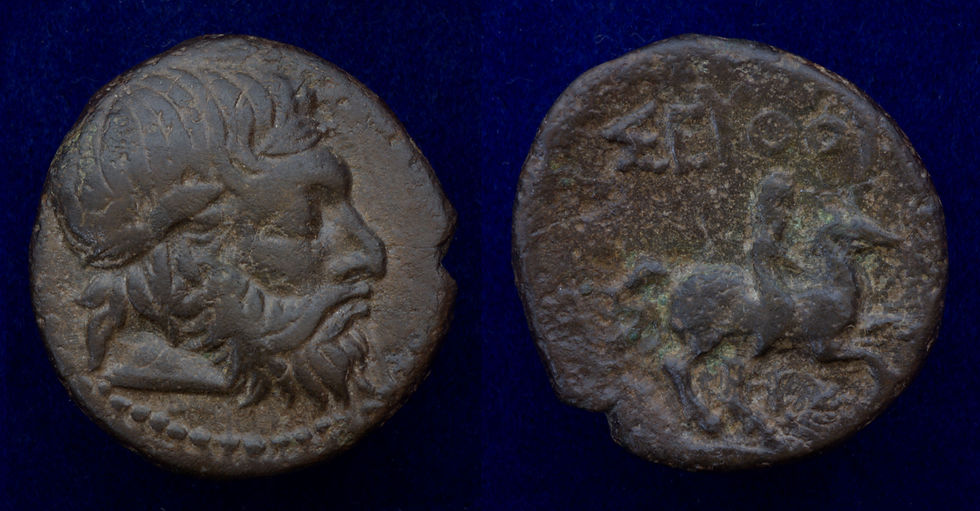
By the end of the reign of Seuthes III and immediately afterward, Thrace was increasingly shaped by Lysimachus and by the unstable politics of the early Hellenistic period.

Local authority became divided among competing dynasts, civic centers, and external powers. The rulers who followed are therefore better treated numismatically as later Thracian dynasts rather than as a linear royal succession: a heterogeneous group of local kings, regional strongmen, Celtic rulers such as Kavaros, Macedonian-aligned authorities, and, eventually, Roman client kings whose coinages advertised localized or mediated sovereignty.
The Coin
With that context, “Kings of Thrace” is not the right category for this coin. The legend [O]ΔPYZO–, is an legend variant in which a Z stands where the standard Greek would be be written with Σ as OΔPYΣΩN.
![Thrace, Black Sea Area (dealer formula), Odrysae, c. 187–72 BC, Æ 18.8 mm (3.95 g). Obv: [O]ΔPYZO[N?], head of young Herakles right, wearing the lion’s skin headdress. Rev: Bull standing left, club of Herakles laid horizontally beneath as exergual ground line. Refs: Koychev 2003, Type I, Period II (cat. nos. 15–18); Corpus Nummorum 4734; Moushmov 5683, BMC Thrace pg. 140, 1; SNG BM Black Sea 333A/333B; HGC 3.2 1667; . Dark green patina.](https://static.wixstatic.com/media/62a3d9_65dbe558820649c18998671c63d58019~mv2.jpg/v1/fill/w_980,h_507,al_c,q_85,usm_0.66_1.00_0.01,enc_avif,quality_auto/62a3d9_65dbe558820649c18998671c63d58019~mv2.jpg)
In hand, this coin is a small, well-struck bronze of 18.8 millimetres and 3.95 grams, with the dark green patina that collectors of Thracian and Lower Danubian bronzes recognize as the hallmark of Bulgarian soil finds. The obverse image of a youthful Herakles in the lion’s skin follows the post-Alexandrine convention. The reverse shows a bull walking left, with the club of Herakles laid horizontally beneath it as an exergual ground line.
Before accepting the obverse identification as straightforwardly Heraklid, it is worth raising a question that the Koychev Part II study (2008) raises on the iconography of Odrysian coinage more generally. Koychev argues that Odrysian rulers consistently depicted their own portraits on coins from Sparadoc onward, not mythological or divine figures, and supports this through computer comparison of the bronze head found before the Golyamata Kosmatka tomb with the coin portraits of Seuthes III, and through systematic matching of signet ring iconography to coin obverses across multiple reigns. On that reading the "young Herakles" on these bronzes may not be a deity at all but Cotys IV himself cast in Heraklid guise. The identification of the obverse figure as Herakles should be treated as a working assumption rather than a settled fact.
The intended legend OΔPYΣΩN is the genitive plural of Odrysai, “of the Odrysians” (Head, BMC Thrace, 1877, p. 140, 1). The legend oin this coin has a clear Z in place of Σ, yielding [O]ΔPYZO–. This is not an engraver’s whim. Koychev (2003, 23, 33) identifies the Σ→Z substitution as a diagnostic feature of his Period II, and reads it as the trace of Roman epigraphic interference on a Thracian die-shop after the absorption of Macedonia in 167 BC. The Z, in other words, is a date-marker as well as a letterform: it places the present coin in the third quarter of the second century, in a workshop already legible to a Latin-reading observer.
Who were “the Odrysians”?
The Odrysae enter the historical record in the early fifth century BC, when, according to Thucydides (2.29; 2.95–101), Teres I united the disparate Thracian tribes between the Aegean and the Danube into the largest territorial state in the Balkans. Teres’s son Sitalces took the Thracian state into the Peloponnesian War on the Athenian side; Cotys I (c. 384–359 BC) and Cersebleptes led it through the fourth century until Philip II of Macedon dismantled it in 341/340 BC.
Under Alexander and his successors the Odrysian heartland passed through Macedonian and then Lysimachean hands, and after the battle at Korupedion (281 BC) that ended Lysimachus’s reign, the region fragmented. Seuthes III had founded a new capital, Seuthopolis, in the Tundzha valley near modern Kazanlak; the city flourished briefly and was abandoned by the second quarter of the third century (Dimitrov and Čičikova 1978).
Between the abandonment of Seuthopolis and the rise of Cotys IV around 183 BC the Odrysian state is largely invisible in the literary record, but numismatic evidence suggests the gap conceals a genuine political catastrophe rather than merely a historiographical silence. Koychev (2003; and Part II, 2007) identifies at least four rulers operating in the period roughly 297-277 BC:
Roidgos, whose coins cluster so tightly around Seuthopolis that only two die pairs are known, attesting purely local authority;
Skostok I, operating in the Haskovo and Eastern Rhodopes region, whose portrait Koychev identifies in the fresco of a mounted ruler in the Alexandrovo tomb;
Spartos, based around Kabyle in the Sliven-Yambol area; and
Teres IV, whose coins feature the same boar motif as the bronze boar statue from the Mezek tumulus.
The Celtic invasion of 277 BC appears to have eliminated or fatally weakened all four simultaneously. This is consequential for reading the OΔPYΣΩN coinage: Cotys IV's emergence in the early second century was not simple dynastic continuation but reconstruction from a much lower base, after a break of nearly a century during which Odrysian authority had fragmented into competing local rulers and then been swept away entirely. The geographic footprint of the OΔPYΣΩN coinage — spreading across the full arc of the upper Hebros valley in contrast to Roidgos's purely local reach - is itself evidence for how ambitious that reconstruction was.

Livy (42.51; 42.59), Polybius, and Diodorus all introduce Cotys IV, son of Seuthes IV, who drove a Macedonian garrison out of Philippopolis around 183 BC, allied with Perseus, fielded the Thracian cavalry that nearly broke the Roman horse at Callinicus in 171 BC, fought at Pydna in 168, and - after retrieving his son Bithys from Roman custody - expanded eastward at Abdera’s expense. A decree of c. 166 BC from the people of Abdera describes their appeal to Rome for support as Cotys claimed their land:
"Since, when the People had need of an embassy to Rome on behalf of its ancestral territory -  the territory concerning which Cotys, king of the Thracians, after submitting a claim to the Senate through both his own son and the ambassadors sent by him in company with that son, was laying claim to our ancestral land - the envoys chosen by the People of Teos, Amymon son of Epicurus and Megathymos son of Athenaios, men noble and good, worthy of their own fatherland and well disposed toward our People, brought to bear every zeal and public-spirited effort, lacking nothing in eagerness."
- Honorary Decree for envoys from Teos supporting Abdera in Rome (Syll.³ 656)=
Cotys IV is the dynast during whose reign this coin was minted. Koychev (2003) places the opening of the type at 187 BC, in the years immediately following the recovery of Philippopolis from Philip V’s garrison; the Abdera affair, the alliance with Perseus, and the subsequent service at Pydna fall within the first period for these coins.

For more on Pydna - see our earlier article Freedom for Thessalian in 196 BC.
The Dating Problem
There is no traditional consensus date for these Herakles–bull bronzes. Poole, Pick, Mushmov, Youroukova, the SNG BM editors, and Topalov all placed them “circa third century BC” on stylistic intuition rather than on hoard or stratigraphic evidence. Hoover, working with Peykov’s catalogue, narrowed the bracket dramatically to c. 187–72 BC (HGC 3.2 1667). Koychev (2003) settles the question on hard archaeological grounds and refines the bracket into three sub-periods.
The decisive evidence is a sacred clay altar (eschara) excavated on the Nebettepe citadel of Plovdiv (ancient Eumolpia/Pulpudeva/Philippopolis). Coin impressions in the four corners of the altar, taken in plaster cast by Kisyov, preserve the obverses and reverses of four bronzes of this exact type, pressed into the clay before firing. Their stylistic position in the sequence - sharp Herakles, well-modelled bull, full legend - fixes them as the earliest issues, and the altar’s construction is dated archaeologically to the years immediately after 183 BC, when the Macedonian garrison was expelled from the city (Koychev 2003, 19–20, pl. 1).

Koychev’s three periods read as follows.
Period I (c. 187 (or later) - 167 BC): the Nebettepe-altar style, weights 3.2–5.0 g, well-cut Herakles, muscled bull, full legend; the engravers were probably Greek-trained craftsmen drawn from the Macedonian tetradrachm tradition.
Period II (c. 167- 148 BC): the post-Pydna phase. Style coarsens - a chubby young face, a simplified bull, slight weight reduction - and most diagnostically the Greek Σ is rewritten as a Z under the epigraphic pressure of the new Roman provincial presence in Macedonia. The flans of this period are themselves significant: Koychev shows that several Period II coins are overstruck on bronzes of Perseus (179 - 168 BC), the residual cash of the Macedonian payments that had supported Cotys’s thousand-strong cavalry at Pydna (Liv. XLII.58.8). After Perseus’s defeat his demonetised bronzes were re-struck by the Odrysian administration with its own dies.
Period III (c. 148 - 78/72 BC): schematic, sometimes anepigraphic, ending with Lucullus’s Thracian campaign.

Today's coin, with its Z and slightly coarsened style, sits squarely in Period II. That places it within a roughly twenty-year window in the third quarter of the second century BC. The recycled flans tell their own story: coins that left the Macedonian treasury as pay for Odrysian cavalry at Pydna came back to Philippopolis as raw material for the next generation of local coinage - the defeated king's money restruck with the tribal legend of his former ally, now navigating a world that Rome was reorganizing.
Herakles, Bull, and Club
The young Herakles in the lion’s skin carries two superimposed claims. First, the Argead house, to which Alexander the Great belonged, traced its line through Karanus and Temenus to Herakles himself; the obverse therefore plugs into the dynastic vocabulary of post-Alexandrine kingship. Second, after Alexander this image circulated as a portable, generalized emblem of legitimate authority.
The bull on the reverse is a recurrent figure in Thracian elite culture and a companion of the Thracian Heros, the indigenous rider deity widely syncretised with Herakles. The club of Herakles serves as the ground line, a heraldic gesture placing the Thracian beast atop the weapon of the Greek hero. It is worth noting that the boar was the dominant animal symbol in the final generation of independent Odrysian coinage before the Celtic disruption. The shift to the bull under Cotys IV may therefore signal a deliberate rebranding, moving away from the imagery of the fragmented late-Odrysian dynasts and toward the Heraklid-Macedonian visual vocabulary on the post-Pydna political moment.
Koychev (2003, 18) reads the legend itself as a deliberate appropriation. The Macedonian people had been minting coins with the legend MAKEΔONΩN, “of the Macedonians”, since the dissolution of the Antigonid kingdom; the Odrysian die-shop answered with OΔPYΣΩN, “of the Odrysians”.
For Koychev the ethnikon, OΔPYΣΩN, is a peer-people claim, made possible by the Macedonian withdrawal from Philippopolis in the early 180s and entirely consistent with the Heraklid-Argead vocabulary that the obverse already invokes. It is worth noting, however, that the Macedonian royal iconography on these coins - the Heraklid obverse and the club - cuts against a purely anti-Macedonian reading; the same imagery could equally signal alliance with rather than independence from the Antigonid house, a posture consistent with Cotys's well-documented partnership with Perseus in the years immediately preceding Pydna.
Mint and circulation
The dealer formula “Black Sea Area” reflects the fact that many specimens of this general family reach the Western market through Bulgarian channels, but Koychev’s find-spot evidence locates the mint inland, at Philippopolis itself. Map 1 in his study (p. 67) plots thirteen find sites in a tight cluster across the upper Hebros valley: Nebettepe and the urban quarter of Plovdiv itself, Skobelevo, Perushtitsa (single finds and a hoard of about twenty), Brestovitsa, Kievo Kale, Dorkovo and Kostandovo, Momina Klisura, Tsalapitsa, Brani Pole, Yagodovo at the eastern edge, the Gaytancha hoard near Pazardzhik (74 specimens), and a homogeneous hoard of thirty from Skutare. The hoards contain only this type. There are no admixtures of foreign issues, which means these coins served as the everyday small-change of a closed inland economy, not as items of Aegean or Pontic exchange.
Combined with the Nebettepe altar evidence, the picture is of a single municipal mint at Philippopolis, operating under the umbrella of the late Odrysian dynasty for something over a century, with the legend OΔPYΣΩN functioning as a tribal rather than civic or royal signature.
The legend variants documented: OΔPYΩN, OΔPYΣ, OΔPOΣ, and the Z-form on the present specimen - are therefore variations over time. They do not attest a network of mobile or unofficial workshops; they attest the gradual degeneration from the well-cut Period I through the Roman-influenced Z of Period II to the schematic, sometimes anepigraphic (no legends) Period III. This fits the fragmented political landscape: a Thrace of local kings, regional strongmen, residual Galatian elements, Macedonian-aligned magnates, and eventually Roman client rulers. This Odrysian collective identity persisted from a single tribal mint at Philippopolis for over a hundred years while political control shifted around it.
This coin is a small bronze, struck on a recycled Macedonian flan, in a workshop where the Greek alphabet was already bending under Latin pressure, in a city that had only recently shaken off a Macedonian garrison and would, within two generations, be absorbed into Rome.
It is not a coin from the world of Alexander's successors but from the world of Perseus and Pydna and Lucullus - a world in which the Heraklid obverse was no longer a claim of dynastic proximity to the Argeads but a fossilized emblem of legitimate authority.
Selected Bibliography
Catalogues and Corpora
Corpus Nummorum (formerly Corpus Nummorum Thracorum). Berlin-Brandenburg Academy of Sciences and Humanities, in collaboration with the Münzkabinett der Staatlichen Museen zu Berlin and the Big Data Lab, Goethe University Frankfurt.
Hoover, Oliver D. Handbook of Coins of Macedon and its Neighbors, Part II: Thrace, Skythia, and Taurike, Sixth to First Centuries BC. The Handbook of Greek Coinage Series 3.2. Lancaster, PA, and London: Classical Numismatic Group, 2017.
Koychev, Atanas. "Монетосеченето с надпис ΟΔΡΟΣΩΝ и владетелите на одриската, астейската, кенийската и сапейската династии през II–I в. пр. Хр." [The Coinage with the Legend ΟΔΡΟΣΩΝ and the Rulers of the Odrysian, Astaean, Caenian and Sapaean Dynasties during the 2nd–1st Centuries BC].
Koychev, Atanas, ed. Numismatica Bulgarica II/1: In honorem Dimitar Draganov. Sofia: Agato, 2003, pp 14-68. In Bulgarian, with English summary. An accessible engagement with its arguments and figures is Lozanov's reappraisal. I also provide a translation of this reappraisal in English.
Koychev, Atanas. ‘ТРАКИЙСКИТЕ ОДРИСКИ ЦАРСКИ ПОГРЕБЕНИЯ, ХРАМОВЕ И ГРОБНИЦИ - ОПИТ ЗА ОПРЕДЕЛЯНЕ НА ВЛАДЕТЕЛСКАТА ПРИНАДЛЕЖНОСТ’ (Част ΙΙ) в Сб. Археологически и Исторически Проучвания в Новозагорско. 2008, Том.2,” n.d.
Mushmov (Moushmov), Nikola A. Antichniti︠e︡ moneti na Balkanskii︠a︡ poluostrov i monetiti︠e︡ na Bŭlgarskiti︠e︡ t︠s︡are [Ancient Coins of the Balkan Peninsula and the Coins of the Bulgarian Tsars]. Sofia: Pechatnit︠s︡a na Grigor Iv. Gavazov, 1912. English translation and reorganisation by D. Genkova, D. Surber, and S. Slaveev.
Peykov, Alexander. A Catalogue of the Coins from Thrace, Part I: Tribal and Rulers' Coinages of Thracians, Paeonians, Celts and Scythians, 5th c. BC – 1st c. AD. Veliko Tărnovo: Centrex, 2011.
Poole, Reginald Stuart, ed. A Catalogue of the Greek Coins in the British Museum: The Tauric Chersonese, Sarmatia, Dacia, Moesia, Thrace, &c. Compiled by Barclay V. Head (Thrace and the Islands) and Percy Gardner (the rest of the volume). London: Printed by Order of the Trustees, 1877.
Sylloge Nummorum Graecorum, Great Britain IX: The British Museum, Part 1, The Black Sea. London: Spink, on behalf of the Trustees of the British Museum, 1993. Series record at the British Museum.
Historical and Numismatic Studies
Archibald, Zosia H. The Odrysian Kingdom of Thrace: Orpheus Unmasked. Oxford Monographs on Classical Archaeology. Oxford: Clarendon Press, 1998.
Delev, Peter. "From Koroupedion to the Beginning of the Third Mithridatic War (281–73 BCE)." In A Companion to Ancient Thrace, edited by Julia Valeva, Emil Nankov, and Denver Graninger, 59–74. Blackwell Companions to the Ancient World. Malden, MA, and Oxford: Wiley-Blackwell, 2015.
Dimitrov, Dimitar P., and Maria Čičikova. The Thracian City of Seuthopolis. British Archaeological Reports, Supplementary Series 38. Oxford: BAR, 1978.
Tačeva, Margarita. Istoria na bălgarskite zemi v drevnostta prez elinističeskata i rimska epokha [History of the Bulgarian Lands in Antiquity during the Hellenistic and Roman Periods]. Sofia: Sofia University Press, 1997.
Valeva, Julia, Emil Nankov, and Denver Graninger, eds. A Companion to Ancient Thrace. Blackwell Companions to the Ancient World. Malden, MA, and Oxford: Wiley-Blackwell, 2015. https://doi.org/10.1002/9781118878248. Reviewed in Bryn Mawr Classical Review 2016.1.
Ancient Sources
Diodorus Siculus. Library of History, Book 30 (esp. fr. 1, on Cotys IV of the Odrysians). Translated by Francis R. Walton. Loeb Classical Library 409. Cambridge, MA: Harvard University Press, 1957.
Livy (Titus Livius). History of Rome, Books 42 (42.29, 42.51, 42.58–59, on Cotys IV at Callinicus) and 44 (44.42, on Pydna). Translated by Evan T. Sage and Alfred C. Schlesinger. Loeb Classical Library 396 and 313. Cambridge, MA: Harvard University Press, 1938 and 1951.
Polybius. Histories, Book 27 (27.12, on the character of Cotys IV); Book 30 (30 fr. 17, on Cotys' royal title). Translated by W. R. Paton. Loeb Classical Library 159–161. Cambridge, MA: Harvard University Press, 2010–2012.
Thucydides. History of the Peloponnesian War, Book 2 (2.29, on Teres I; 2.95–101, on Sitalces). Translated by Charles Forster Smith. Loeb Classical Library 108. Cambridge, MA: Harvard University Press, 1919.
Thrace and Moesia Inferior > Great Seuthopolis Inscription SEG 42:661 "The oath of Epimenes, of Berenike and of her sons" English translation available from Attalus SEG 42:661


Comments