
Byzantine: the uglier the better

Updated: Apr 26
Byzantine coins are an acquired taste. These are not the coins you put on display to impress your friends. This one in particular has no portrait, no triumphant emperor gazing out from a field of bronze. The obverse gives you a monogram: interlocked Greek letters folded into a hieroglyphic knot. The reverse gives you a large E and a small K. That is all.
The Coin

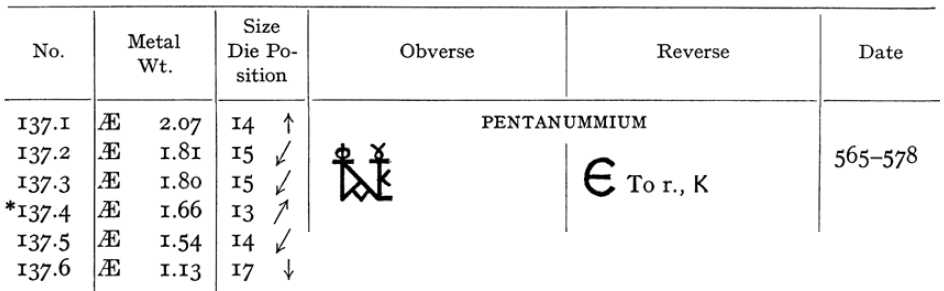
The reference coin in Dumbarton Oaks is not going to get someone to bid into the stratosphere.
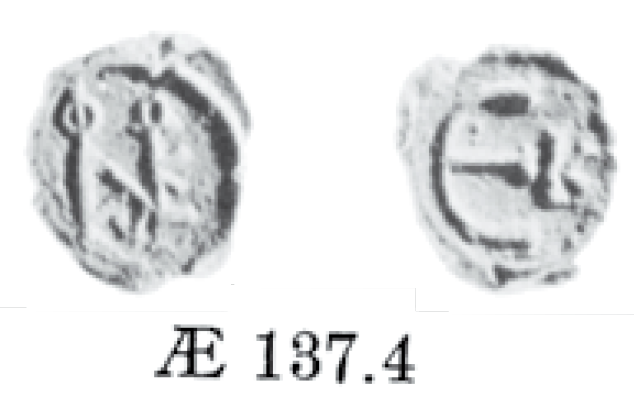
Yet, there is something perversely attractive about this coin, after fifteen centuries of sleep in some unknown Anatolian soil, the size of a small button, with it's deep green pathina, and ancient earth still clinging to its crevices.
This Byzantine pentanummium of Justin II was struck at Kyzikos sometime between 565 and 578 AD. It is, by the standards of classical numismatics, an ugly coin. And yet, it is also extraordinary.
A Pentanummium, literally "five coins", was the humblest denomination in the Byzantine monetary system introduced by Anastasius I in his great currency reform of 498 AD. Worth one-twenty-fourth of a follis, it changed hands in the markets of the eastern Mediterranean.
The obverse carries the monogram of Justin II: a cross-shaped interlacing of Greek letters that compresses the emperor's imperial title into an almost abstract symbol. It is not portraiture. It is closer to a seal, or a cipher.
The reverse is even more direct: a large E, the Greek numeral for five, and beside it the letter K, the workshop identifier for the mint at Kyzikos, the ancient Greek city on the Propontis.
Those who love ancient coins for their beautiful engraving have already moved on. Byzantine provincial bronzes are not the coins you choose for their artistry. They sit as far as possible from the masterpieces of the Sicilian mints: the signed tetradrachms of Syracuse produced by Kimon and Euainetos in the late fifth century BC, where an artist's individual genius is literally written into the die, where the hair of the nymph Arethusa coils with such precision and such joy that scholars still argue about which hand cut which die after two and a half millennia. Those coins are objectively, beautiful works of art that happen to be currency.
The provincial mints of the sixth and seventh centuries produced coins quickly, in quantity, for a functioning commercial economy. The dies were cut by craftsmen, not by artists. The results are often misshapen, off-center, sometimes barely legible.


The Emperor
Although Wroth (British Museum) and others misclassified these coins as Justinian (and misread the monogram), These is a coin of Justin II. It is a relatively recent (20th century) assignment of this coin to Justin II. The interpretation of the monogram plays a role in attributing correctly. Warren Esty has an excellent webpage on the monograms of Byzantine coins at AugustusCoin.com.

Justin II came to power in November 565 AD, the day after his uncle Justinian I died after a reign of nearly four decades. One of his first acts sets a tone for his reign: refusing the annual tribute Justinian had been sending to the Avars and the Persians to purchase peace. A loose translation of Corippus' work In Praise of Justin the Younger documents Justin's retort: "The Romans are not accustomed to buy peace; they impose it".
In a more faithful translation of Corippus , writing as a near eye-witness of events in the court of Justin II, compares the many victories boasted by the Avers to the holiday amusements of Roman soldiers:
"What you have now seen fit to assign to your own efforts is commonly the daily sport (recreation) of our soldiers; this is the masters' pastime, this is servants' holiday. This sacred empire has flourished thus throughout the world, waging wars and preserving peace. We, in the custom of our fathers, love peace, and never fear savage wars. Peace belongs to those who submit; the proud perish in wars."For another source, Menander Protector (also called Menander the Guardsman), the late sixth-century Byzantine historian.
"Depart, therefore, having purchased from us a gift of the greatest value - your lives and having received, instead of Roman gold, a terror of us which will ensure your survival. I shall never need an alliance with you, nor shall you receive from us anything other than what we wish to give, and that as a free gift for your service, not, as you expect, a tax upon us."
-The History of Menander the Guardsman, Fragment 8
Unfortunately - as elegant and proud as Justin II's retort was - it was also catastrophic policy and after several defeats at the hands of the Avers he had to buy peace at an annual cost of 80,000 solidi (DOC I, p195). Justin spent his reign watching the frontiers that Justinian had attempted to secure at great expense begin to unravel. The Lombards invaded Italy in 568; much of the peninsula reconquered at enormous cost was lost within years. In the east, the war with Persia Justin had provoked ground into ruinous deadlock.
By 574, something in Justin broke. John of Ephesus attributes this to an act of God - punishing the emperor for his wickedness.
"He sent it by means of an evil angel, who suddenly entered into him, and took his form, and domineered over him cruelly and fearfully, making him an example of the terribleness of their malice. For suddenly it destroyed his reason, and his mind was agitated and darkened, and his body given over both to secret and open tortures and cruel agonies, so that he even uttered the cries of various animals, and barked like a dog, and bleated like a goat; and then he would mew like a cat, and then again crow like a cock: and many such things were done by him, contrary to human reason, being the workings of the prince of darkness, to whom he had been given up, and who had darkened his understanding, and taken it captive, and who wrought in him every thing that he did."
-John of Ephesus, Ecclesiastical History, Part III, Book III.2
His attendants sought diversions that might restore his sense.
"The most successful of these was a little wagon, with a throne upon it for him to sit upon, and having placed him on it, his chamberlains drew him about, and ran with him backwards and forwards for a long time, while he, in delight and admiration at their speed, desisted from many of his absurdities. Another was an organ, which they kept almost constantly playing day and night near his chamber; and as long as he heard the sound of the tunes which it played he remained quiet
-John of Ephesus, Ecclesiastical History, Part III, Book III.3
His wife, the Empress Sophia, niece of Theodora (Empress and wife of Justinian I), effectively governed in his name. Sophia arranged for Justin to adopt the general Tiberius, no blood relationship, as Caesar and Justin surrendered real power four years before his death."
This coin was almost certainly struck before his collapse, during the years when Justin still ruled and still believed Rome could be what it once was.
The Place
The sixth century was a world in the act of becoming something it did not yet know how to name. The Byzantines never called themselves Byzantines. The Roman world was Christian in its theology, Greek in its language, eastern in its geography. Justin II's uncle and predecessor, Justinian, had tried to turn back the clock, to reassemble the old empire. Justin II inherited both the ambition and the failure.
Kyzikos, the mint that struck this coin, was itself a city of layered antiquity. Founded by Greek colonists in the seventh century BC, it had been Persian, then Greek again, then Roman, and now Byzantine, the word historians use to distinguish this variant of Roman. It sat on the Propontis which is today the Sea of Marmara to control the approaches to Constantinople, roughly a hundred miles to the east. Its mint served the commerce of the eastern Mediterranean, producing the small bronze currency that ordinary life required.
Epilogue
There is a moment in the handling of an old coin when you stop thinking about value and simply hold something that someone else held, fifteen hundred years ago, in a world you will never visit. The monogram of Justin II, encrusted and indistinct, is not the image of a man, but it is the mark of a reign: of ambition and the unraveling of a Roman dream.
This coin is ugly by every conventional measure. It has no portrait, no fine engraving, no attempt at beauty. What it has instead is something rarer: the beauty of absolute authenticity, a nice patina, and decent heft in hand for a small coin. The green of its patina was not applied. The dirt in its crevices was not staged. It looks exactly like what it is - a small coin, made in haste, spent in a market, lost in a field, and found again across an almost incomprehensible distance of time.
The uglier the better.
References
John of Ephesus. The Third Part of the Ecclesiastical History of John, Bishop of Ephesus. Translated by R. Payne Smith. Oxford: Oxford University Press, 1860. Book III, chapters 2–3.
Menander Protector. The History of Menander the Guardsman: Introductory Essay, Text, Translation, and Historiographical Notes. Edited and translated by R. C. Blockley. ARCA Classical and Medieval Texts, Papers and Monographs 17. Liverpool: Francis Cairns, 1985.
Bellinger, Alfred R., and Philip Grierson, eds. Catalogue of the Byzantine Coins in the Dumbarton Oaks Collection and in the Whittemore Collection. Vol. 1, Anastasius I to Maurice, 491–602. Washington, DC: Dumbarton Oaks Research Library and Collection, 1966.
Grierson, Philip. Byzantine Coins. London: Methuen; Berkeley: University of California Press, 1982.
Pierre-François Foggini: Fl. Cresconius Corippus de laudibus Iustini Augusti minoris ex recensione P. F. Foggini cum notis variorum (Rome, 1777), pp. 86–107.
Note: I am currently looking for copies of:
Wolfgang Hahn and Michael Metlich, Money of the Incipient Byzantine Empire Continued (Justin II – Revolt of the Heraclii, 565–610). Wien, 2009. VIN 13.
Cameron, Averil, ed. and trans. Flavius Cresconius Corippus: In Laudem Iustini Augusti Minoris. London: Athlone Press, 1976.
Here's my own translation from Foggini's 1777 copy of the Latin text into prose - copyright 2026, shared as a pdf for non-commercial use as long as you reference the source (this page).


Comments