
God, help the Romans!

In the spring of 615 CE, in a Constantinople ringed by enemies, the imperial mint struck a coin that had no recent precedent. It was made of silver - a metal the city’s mint had largely abandoned for more than a century - and it carried, around the stepped cross on its reverse, a short Latin prayer that no Roman coin had ever borne before: dEUS AdIUtA ROmANIS ("God, help the Romans"). Today's coin of interest, a hexagram of Heraclius and his eldest son Heraclius Constantine weighing 6.56 grams, belongs to the first generation of these coins. The world that it came from was collapsing.
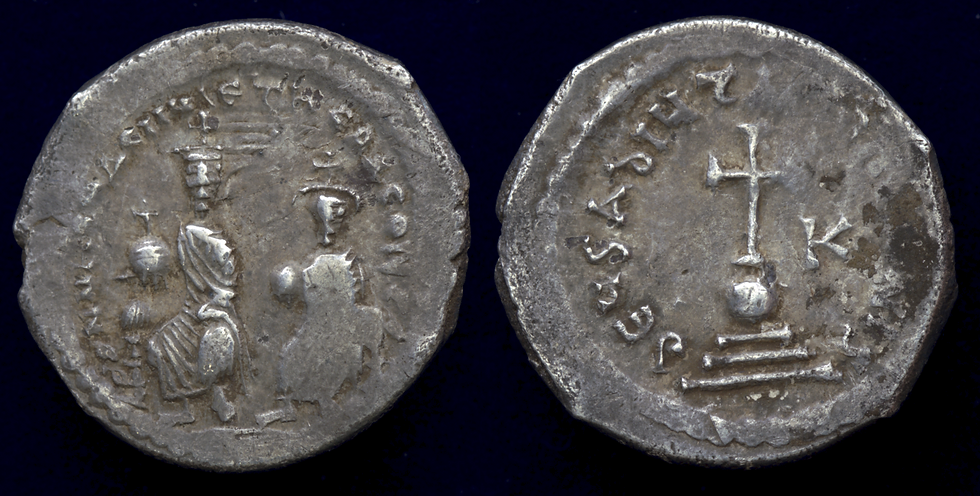
Heraclius, with Heraclius Constantine, 610-641, AR Hexagram (23mm, 6.56 g, 6h), Constantinople mint, struck 615-630.
Obv: DD NN HERACLIUS ET HERA CONST, Heraclius and Heraclius Constantine seated facing on double throne, both wearing crown and chlamys and holding globus cruciger; cross above
Rev: dEUS AdIUtA ROmANIS, cross potent on globe set on three steps; K to right.
Ref: DOC 64; MIB 140; Yannopoulos Type I, First Series, Class 4; SB 798. Toned, minor marks and deposits, slight clashing on obverse. VF. From the James A. Lock Collection.
Philip Grierson wrote about the coins of Heraclius in 1982 (Byzantine Coins)
"the coins are of such slovenly fabric that they have been little sought-after by collectors". This is certainly not as true today as it might have been in 1982 - the coins have not improved in quality, but collector interest has increased.
The Collapsing Empire
Constantinople at this time was an imperial capital that had lost almost everything beyond its walls. Antioch had surrendered to the Sassanian armies of Khusro II in 611, Damascus in 613; Jerusalem fell in 614, and with it the True Cross was carried east as a trophy. Persian raiders had crossed Asia Minor and stood at Chalcedon, looking back across the Bosphorus at the capital itself. The city’s gold-based fiscal machinery, built over centuries on the tax revenues of Syria and Egypt, was running dry.
It is against this backdrop that the hexagram was issued by the Constantinople mint using what silver bullion could be assembled.
The Historical Moment
The Chronicon Paschale, a chronicle compiled in Constantinople and closing in 628, records the moment with a single dry sentence: in the third indiction (614/615), “a six-gram silver coin was made by law, and imperial salaries were paid with it, and at half their old rate” (p.158). The detail about pay is striking. The state, unable to meet its obligations in gold, halved the rhogai (salaries) and paid out in this new silver.
Four years later, in 619, Alexandria, the empire’s granary fell. Heraclius, who had overthrown the usurper Phokas in 610 and inherited this catastrophe, offered peace to Khusro II - who wasn't in the mood to settle. Here are his words addressing "Heraclius, his senseless and insignificant servant".
"Khosrov, honoured among the gods, lord and king of all the earth, and offspring of the great Aramazd, to Heraclius our senseless and insignificant servant.
You have not wished to submit yourself to us, but you call yourself lord and king. My treasure which is with you, you spend; my servants you defraud; and having collected an army of brigands, you give me no rest. So did I not destroy the Greeks? But you claim to trust in your God. Why did he not save Caesarea and Jerusalem and the great Alexandria from my hands?  Do you not now know that I have subjected to myself the sea and the dry land? So is it only Constantinople that I shall not be able to erase? However, I shall forgive you all your trespasses. Arise, take your wife and children and come here. I shall give you estates, vineyards and olive-trees whereby you may make a living.”
Sebeos, 7th Century, Armenian bishop. The Armenian History Attributed to Sebeos. vol. 1, pp.80-81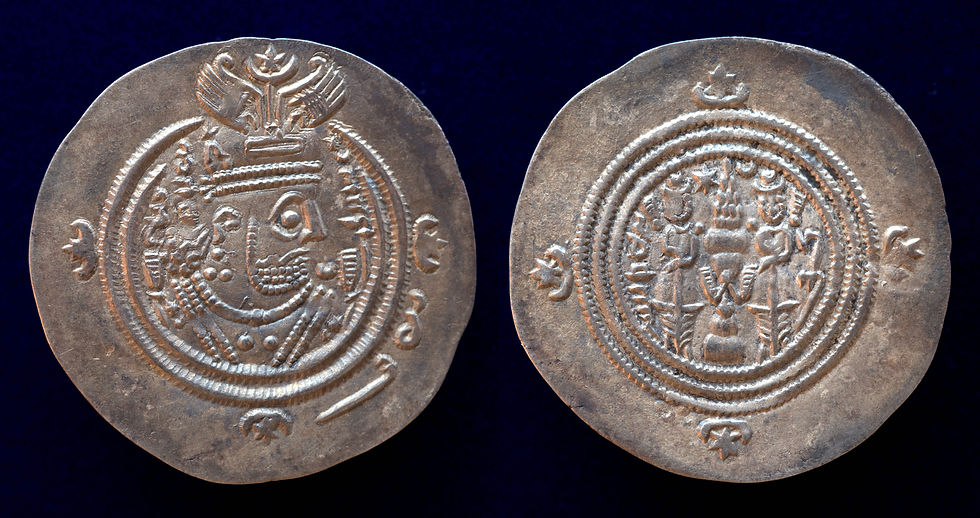
A famous passage in Theophanes, dated to Annus Mundi 6113, describes Heraclius taking on loan the funds of religious foundations and the candelabra of Hagia Sophia, melting them into “a great quantity of nomismata and miliarisia". This has been read as the origin story of the hexagram itself - the bullion of the Great Church transformed, by an emperor’s desperation, into the silver of his armies.
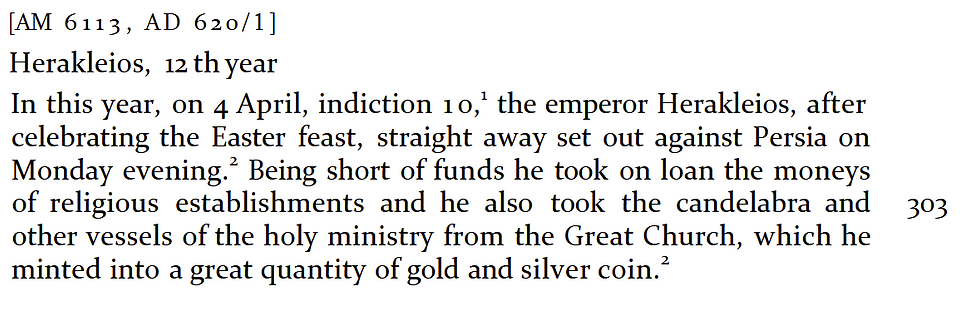
Whalin has recently argued that Theophanes’ entry which the chronicler himself places at 620/621, should be read at face value as a separate event from the hexagram's 615 introduction. By 620 the hexagram was already in circulation, and Theophanes describes a separate moment prompted by the loss of Egyptian revenue. The hexagram and the church plate belong to the same crisis, but not, as Grierson once suggested, to the same date.
By 622, when George of Pisidia accompanied Heraclius to his training camp in Bithynia, the emperor was lecturing his reassembled soldiers on the war as a religious struggle and addressing them, in George’s verse paraphrase, as God’s plasmata, the instruments of His will. The hexagram and the rhetoric ran in parallel.
Reading the Coin
The coin weighs 6.56 grams against a theoretical standard of about 6.84 (six grammata, the unit that gives the denomination its modern name). Constantinople had not produced silver coinage in quantity since the late fourth century; the imperial system since Anastasius had run on gold and copper, with silver appearing only in ceremonial flashes. The hexagram was a deliberate revival, a return to silver at a moment when the empire’s gold was scarce and its credibility tested.
The obverse shows Heraclius and Heraclius Constantine enthroned, both crowned and chlamydate, each holding a globus cruciger. A small cross hovers between their heads. The legend, DD NN HERACLIUS ET HERA CONST, identifies them in formulaic Latin.
The reverse shows a cross potent rising on three steps above a globe; a single Greek letter K sits in the right field; and around the whole runs the inscription dEUS AdIUtA ROmANIS.
For most of the twentieth century, dEUS AdIUtA ROmANIS was read as a cry of distress. Walter Kaegi described it as “poignantly” reflecting “the stressful and desperate contemporary conditions and anxieties.” A recent reinterpretation by Douglas Whalin shifts the reading.
In the Strategikon attributed to the emperor Maurice (composed before Heraclius’s reign and reflecting late sixth-century army practice), the manual prescribes a vocal sequence shouted by Roman troops as they closed on the enemy at a bowshot’s distance: one officer calls parati, another adiouta, and the whole line answers deous - “Ready! Help us! O God!” The coin’s legend, with its order reversed, is the same prayer. The irregular Latin - adiuta normally takes the accusative, not the dative Romanis - suggests the formula entered the die-cutters’ workshop through camp speech, not chancery drafting. What was initially read as a desperate plea was a fierce battle cry.
The Hexagram
The hexagram was not, in the first instance, a coin for daily expenditures. The hoard record, mapped by Florin Curta and others, concentrates outside the imperial frontiers in Armenia, Transcaucasia, the Danubian Balkans, and even, in one striking case, deep in Siberia. This distribution supports the view that the coin was used to pay foreign troops: Turkic Khazar allies of the steppes, Christian Caucasian troops, Balkan recruits drafted into Heraclius’s campaigns against Persia.
Cécile Morrisson has noted that Caucasian preference for silver predates Heraclius and that modern excavation patterns inside the former empire are not directly comparable to extramural hoard recovery; Numismatic Circular has long observed that hexagrams are in fact among the commonest Byzantine silver coins to surface in Asia Minor. The picture is less of a coin minted exclusively for mercenaries than of a general-purpose silver issue that the army and foreign allies used intensively.
The K in the right field of this specimen is one of a small family of mint or workshop marks that appear on the type. Their precise meaning remains debated; Hahn has read certain field letters on related issues as indictional dates (a 15-year tax-assessment cycle) analogous to those on contemporary solidi, but no consensus assigns each variant a year. What can be said is that this piece belongs to the early run of the denomination, before the iconography shifted around 625 to depict Heraclius Constantine as a bearded co-emperor.
Conclusion
By the time Heraclius defeated Khusro’s armies in 627 and recovered the True Cross in 630, the hexagram had been in circulation for fifteen years. It went on being struck, in declining quantities, until the 680s, and survived as a ceremonial issue into the early eighth century. The introduction date of 615 is firm, fixed by the Chronicon Paschale. The mercenary-payment thesis is well supported by hoard distribution but is not the whole story, as Morrisson’s review makes clear. When this coin was issued - Khusro had the upper hand.
Bibliography
Curta, Florin. “Byzantium in Dark-Age Greece (the Numismatic Evidence in Its Balkan Context).” Byzantine and Modern Greek Studies 29, no. 2 (2005): 113–146.
Dennis, George T., trans. Maurice’s Strategikon: Handbook of Byzantine Military Strategy. Philadelphia: University of Pennsylvania Press, 1984.
Grierson, Philip. Catalogue of the Byzantine Coins in the Dumbarton Oaks Collection and in the Whittemore Collection. Vol. II.1, Phocas to Theodosius III, 602–717. Washington, DC: Dumbarton Oaks, 1968.
Howard-Johnston, James. Witnesses to a World Crisis: Historians and Histories of the Middle East in the Seventh Century. Oxford: Oxford University Press, 2010.
Howard-Johnston, James. “Heraclius’ Persian Campaigns and the Revival of the East Roman Empire, 622–630.” War in History 6, no. 1 (1999): 1–44.
Kaegi, Walter E. Heraclius, Emperor of Byzantium. Cambridge: Cambridge University Press, 2003.
Mango, Cyril, and Roger Scott, trans. The Chronicle of Theophanes Confessor: Byzantine and Near Eastern History, AD 284–813. Oxford: Clarendon Press, 1997.
Morrisson, Cécile. Review of L’hexagramme: un monnayage byzantin en argent du VIIe siècle, by Panayotis Yannopoulos. Revue des études byzantines 39 (1981): 348–350.
Thomson, Robert W., and James Howard-Johnston, with Tim Greenwood, trans. The Armenian History Attributed to Sebeos. 2 vols. Translated Texts for Historians 31. Liverpool: Liverpool University Press, 1999.
Whalin, Douglas C. “A Note Reconsidering the Message of Heraclius’ Silver Hexagram, circa AD 615.” Byzantinische Zeitschrift 112, no. 1 (2019): 221–232.
Whitby, Michael, and Mary Whitby, trans. Chronicon Paschale, 284–628 AD. Translated Texts for Historians 7. Liverpool: Liverpool University Press, 1989.
Yannopoulos, Panayotis. L’hexagramme: un monnayage byzantin en argent du VIIe siècle. Numismatica Lovaniensia 3. Louvain-la-Neuve: Université Catholique de Louvain, 1978.


Comments