
Elagabalus, 218–222 CE


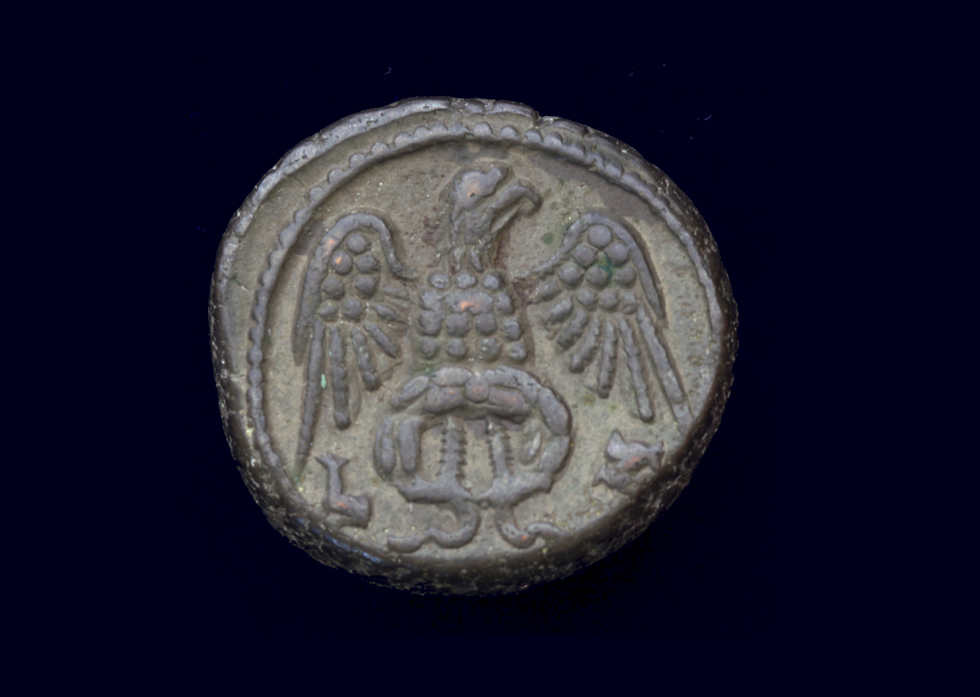
Tetradrachm : Marcus Aurelius Antoninus “Elagabalus” (r. 16 May 218 – 11 March 222 CE) Date/Mint: 218–220 CE, likely Antioch. Prieur gets to the level of identifying the style of individual engravers from previous issues of Caracalla and Macrinus and lists this coin as Emesa and others in Carrhae, Laodicea, and Unknown in his section on Antioch. RPC goes with "Uncertain mint of the Syrian Tetradrachms" e.g. RPC 7954 which is perhaps the safest option without some stronger evidence.
Obv: Laureate, cuirassed, and draped bust of Elagabalus right, seen three-quarters from behind.
Legend: ΑΥΤ Κ Μ Α ... ΑΝΤΩΝΕΙΝΟΣ ΣΕΒ (Imperator Caesar Marcus Aurelius Antoninus Augustus).
Rev: Eagle in “Emesa style,” standing right with wings spread, head and tail left, holding a laurel wreath in beak; star between legs. Δ Ε on the shoulders of the eagle.
Legend: ΔΗΜΑΡΧ ΕΞ ΥΠΑΤΟC ΤΟ Β (tribunician power, consul for the second time).
Caracalla & the other by Macrinus both issued coins that can firmly be attributed to the Emesa mint with an image of Shamash, the Emesain Sun God, between the eagles's legs. Why would Emesa be minted with a star - is a fair question about Prieur's decision to like to Emesa. Prieur connects the star with another coin that shows "almost uniquely a radiate crown" #253 and suggests that this "propaganda tool" would have been most likely from Emesa.
Neumann, Kristina M. Antioch in Syria: A History from Coins (300 BCE–450 CE). Cambridge: Cambridge University Press, 2021, describes the coins of Caracalla and Elagabalus :
"Additionally, a delta-epsilon is featured on the silver tetradrachms minted at Antioch from the reigns of Caracalla through Elagabalus. The delta-epsilon also appears with a star and Latin legends on anonymous bronze issues thought to be minted at Laodicea, although once attributed to Antioch."and then there are three explanations for the delta-epsilon
Butcher’s view: ΔΕ = Δ Ε(παρχείων), “of the four eparchies”. Antioch promoting itself as metropolis of the four provinces. This one seems most likely.
Baldus’s view: ΔΕ = Δ(όγμα) Ε(κκλησίας) or Δ(ἡμῶ) Ε(δόξεν), “public decree” / “the people resolved.” for silver under Caracalla-Elagabalus, ΔΕ marks Antioch laying claim to its mint despite imperial pressure. This one appeals to me the most.
Tribunician title: ΔΕ abbreviates Δ(ημαρχικῆς) Ε(ξουσίας), “tribunician power.” aligned with other silver coinage but why would one need the redundancy?
Born Varius Avitus Bassianus, priest of the sun god Elagabal at Emesa. With Julia Maesa’s support, troops at Raphaneae, near Emesa in Syria, acclaimed him emperor, claiming he was Caracalla’s son.
"For they carried Avitus, whom they were already styling Marcus Aurelius Antoninus, round about upon the ramparts, and exhibited some likenesses of Caracallus when a child as bearing some resemblance to the boy, at the same time declaring that the latter was truly Caracallus' son, and the only rightful heir to the throne. "Why do you do this, fellow-soldiers?" they exclaimed, "Why do you thus fight against your benefactor's son?" By this means they corrupted all the soldiers who were with Julianus, the more so as these were eager to revolt, so that the assailants slew their commanders, with the exception of Julianus, who escaped in flight, and surrendered themselves and their arms to the False Antoninus."
- Cassius Dio 79.32
Elagabalus’s forces defeated Macrinus at Antioch (June 218).
[5.4.6] [8 June 218] When the two armies met on the borders of Phoenicia and Syria, Heliogabalus' soldiers fought with spirit, fearing that if they should lose, they would suffer for what they had done. The soldiers of Macrinus, on the other hand, were completely indifferent and deserted to Heliogabalus.
- Herodian 5.4,6.
V. Avitus Bassianus took the imperial title Marcus Aurelius Antoninus and arrived in Rome in 219 CE where he established the cult of Elagabal: importing a black conical stone (the god’s image) from Emesa. Shortly after arriving in Rome he married Julia Cornelia Paula but the marriage lasted less than a year. He built a new temple (Elagabalium) on the Palatine and placed sacred Roman relics inside (Palladium, shields of Mars, fire of Vesta). The emperor danced around the altar with Syrian music and processions of women. Needless to say this didn't ingratiate him with the senatorial class whom he forced to participate in these religious rites.

He divorced Julia Cornelia Paula because she was considered “unworthy” of him after he met the Vestal Aquilia Severa. He went one step further and married the Vestal Virgin Aquilia Severa (sacrilege in Roman eyes). Under pressure from Julia Maesa), he divorced Severa and briefly married Annia Aurelia Faustina, a wealthy widow and descendant of Marcus Aurelius.
"[July 221] But a short time later he divorced this girl [Aquilia Severa] and took yet a third wife [Annia Aurelia Faustina], a girl who belonged to the family of Commodus."
-Herodian 5.6.2
I will skip lightly past the descriptions of his extravagance and sexual promiscuity, which are certainly grounded in some objective truths. However, the many exaggerated stories from the Historia Augusta fuel articles like "The short reign of Elagabalus, Rome's hard-partying emperor" from National Geographic in 2018.
"The scandals and excesses of the emperor apparently knew no bounds. In one account he is said to have amazed the Roman people with his naumachiae, simulated naval battles held in the Circus Maximus, with ships floating on wine to evoke the “wine-dark sea” of Homer’s Odyssey. Just as impressive were the elaborate processions in which chariots pulled by elephants, tigers, and lions scaled the Vatican Hill, trampling any tomb that lay in their path." (National Geographic 2018)I like Prieur's more muted description (from The Syro-Phoenician Tetradrachms and Their Fractions, CNG, 2000):
"We must try to understand how his contemporaries viewed Elagabalus. He as a god, and his behavior followed mystical rites that he could not influence..." He goes on to explain how his mystical marriage to Tanit/Astarte and manifestation of sexual ambiguity would have shocked Roman sensibilities while being interpreted differently in Emesa. Mary Beard's book "How do we look" comes to mind, interpretation of art always says more about the viewer than it does “objectively”
In 221 CE, he adopted Alexander Severus (at Julia Maesa’s urging). He was jealous of Alexander’s popularity, tried to revoke adoption, and plotted to kill him. The marriage to Annia Faustina didn't last a year before Elagabalus remarried Aquilia Severa (see: De Imperatoribus Romanis).
This coin has generated a lot of interest for the unusual headgear: a "horn" that was identified as a bull's penis in this 1997 paper: Krengel, E. “Das sogenannte “Horn” des Elagabal – Die Spitze eines Steierpenis”, Jahrbuch fur Numismatik und Geldgeschichte 47 (1997)

Elagabalus (218-222), AR Denarius, Rome, AD 221
Obv: IMP ANTONINVS - PIVS AVG, laureate, horned, cuirassed and draped bust right
Rev: P M TR P IIII COS - III P P, emperor standing left, sacrificing out of patera over altar and holding branch on left, star above patera on his right, two standards on his left
March 11, 222 the Praetorian Guards mutinied, protecting Alexander and turning on Elagabalus. Elagabalus and his mother, Julia Soaemias, were killed; their bodies dragged through the streets and their corpses thrown into Tiber.

RIC IV Elagabalus 187d http://numismatics.org/ocre/id/ric.4.el.187d
Alexander Severus was proclaimed emperor; and Elagabalus’s memory condemned (damnatio memoriae).

Comments