
Rauceby Hoard (LIN-F6D516) Coins

Updated: Feb 2

All of today's coins are from they Rauceby Hoard or more precisely PAS Coin Hoard Unique ID: LIN-F6D516 https://finds.org.uk/database/artefacts/record/id/857468
For many of the coins in this collection, the questions of "where were they found & when" will never be known. For the coins from today's notes, we know a lot about them thanks the the UK Portable Antiquities Scheme (PAS) managed by the British Museum that records archaeological objects found by the public to advance historical knowledge.
UK Portable Antiquities Scheme
The PAS is one of the best systems in the world for capturing data about archaeological finds that would otherwise be lost, creating a massive resource for researchers and the public to understand the history of the landscape and past communities.
The scheme operates through a network of locally based Finds Liaison Officers (FLOs). It is a voluntary scheme for recording non-Treasure archaeological finds discovered by the public (often by metal detectorists, but also by people gardening or walking) in England and Wales. Finders bring objects to their local FLO, who identifies, photographs, and records them into a publicly accessible online database.
While the PAS focuses on voluntary finds, it also facilitates the mandatory reporting of "Treasure" under the Treasure Act 1996. By law, finders must report potential Treasure (generally gold or silver objects over 300 years old, groups of coins, or prehistoric base-metal assemblages), and FLOs often assist finders with this legal process.

Rauceby Hoard (LIN-F6D516)
The hoard was found on July 9, 2017, by a metal detectorist in cultivated land in Rauceby, Lincolnshire. A professional archaeological excavation of the site was conducted on July 25, 2017. The hoard was contained in a ceramic vessel seated in a specifically prepared oval pit. The pit was lined with quarried limestone and sealed with a limestone roof tile.
Deposited in a vessel were 3,099 copper alloy nummi spanning the First, Second, and Third Tetrarchies and dating from AD 294 to 307/8. the mints of Trier (1,459 coins) and London (875 coins) dominate. Deliverately placed in the pit outside of the pot and within the limestone packing material were 10 earlier copper alloy radiates dating from AD 260 to 293.
There is a publication associated with the hoard available online at the British Museum: Ghey, Eleanor, ed. Recent Discoveries of Tetrarchic Hoards from Roman Britain and their Wider Context. Research Publication 236. London: The British Museum, 2024.
A Note on Legends
Both Maximian and Galerius used "MAXIMIANVS" in their legends so for those attributing these coins for the first time - there is a valuable page from Warren Esty at Augustus Coins on distinguishing similar legends: http://augustuscoins.com/ed/tetrarchy/distinguishing.html.
Rule 1: MAXIMINVS always identifies Maximinus II
Rule 2: MAXIMIANVS with CAES identifies Galerius
Rule 3: MAXIMIANVS with GAL identifies Galerius
Rule 4: Coins with "MA" and "MAXIMIANVS" are of Maximian e.g IMP C MA MAXIMIANVS PF AVG
Rule 5: As Augustus both Maximian and Galerius have coins with "MAXIMIANVS" and "AVG" - legends not distinguishing you have to turn to Maximian's "upturned" or "bulbous" nose, coin weights and and/or unique legends that distinguish the emperors.
A Plate Coin
I purchased these coins from Leu in the December 13-14, 2025 Web Auction 38.
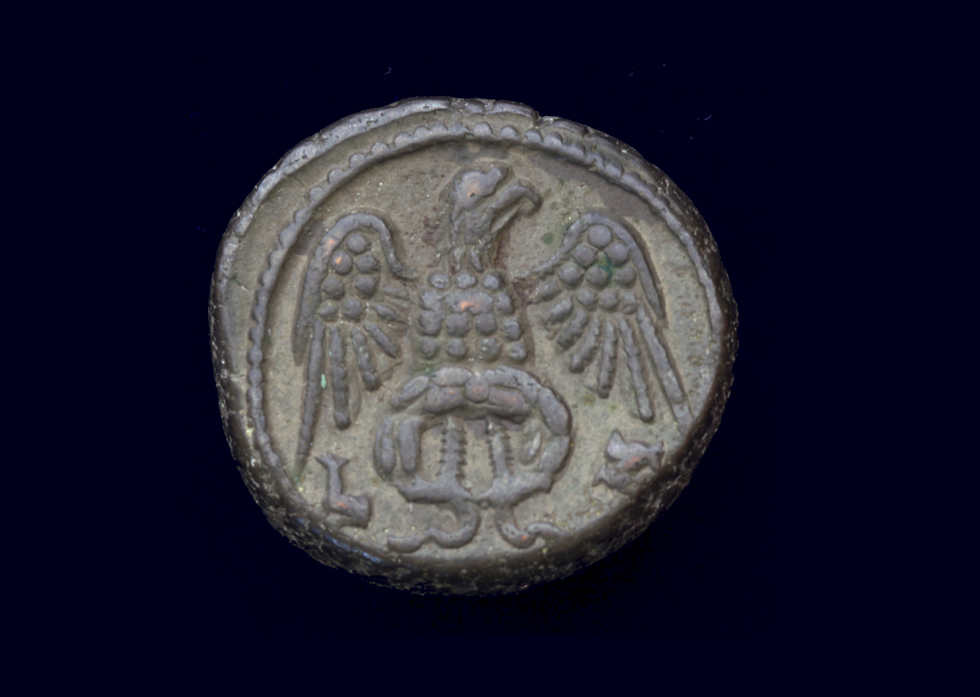
Here is one coin that is photographed in Ghey's catalog and therefore we can see before (9.48g) and after cleaning (9.38g). This coin is also fun because it is the only example of its type in the hoard.


The hoard was likely buried circa 307, amidst the events of Constantine I's acclamation as Caesar in Eboracum in 306 and his subsequent elevation to the rank of Augustus in December 307.
Evidence of a "Ritual" Burial Ceremony
Unlike many hoards that are simply buried in a hole, the Rauceby hoard was placed in a specially prepared construction, suggesting a ceremonial or votive deposit rather than emergency concealment.
The Limestone Chamber: The pot was not just dropped in the dirt; it was placed on a level, constructed platform of limestone blocks within a pit. It was then carefully packed around with more limestone.
Burnt Offering: Beneath the pot, on the limestone platform, excavators found a layer permeated with dark, burnt organic inclusions. This suggests that a food offering or something similar was burned in the pit before the pot was placed inside.
The "Satellite" Hoard (Hoard B)
A fascinating and unusual feature of this find was the discovery of a tiny, secondary hoard carefully tucked next to the main pot.
The Find: While the main pot contained ~3,099 coins, a separate group of exactly 10 coins was found carefully placed to one side within the limestone packing.
The Coins: These 10 coins were all "radiates" (a slightly older denomination), dating from AD 260–293 (reigns of Gallienus to Carausius). They were significantly older than the bulk of the main hoard.
Interpretation: These may have been a "closing deposit" or perhaps older coins that were sorted out of the main group and set aside during the burial ritual.
The "Money Box" Lid
The vessel itself was covered in a way that suggests it may have been intended to be accessed or added to, rather than sealed forever.
The Tile: The pot was covered by a limestone roof tile that had a hole pierced through it.
Visibility: The excavators suggest the pot might have been left partially exposed or marked by the white limestone packing, and the hole in the lid could have allowed for the offering of libations (liquid offerings) or the insertion of additional coins, functioning almost like a "money box" or votive jar.
It is the Second Largest Hoard of its Type
With 3,099 coins, Rauceby is the second-largest fully recorded hoard of this specific period (Tetrarchic nummi) found in Britain, second only to the Evenley hoard (3,153 coins).
Composition: It represents a massive influx of coinage into Britain. The coins are dominated by the mints of Trier (47%) and London (28%).
It Captures a Moment of Inflation (The "Tail")
The hoard perfectly captures the moment Roman currency began to shrink due to inflation and imperial reforms.
The "Tail": The vast majority of the coins are large, heavy "unreduced" nummi (c. 10g). However, there is a small "tail" of about 50 coins at the very end of the hoard that are much smaller and lighter (reduced to c. 6–8g).
Dating: This mix of heavy and light coins allows the hoard to be dated very precisely to AD 307–308, right when Constantine I was consolidating power and reducing the weight of the coinage.
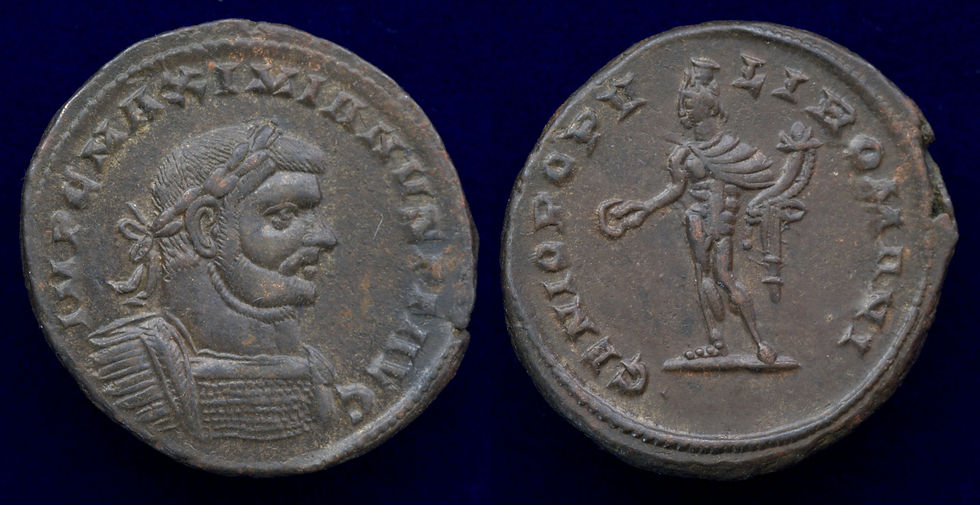
Maximianus. First reign, A.D. 286-305. Æ follis (26mm, 9.26g, 6h). London, ca. AD 300. Obv: IMP C MAXIMIANVS P F AVG, laureate and cuirassed bust of Maximianus right Rev: GENIO POPV-LI ROMANI, Genius standing facing, head left, holding patera and cornucopiae. Ref: RIC 6b. Dark brown patina Rauceby hoard 25.10.
This coin is not pictured in the publication but is listed in the catalog. It and example of Coin #25 from Rauceby and is likely the coin listed at 9.38g which is a little lighter after cleaning.


For more on the history of the Tetrarchy see this post: Head in Hand.


Comments