
Ancient Indian Elephants

The Coins
Today's coins of interest are two silver fractions from the same janapada, a third and a half, each with an elephant among its four punches. Both are fractions of a karshapana attributed to the Vidarbha janapada, the date on these is circa sixth to fifth century BC with some placed as late as fourth century. The coins belongs to a series that recent finds now assign to Vidarbha, the eastern arm of Maharashtra around modern Nagpur. A janapada is a people together with the country it holds, from jana, a clan, and pada, a foothold. These were the political units of early India, and several of them struck their own silver.
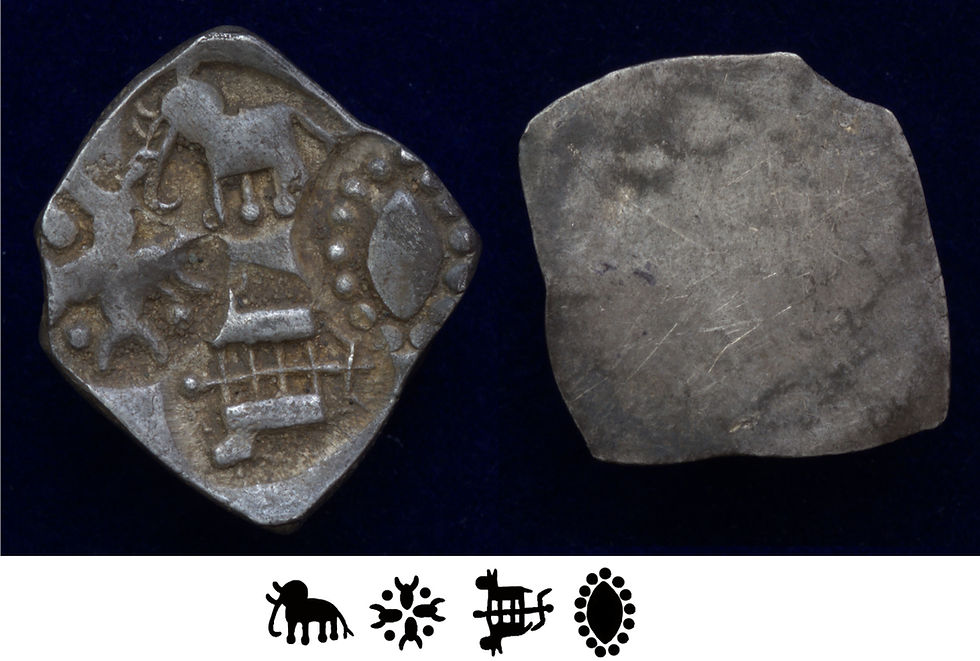
This second coin appears to have been struck over an older coin - as we can see clearly a different elephant on the reverse and remnants of other punches.

The elephant is the most common large animal in early Indian coinage. It recurs for some twenty-five centuries: among the punches of the imperial series that displaced these local coinages, on Satavahana copper struck in this same Deccan and Kushan bronze to the north, through the medieval dynasties, and on to the princely states, where Travancore and Mysore were still putting elephants on coins in the twentieth century.
The Arthashastra, a government handbook for the acquisition and management of power and wealth (Artha = material advantage; shastra = technical treatise) was compiled from older materials between the late centuries BC and the early centuries AD. It gives elephants and elephant forests a whole administrative establishment, and states the reason plainly:
"The victory of kings (in battles) depends mainly upon elephants; for elephants, being of large bodily frame, are capable not only to destroy the arrayed army of an enemy, his fortifications, and encampments, but also to undertake works that are dangerous to life."
-Arthashastra, Book II Chapter II, p.56
How it was made
A punch-marked coin begins as a blank of refined silver, cut from a hammered sheet or a flattened globule and trimmed until it makes weight; the irregular outline of this piece records that adjustment. Separate dies then strike it, each carrying one symbol, applied side by side wherever the flan offers room. Greek mints of the same era struck the whole design at one blow between two dies; the Indian method builds the design punch by punch, and the coins carry symbols in place of legends.
Weight and standard

The standard literature reckons the full silver karshapana at 32 rattis, the ratti being the scarlet seed of the gunja creeper (Abrus precatorius) at roughly 0.11 g, which yields a coin of about 3.4-3.5g, a half at 1.6-1.65g and a third of about 1.16-1.27g. Both coins sit in the upper end of the range for their denomination. Coins of third karshapana are also catalogued as halves on a reduced standard leaving an open question about weight standard. The Arthashastra describes a state mint issuing silver panas in fractions down to an eighth (Arthashastra 2.12).
"The superintendent of mint (lakṣaṇādhyakṣa) shall carry on the manufacture of silver coins (rūpyarūpa) made up of four parts of copper and one-sixteenth part (māṣa) of any one of the metals, tīkṣṇa, trapu, sīsa, and añjana. These shall be a paṇa, half a paṇa, a quarter and one-eighth."Vidarbha

Vidarbha is the black-soil plain of eastern Maharashtra, the districts around Nagpur, Amravati and Wardha, drained by the Wardha and Wainganga rivers on their way south to the Godavari. The name is old. The Aitareya Brahmana, a late Vedic ritual text, names Bhima of Vidarbha among five kings whom the sages Parvata and Narada taught the use of a substitute for the soma plant (Aitareya Brahmana 7.34).
Written sources have little to say about Vidarbha. The Buddhist list of sixteen great states (mahajanapadas, the great janapadas) in the Anguttara Nikaya, the usual starting point for the political map of India about 500 BC, includes Assaka on the middle Godavari and passes over Vidarbha. The Vidarbha capital, Kundina, survives in the village name Kaundinyapur, on the Wardha river roughly 40 km east of Amravati. M.G. Dikshit excavated the mound there in the early 1960s and reported punch-marked coins among the finds (Dikshit 1968).
From Andhra to Vidarbha
These coins first entered the literature under another name: Andhra. Dilip Rajgor's 2001 placed these types with the material known from a single hoard found in Andhra. More finds surfaced within Vidarbha, and in 2004 Prashant Kulkarni gathered them and moved the series to Vidarbha in the Oriental Numismatic Society Newsletter. The CoinIndia galleries, maintained by Pankaj Tandon, follow the reassignment and record half karshapanas of 1.60-1.65 g and thirds of 1.09-1.27g. Kulkarni returned to the material at book length in Archaic Coinage of Godavari Valley and the Deccan (2022); hoards, weight systems, manufacture and re-struck coins are among its subjects.
The end of the series
The usual explanation for the end of such local series is Magadhan expansion: by the mid third century BC Ashoka held the Deccan, and the imperial karshapana with its five punches displaced local silver. When Vidarbha next surfaces in literature it is as a kingdom at war with the Shungas about 150 BC, in the plot of Kalidasa's play Malavikagnimitra, written centuries after the events it stages.
References
Aitareya Brahmana. Translated by Martin Haug as The Aitareya Brahmanam of the Rigveda, vol. 2. Bombay: Government Central Book Depot, 1863.
Anguttara Nikaya. Translated by Bhikkhu Bodhi as The Numerical Discourses of the Buddha. Somerville, MA: Wisdom Publications, 2012.
Kalidasa. Malavikagnimitra. Translated by C.H. Tawney as The Malavikagnimitra: A Sanskrit Play by Kalidasa. 2nd ed. Calcutta: Thacker, Spink, 1891.
Arthashastra. Translated by R. Shamasastry as Kautilya's Arthashastra. Bangalore: Government Press, 1915.
Dikshit, Moreshwar G. Excavations at Kaundinyapura. Bombay: Director of Archives and Archaeology, Maharashtra State, 1968.
Kulkarni, Prashant P. "Coins of Vidarbha Janapada." Oriental Numismatic Society Newsletter 178 (Winter 2004): 40-45.
Kulkarni, Prashant P. Archaic Coinage of Godavari Valley and the Deccan. Nagpur: Eternal Arts and Coins, 2022.
Rajgor, Dilip. Punch-marked Coins of Early Historic India. California: Reesha Books International, 2001.
Tandon, Pankaj. "The Coin Galleries: Vidarbha Janapada." CoinIndia.


Fascinating coins that can say more with symbols than words 🤩!