
Hyrcodes: A Nomad King

This small silver coin was struck in Central Asia, in the lands north of the Oxus river (the modern Amu Darya), by a ruling house of nomad origin. Older catalogues and the dealer's ticket assign it to the Dahae, a nomad people of the steppe east of the Caspian, ruling in Choresmia (Khwarezm, the river oasis on the lower Amu Darya, south of the Aral Sea under a king called Hyrcodes and date it to about 120 BC. Both the attribution and the date are disputed, as set out below.
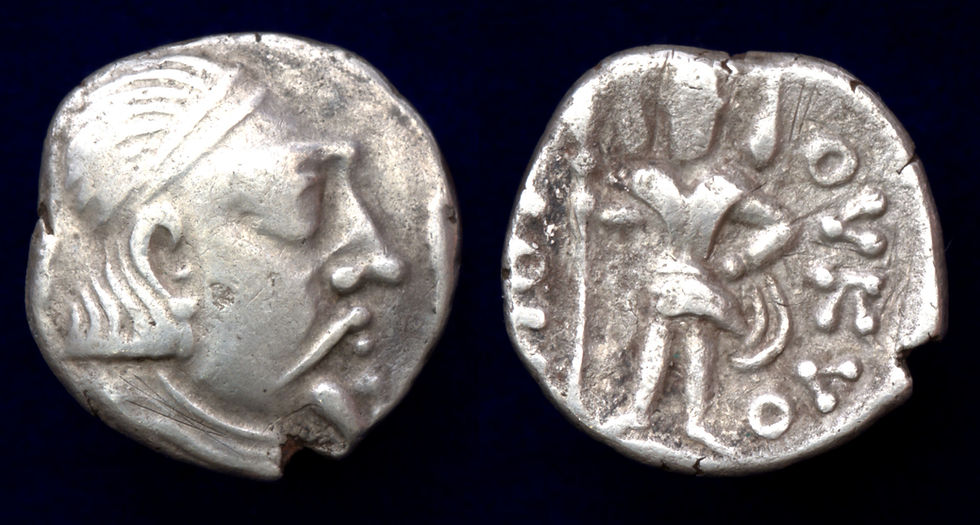
Central Asia, Choresmia or Sogdiana, uncertain mint, Hyrcodes (?) (nomad ruler; date disputed, between the late second century BC and the first century AD), AR hemidrachm or reduced drachm (1.68g).
Obv: no legend visible; male head right, hair bound with a diadem or headband and swept back to a mass at the nape; long drooping moustache.
Rev: degraded Greek legend in two vertical lines, the right line showing OVKVO; male figure standing facing, wearing a belted knee-length coat, holding a long spear upright in his right hand, left hand on hip; a curved object at his left side, perhaps a sword or the end of a cloak.
Ref: Senior, Indo-Scythian Coins and History, A10.1; Mitchiner, The Early Coinage of Central Asia, 32; Mitchiner, Indo-Greek and Indo-Scythian Coinage, 671; Mitchiner, Ancient Trade and Early Coinage, 1575.
Context
I find it easy to get lost in the overarching narrative of the people of the central Asian steppes - so I created this interactive view to try to get a better understanding of why this coin might look so much like a coin of the Gupta empire, more than 500 years later.
The Portrait
The diademed royal profile on the obverse and the Greek alphabet on the reverse continue the conventions of the Greco-Bactrian kings, whose silver circulated widely north of the Oxus. Earlier Sogdian mints (the Zeravshan and Kashkadarya valleys around Samarkand and Bukhara) had already copied the coins of the Bactrian king Euthydemos I, replacing his Greek legend with Aramaic script; the Hyrcodes series instead kept Greek.
The long moustache and the hair swept back from a band differ from the clean-shaven Greek royal portrait and have been compared, by collectors and some specialists, with the coin portraits of Heraios, a Yuezhi prince, often counted as an early Kushan ruler of the late first century BC or early first century AD. Some specialists cite the resemblance in favor of a first century AD date.

On the better-made drachms of this series the king's name appears behind the portrait in the Greek genitive, ΥΡΚΩΔΟΥ, "of Hyrkodes." On this specimen no obverse legend survives which leaves some doubt about the king on the obverse.
The "Soldier"
The reverse figure is usually described as a soldier. On some better-preserved specimens of the series, flames appear to rise from the figure’s shoulders, and this coin seems to show them. This motif is one that later Kushan coins use for kings and deities. The figure may be a god or a deified ruler.
The legend on this coin shows recognizable Greek Letter shapes, OVKVO, that do not spell a word. A plausible reading of this is that the engravers were copying letter forms that they couldn't read.
Where it sits in the series
Michael Mitchiner, in The Early Coinage of Central Asia (1973), arranged these coins as a "soldier series" in four groups. No. 30 is the full-weight drachm naming the king, with British Museum specimens weighing about 2.7 to 3.2 g. No. 31 is an anonymous drachm with Greek legends. No. 32 is a reduced-weight drachm with degraded legends, with British Museum specimens of about 1.1 to 1.9 g. No. 33 is an anonymous coin in rough style with the legend degraded or absent.
Weight Standard
This coin, at 1.68 g, falls in the weight range of Mitchiner 32. Mitchiner called these light pieces reduced drachms. In Mitchiner's weight tables the drachm of the region begins on the Attic standard, about 4.2 g, and declines to about 3 g over the last three centuries BC. Choresmian coinage, in his reading, kept to the Attic standard longer than its neighbors in Bactria and Sogdiana.
Greek Letters
Using the sequence of types, Mitchiner proposed that after the nomad migrations of about 130 BC, Greek engravers displaced from Bactria came to work for the new rulers, improving flans and style and introducing Greek legends; in his scheme the standing soldier replaced the archer of an earlier series.
The attribution question
Mitchiner's attribution to the Dahae is now questioned. Coins of the Hyrcodes series are reported chiefly from the area of Bukhara, in the Zeravshan valley of western Sogdiana, and many modern catalogues list them under "Bukhara Sogd." Bukhara lies about 390 km in a straight line southeast of Khiva, the historic center of Khwarezm.
Some catalogues place the series in the first century AD or later. A later date would make Hyrcodes a contemporary of the early Kushan rulers to the south. With no written source documenting the reign of Hyrcodes, the date rests on die style, weight, findspots and comparison with dated coinages.
Who were the Dahae and the Choresmians?
Greek writers knew the Dahae as nomads of the steppe east of the Caspian Sea. Herodotos lists among the Persian peoples "the Dai, the Mardi, the Dropici, the Sagartii, all wandering herdsmen" (Histories 1.125, trans. A. D. Godley).
Strabo, writing under Augustus, gives the fullest description: "Now the greater part of the Scythians, beginning at the Caspian Sea, are called Däae, but those who are situated more to the east than these are named Massagetae and Sacae" (Geography 11.8.2, trans. H. L. Jones). He adds that of the Däae, "some of them are called Aparni, some Xanthii, and some Pissuri."
One of those groups founded an empire. Strabo reports that "Arsaces, a Scythian, with some of the Däae (I mean the Aparnians, as they were called, nomads who lived along the Ochus), invaded Parthia and conquered it" (Geography 11.9.2, trans. Jones).
In Strabo's account, then, the Parthian Arsakid dynasty traced its origin to the same nomad world as the issuer of this coin.
The Choresmians appear in the Persian tribute lists. Herodotos records that "The Parthians, Chorasmians, Sogdi, and Arii were the sixteenth, paying three hundred" talents of silver (Histories 3.93, trans. Godley). After the Persian empire fell, a Choresmian ruler dealt with Alexander directly: "At this time also came Pharasmanes, king of the Chorasmians, to Alexander with 1,500 horsemen," offering to guide him toward the Black Sea (Anabasis 4.15.4, trans. E. J. Chinnock). Alexander declined and made an alliance with him instead.
The nomad migrations
The coin belongs to the period after the Greek kingdom of Bactria fell to nomad invaders in the second half of the second century BC. Strabo names the invaders:
"But the best known of the nomads are those who took away Bactriana from the Greeks, I mean the Asii, Pasiani, Tochari, 4 and Sacarauli, who originally came from the country on the other side of the Iaxartes River that adjoins that of the Sacae and the Sogdiani and was occupied by the Sacae."
- Strabo, Geography 11.8.2, trans. Jones. 
Chinese sources record that the Xiongnu, the confederation that ruled the Mongolian steppe, had already defeated the Yuezhi by 176 BC, the date of a letter from the Xiongnu ruler Modu preserved in the Shiji (chapter 110). His son Laoshang, who reigned from 174 to about 161 BC, killed the Yuezhi king and had his skull made into a drinking cup. The Yuezhi left their homeland between Dunhuang and the Qilian mountains in Gansu and moved west.
Sima Qian records the episode in one sentence:
“Lau-shang, Shan-yu of the Hsiung-nu, killed the king of the Yue-chi and made a drinking vessel out of his skull”
- Shiji 123, trans. Friedrich Hirth, 1917
The Chinese envoy Zhang Qian reached the Yuezhi around 129 to 128 BC and found their king’s court on the north bank of the Oxus. On his way he crossed Kangju, which his report places north of Dayuan (the Ferghana valley). The Greek city at Ai Khanoum on the upper Oxus was abandoned about 145 BC, a date archaeologists derive from coin finds and inscriptions on the site. How these events map onto particular coin series, including this one, remains a matter of interpretation.
Sources
Arrian. The Anabasis of Alexander. Translated by E. J. Chinnock. London: Hodder and Stoughton, 1884.
Classical Numismatic Group. Electronic Auction 441. Lancaster, PA, and London, 2019. Lot 224.
de Blois, François, and Willem Vogelsang. “Dahae.” In Encyclopaedia Iranica, vol. 6, fasc. 6. Costa Mesa, CA: Mazda Publishers, 1993.
Herodotos. Herodotus. Translated by A. D. Godley. 4 vols. Loeb Classical Library. Cambridge, MA: Harvard University Press, 1920 to 1925.
Hirth, Friedrich. “The Story of Chang K’ien, China’s Pioneer in Western Asia.” Journal of the American Oriental Society 37, no. 2 (1917): 93 to 116.
Mitchiner, Michael. Ancient Trade and Early Coinage. 2 vols. London: Hawkins Publications, 2004.
Mitchiner, Michael. The Early Coinage of Central Asia. London: Hawkins Publications, 1973.
Mitchiner, Michael. Indo-Greek and Indo-Scythian Coinage. 9 vols. London: Hawkins Publications, 1975 to 1976.
Senior, R. C. Indo-Scythian Coins and History. 3 vols. Lancaster, PA, and London: Classical Numismatic Group, 2001.
Strabo. The Geography of Strabo. Translated by H. L. Jones. 8 vols. Loeb Classical Library. Cambridge, MA: Harvard University Press, 1917 to 1932.


Comments