
The Deccan

Updated: Feb 19

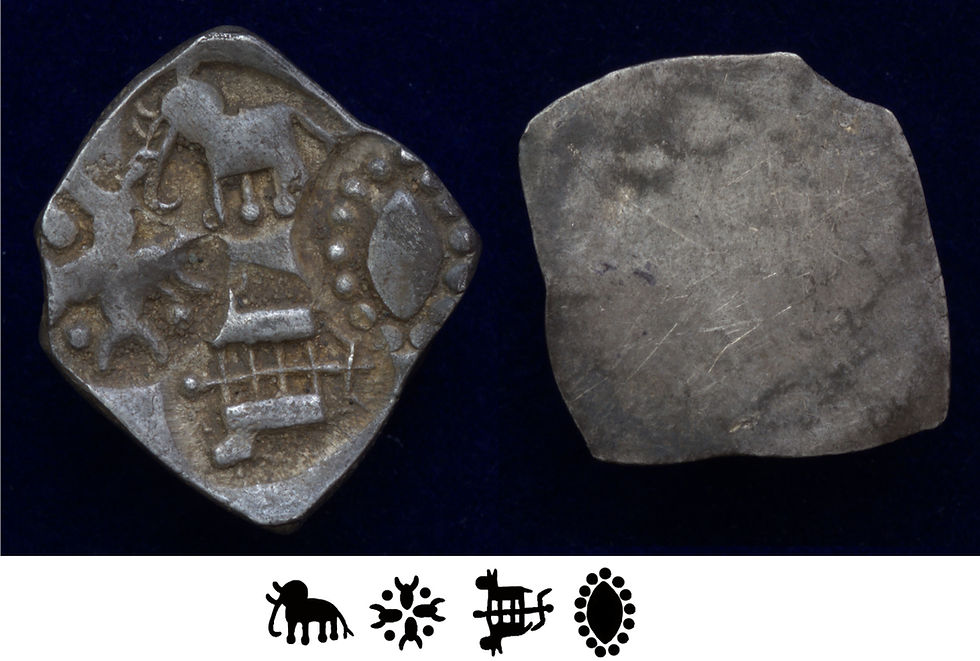
Today's over-struck coins of interest are small silver coins, ~2g of silver each, with competing legends & no beautiful portrait. Anyone looking for a Sicilian work of art will not pause to look at these coins. However, if we do look a little closer, we will find an interesting story of invasion, dramatic battles, and psychological warfare. Before we get to this coin - a survey of the history of the Deccan Plateau.

The Geology
The Deccan Plateau is the massive, elevated tableland that occupies the vast majority of the interior of the Indian peninsula. The word "Deccan" is an anglicized version of the Prakrit word dakkhin, which derives from the Sanskrit dakshina, meaning "south." Geologically, it is a staggering formation - a huge shield of ancient volcanic rock. Geologists call this region the Deccan Traps. It is one of the largest volcanic features on planet Earth.
66 Million Years Ago, long before humans existed, around the time that the dinosaurs were being wiped out, the landmass of India was an island rapidly drifting northward across the ocean toward Asia. This drifting Indian plate passed directly over a massive "hotspot" deep within the Earth's mantle.
Gigantic cracks opened up in the ground, some of them dozens of miles long, and unimaginable volumes of highly fluid basaltic lava just poured out. The lava flowed, stopped, cooled, and then millions of years later, another fissure would open, pouring new lava over the old crust and eventually covered an area of roughly 500,000 square kilometers. In the western part of the Deccan, near modern-day Mumbai, these stacked layers of cooled lava are more than two kilometers (over 6,500 feet) thick.
About 50 million years ago the Indian Plate slammed into the Eurasian continental plate. This was a violent, high-speed tectonic collision that crumpled the earth's crust, shoving the ancient sea floor into the sky and creating the Himalayan Mountains and the Tibetan Plateau.
The Deccan Traps
The word "Traps" comes from the Swedish word trappa, meaning "stairs." Because the lava flowed in distinct, massive waves over millions of years, the landscape eroded into giant, flat-topped hills with steep, stair-step sides. These hills act as a natural fortress, ringed by the Vindhya and Satpura Mountains to the north, the steep Western Ghats along the coast, and the broken Eastern Ghats to the east. Over millennia, the weathered basalt produced a dark, mineral-rich soil called Regur - incredibly fertile, ideal for growing cotton. That cotton would eventually be spun, woven, and traded to the Roman Empire for gold and silver.
"in no year does India drain our empire of less than five hundred and fifty millions of sesterces, giving back her own wares in exchange, which are sold among us at fully one hundred times their prime cost."
- Pliny,writing circa 77-78 BCE in Natural History, 6.101
The Deccan Plateau is not a single uniform tableland; it is a mosaic of river valleys, basalt and granite uplands, seasonal monsoon rhythms, and pockets of better-watered corridors. For thousands of years, while the plateau supported a slow progression from hunter-gatherers to copper-age farming chiefdoms - cultures like the Jorwe and Malwa, with their millet fields, cattle herds, and distinctive Black-on-Red pottery - a radically different story was unfolding beyond the Vindhya Mountains.
The Rise of the Mahajanapadas
The North was a vast, flat, fertile canvas and civilizations were scaling up fast. The Indus Valley cities of Harappa and Mohenjo-Daro had already risen and fallen. The Vedic Age had swept the northern plains, laying down the rigid social order of the caste system and composing the Vedas.
By roughly 1000 BCE, northern populations had mastered iron smelting - a geopolitical game-changer. Iron axes and heavy plows tore open the dense jungles of the Ganges Valley, transforming it into a massive agricultural engine.

By circa 600 BCE, those northern, iron-wielding tribal lands had aggressively consolidated into the Mahajanapadas - sixteen fiercely competitive, wealthy kingdoms and republics dominating the Ganges plain.
The resulting explosion of wealth built cities, established trade arteries reaching toward the Silk Road and the Mediterranean, and inevitably turned northern eyes southward - toward the volcanic riches and coastal ports of the Deccan.

Buddhism
This high-stakes, hyper-competitive northern environment birthed revolutionary thinkers like the Buddha. The Buddha challenged the rigid Vedic varna system that restricted social mobility and compartmentalized ancient Indian society. By emphasizing personal conduct, morality, and ethical living over birth-based status, Buddhism offered a radically inclusive spiritual path - one that appealed across social boundaries, from kings and warriors to ascetics, farmers, and urban professionals.
Buddhism's appeal was broad, but its relationship with the emerging merchant class was particularly significant. The boom in urbanization and iron-tool agriculture had created a newly wealthy class of traders and artisans who held economic power but occupied a lower rung in the traditional Vedic hierarchy. Buddhism offered them spiritual legitimacy and a religious community that valued generosity and ethical conduct over bloodline. Merchant guilds became major patrons of Buddhist monasteries, and monasteries in turn became nodes of economic and social organization - hostels along trade routes, centers of literacy, and neutral ground for commercial exchange.
Buddhism did not rise in order to fund empires. But the practical effect was transformative. The same networks of trade, urbanization, and mercantile wealth that Buddhism thrived within also generated the tax revenues and administrative infrastructure that powerful states could harness. When the Mauryan Empire rose in the late fourth century BCE, it inherited a northern India that was wealthier, more urbanized, and more commercially interconnected than ever before - and it was that engine of wealth and organization that would eventually fuel Mauryan expansion southward into the Deccan.

The Mauryan Empire
In 322 BCE, Chandragupta Maurya founded the Mauryan Empire. A few years earlier, Alexander the Great had marched into northwestern India, smashed the local kingdoms, and retreated - leaving behind a massive power vacuum. Chandragupta seized the moment, overthrowing the Nanda Dynasty in the north and building a formidable military state. He then fought Alexander's successor, Seleucus I Nicator, soundly defeating the Greeks and securing India's northwestern frontier.
The empire peaked under Chandragupta's grandson, Ashoka the Great (r. 268–232 BCE). Early in his reign, Ashoka launched a spectacularly bloody campaign to conquer the region of Kalinga (modern-day Odisha). The scale of the slaughter - ancient sources describe hundreds of thousands killed or displaced -triggered a profound personal crisis. Ashoka converted to Buddhism, renounced wars of conquest, and spent the rest of his reign governing through Dhamma (righteousness or moral law). He erected inscribed stone pillars across the subcontinent - among the earliest deciphered examples of written edicts in ancient India.
At its height, his empire stretched from the borders of modern-day Iran and Afghanistan in the northwest deep into the Deccan Plateau. Like many highly centralized empires, the Mauryan state was only as strong as the man on the throne. After Ashoka's death, a succession of weaker kings could not hold it together. The bureaucracy and standing army grew too expensive, and the outer provinces began breaking away. The final blow came in 185 BCE: the last Mauryan emperor, Brihadratha, was reviewing his troops when his own commander-in-chief, Pushyamitra Shunga, assassinated him on the parade ground.
The Satavahanas


The assassination in 185 BCE broke the unified map of India. The subcontinent splintered back into regional powers. And it was this geopolitical fragmentation that allowed the Satavahanas in the Deccan Plateau to rise up and claim independence. The Satavahanas built an empire that stretched straight across the Deccan Plateau, from the Arabian Sea to the Bay of Bengal.

What makes them fascinating to historians is their social ambiguity. The Puranas, ancient texts, describe the dynasty's founder as low-born, yet Gautamiputra Satakarni's own mother claimed him as eka-brahmana - the peerless Brahmin. Whatever their origins, the Satavahanas governed as warrior-kings while asserting priestly authority, performing grand Vedic sacrifices like the ashvamedha even as they lavished patronage on Buddhist monasteries. They defied the clean boundaries of varna in practice, even while publicly upholding them.
They were fiercely proud of their orthodox Hindu roots, but they were also incredibly pragmatic. They knew you couldn't rule a vast, diverse empire by alienating people. So, while they performed massive Vedic horse sacrifices to prove their kingship, they simultaneously poured vast amounts of money into sponsoring Buddhist monasteries. They bought peace and loyalty through religious tolerance.

The Satavahanas and their successors used the sheer cliffs of this volcanic rock to carve out spectacular rock-cut architecture, like the Ajanta caves. They literally carved massive, multi-story Buddhist monasteries and Hindu temples straight into the ancient lava flows.
The Western Kshatrapas

Nahapana was a Saka, one of the Indo-Scythian warlords whose ancestors had swept down from Central Asia a couple of centuries earlier. By the early first century, Nahapana had carved out a powerful domain in what is now Gujarat, Maharashtra, and Rajasthan.
He was a patron of trade, a builder, a man who inscribed his donations in caves at Nasik and Junnar. His coins circulated everywhere. Beautiful Greek-style silver drachms, with his portrait on one side and a thunderbolt and arrow on the other, legends in both Greek and Brahmi script. These were the currency of western Indian commerce circulating amongst traders, merchants, port cities stretching from Barygaza to the Red Sea.
The Conflict
By Nahapana's time, the Satavahanas had been pushed out of their northwestern territories by the Saka. But the Satavahanas would not accept that loss. A remarkable inscription by Queen Gautami Balashri, carved into a cave at Nasik, brags about what her son did next.


Gautamiputra Satakarni launched a devastating campaign against Nahapana, probably sometime around 124 CE. He smashed the Western Kshatrapa forces and recaptured the rich territories of western Maharashtra, Konkan, and beyond. It was a total rout.
Gautamiputra captured enormous quantities of Nahapana's coinage and struck his own designs on top of them. He obliterated Nahapana's Greek-style portrait and replaced it with the Satavahana symbol: a hill with three arches, a pellet in each. On the reverse, the Ujjain symbol surmounted by a crescent - a deeply Indian, deeply Deccani emblem - stamped over the foreign imagery.
However, he didn't erase everything. Remnants of Nahapana's original legend are still visible, ghosting through the new king's designs - the old king's name and titles bleeding up through the Satavahana symbols. Whether this was deliberate messaging or simply a limitation of the overstriking process, the practical effect was the same: every coin that passed through the markets of western India carried the visible evidence of one king's authority stamped over another's. Gautamiputra replaced foreign, Greek-influenced imagery with deeply Indian, Deccani symbols on a massive scale - and he did it using his enemy's own silver.
Of the coins that came into my hands (~13,500) about 9,270 are coins of Nahapāna the Kṣaharāta, counter-marked by his conqueror Gotami-putra Śrī Sātakarṇi. The remainder, nearly 4,000 coins, are coins of Nahapāna which have not been so counter-stamped.
-Scott, The Nasik (Jogalthembi) Hoard, 1908
The scale of the overstriking was enormous. A hoard, discovered at Jogalthambi in Nasik district, contained more than 13,500 coins ~68% of which were overstruck. A hoard of that size points to the capture of a substantial portion of the Western Kshatrapa treasury - and Gautamiputra's systematic conversion of that silver into Satavahana currency. Whatever his motives, the effect was both economic and symbolic: Nahapana's coinage, the commercial backbone of western India, was being physically remade under new authority.
Gautamiputra ruled at the peak of Satavahana power. He was a Brahmin by lineage - his name, Gautamiputra, "son of Gautami," reflects a distinctive Satavahana practice of identifying kings through their mothers. He patronized Buddhism while upholding Brahmanical social order. His mother's inscription at Nasik calls him eka-brahmana, the "peerless Brahmin" - a man who, in her words, destroyed the Sakas, the Yavanas, and the Pahlavas, and restored the glory of the Satavahana line. It is a mother's boast, carved into the wall of a Buddhist cave.
The ports along the western coast - Sopara, Kalyan - were the exit points for what has been called "the Cotton Road". Spices, cotton textiles, ivory, and precious stones flowed out. Roman gold and silver flowed in. Hoards of Roman coins and artifacts found across the Deccan attest to the scale of trade.


Gautamiputra's reconquest secured that trade for the Satavahanas, and the dynasty endured for another century after his reign. But the northwestern territories he had recaptured proved harder to hold. Within a generation, a new Saka dynasty - Chastana's Kardamaka line, replacing Nahapana's destroyed Kshaharata family - clawed back lost ground under Rudradaman I. The cycle of conquest and reconquest would continue across the Deccan for centuries.
"It is curious and interesting to find that the famous Mahākṣatrapa Rudradāman in his inscription at Girnār claims to be just such an-other king as Sātakarṇi is here described, and to have ruled over practically the same immense district. Rudradāman also claims to have twice conquered Sātakarṇi, the lord of the Deccan, and to have refrained from destroying him only on account of his being a near relative. It is probable that the Sātakarṇi who was defeated by Rudradāman was a grandson of the Sātakarṇi of these coins."
-Scott, The Nasik (Jogalthembi) Hoard, 1908
The empires are gone. The coin remains - two kings' names on one small disc of silver, the conqueror's stamp and beneath it the faint ghost of the conquered. That is the story of this coin.

References
Sheth H, Tripathi SC. Deccan Traps. IUGS International Commission on Geoheritage. Accessed February 15, 2026.
Alam, Muzaffar. “Ashoka’s Edicts.” Encyclopaedia Britannica. Last updated February 13, 2026.
Bhandarkar, R. G. A Peep into the Early History of India: From the Foundation of the Maurya Dynasty to the Downfall of the Imperial Gupta Dynasty (322 B.C.–circa 500 A.C.). Preface by H. G. Rawlinson. Bombay: D. B. Taraporevala Sons & Co., 1920.
Epigraphia Indica and Record of the Archaeological Survey of India. Vol. VIII. Edited by E. Hultzsch. Published under the authority of the Government of India as a supplement to The Indian Antiquary. 1905–1906 (vol. date as commonly cited for Vol. VIII).
Bud, Guy. “Evidence for Cultural Influence and Trade in the Coinage of the Western Kshatrapas.” Berkeley Undergraduate Journal of Classics 3 (1), 2014.“Evidence for Cultural Influence and Trade in the Coinage of the Western Kshatrapas.”
“Satavahana dynasty.” Encyclopaedia Britannica. Article revised and updated March 5, 2009.
Fuller, Dorian Q., Nicole Boivin, and Ravi Korisettar. “Dating the Neolithic of South India: New Radiometric Evidence for Key Economic, Social and Ritual Transformations.” Antiquity 81, no. 313 (2007): 755–778. Accessed February 15, 2026.
Haslam, Michael, Chris Clarkson, Michael Petraglia, Ravi Korisettar, Sacha Jones, Ceri Shipton, Peter Ditchfield, and Stanley H. Ambrose. “The 74 ka Toba super-eruption and southern Indian hominins: archaeology, lithic technology and environments at Jwalapuram Locality 3.” Journal of Archaeological Science 37, no. 12 (December 2010): 3370–3384.
Haslam, Michael, Chris Clarkson, Richard G. Roberts, Janardhana Bora, Ravi Korisettar, Peter Ditchfield, Allan R. Chivas, Clair Harris, Victoria Smith, Anna Oh, Sanjay Eksambekar, Nicole Boivin, and Michael Petraglia. “A southern Indian Middle Palaeolithic occupation surface sealed by the 74 ka Toba eruption: Further evidence from Jwalapuram Locality 22.” Quaternary International 258 (May 1, 2012): 148–164.
Jha, Gopesh, Mafalda Costa, Anna Tsoupra, Cristina Barrocas Dias, Ola Kwiecien, Jack Longman, Sebastian F. M. Breitenbach, Peter Ditchfield, Deepak Kumar Jha, Rachel Rudd, Devara Anil, Roshan Paladugu, Sindu Shree, Hema Achyuthan, Rachna Raj, K. Krishnan, Nicole Boivin, Patrick Roberts, and Michael Petraglia. “Seasonally resolved stratigraphy at Jwalapuram India shows regional surface warming after the Toba volcanic super-eruption.” PNAS Nexus 4, no. 4 (April 2025): pgaf109.
Paddayya, K. “The Acheulian Culture of the Hunsgi-Baichbal Valleys, Peninsular India: A Processual Study.” Quartär: International Yearbook for Ice Age and Stone Age Research 41/42 (1991): 111–138.
Pappu, Shanti, Yanni Gunnell, Kumar Akhilesh, Régis Braucher, Maurice Taieb, François Demory, and Nicolas Thouveny. “Early Pleistocene presence of Acheulian hominins in South India.” Science 331, no. 6024 (March 25, 2011): 1596–1599.
Petraglia, Michael D., Chris B. Stringer, Robert Grun, Patrick J. O’Doherty, Simon A. L. D. J. McNabb, et al. “Out of Africa: new hypotheses and evidence for the dispersal of Homo sapiens along the Indian Ocean rim.” Annals of Human Biology 37, no. 3 (2010): 288–311.
Rama Rao, M. Select Satavahana Coins in the Government Museum, Madras. Bulletin of the Madras Government Museum, New Series, General Section, Vol. VII, No. 2. Chennai: Commissioner of Museums, Government Museum, 1959.
Rapson, E. J. Indian Coins. Strassburg: Verlag von Karl J. Trübner, 1898.
Singh, Upinder. “Inscriptions of Ashoka.” In Encyclopédie des historiographies: Afriques, Amériques, Asies, edited by Nathalie Kouamé, Éric P. Meyer, and Anne Viguier. Paris: Presses de l’Inalco, 2020.
Singh, Upinder. Inscribing Power on the Realm: Royal Ideology and Religious Policy in India c. 200 BCE–300 CE. 28th J. Gonda Lecture (June 2022). Royal Netherlands Academy of Arts and Sciences (KNAW), 2022.
Skinner, Michael C. Urbanization and Interactions in the Early Historic Deccan: The Sātavāhana, Western Kṣatrapa, and Ikṣvāku Dynasties. M.A. thesis, University of Washington, 2012.
Sudyka, Joanna. “The ‘Megalithic’ Iron Age Culture in South India—Some General Remarks.” Analecta Archaeologica Ressoviensia 5 (2010 [published 2011]): 1–43.
“The Nāsik Hoard of Nahapāna’s Coins.” Journal of the Royal Asiatic Society 40, no. 2 (April 1908): 550–551. https://doi.org/10.1017/S0035869X00080692
UNESCO World Heritage Centre. “Serial nomination for Ashokan Edict sites along the Mauryan Routes.” Tentative Lists. Date of submission February 11, 2025.
Velliah, Radhakrishnan Ponniah. Satavahana Coins: Information Brochure: 7. Mumbai: RBI Monetary Museum, November 2019.
H. R. Scott, "The Nasik (Jogalthembi) Hoard of Nahapana's Coins," Journal of the Bombay Branch of the Royal Asiatic Society (JBBRAS), vol. 22, 1908, pp. 223–244.
Pankaj Tandon, How to read the legends on coins of the Western Kshatrapas: A Beginner's Guide
CoinIndia.Com, Western Kshatrapas (source for translations of the reverses on coins of the Western Kshatrapas)
R.C. Senior, Indo-Scythian Coins and History, CNG, 2001


Comments