
An Anonymous Dirham from 197 AH

The World in the 8th Century

The Umayyads were the ruling dynasty of the Islamic caliphate. The family, descended from Umayya of the Quraysh, had governed the empire from Damascus since 661 CE. The reigning caliph was al-Walīd I (r. 705–715). In 711 CE, the governor of Ifrīqiya, Mūsā ibn Nuṣayr, pushed west with a largely Berber force led by the Berber commander Ṭāriq ibn Ziyād, defeating the Visigothic king Roderic. Within roughly seven years all but the Asturian and Basque north was under Muslim rule, the new province taking the name al-Andalus.
In the Latin West, the Carolingians completed a generations-long climb from servants to sovereigns. They had begun as the Merovingians' mayors of the palace - hereditary stewards who held the real power behind a line of increasingly ornamental kings. In 751, with the support of the pope, Carolingian Pippin III deposed the last Merovingian, Childeric III, and had himself made king. Pippin's son Charlemagne conquered outward in every direction and was crowned emperor in Rome by Pope Leo III on 25 December 800 - the first emperor in the West in over three centuries.
Byzantium, battered, held on in Anatolia and the Balkans. The same century of conquests that had carried Islam from the Atlantic to the Indus had stripped the empire of Syria, Egypt, and North Africa, leaving it a hard core around the Aegean; and it had turned inward, convulsed by the Iconoclast controversy over the veneration of images. It was, in 750, a diminished but resilient survivor.
Abbasid Revolution
The Umayyad peak was short-lived, and in 750 CE the Abbasid revolution destroyed it and refounded the Islamic empire around a new capital, Baghdad (762). The Abbasids exterminated the Umayyad house. The dynasty's near-sole survivor was the young prince ʿAbd al-Raḥmān ibn Muʿāwiya, who fled the Levant, crossed the Euphrates under pursuit, and traversed Egypt and North Africa over some five years to his Berber mother's kin in the Maghrib.
From there he sent his client Badr to test the Syrian junds, crossed in 755, defeated the governor outside Córdoba in 756, and founded an independent amirate. ʿAbd al-Raḥmān and his successors ruled as amīr, "commander," and pointedly not as khalīfa: to claim the caliphate would have been to declare the Abbasid in Baghdad a usurper and to assert headship over all Islam - a provocation a fragile western regime could not enforce. That restraint is legible on the coin itself, for in Islam the two classic marks of a ruler's authority were the khuṭba, the naming of the sovereign in the Friday sermon, and the sikka, the right to strike his name on the coinage. The emirate dirhams exercise neither claim: they name God, the Prophet, the mint, and the year - but never the amir.
A nearly contemporary and hostile Carolingian ("the descendants of Charlemagne") view of Ibn Muʿāwiya can be found in The Chronicle of Moissac:
This Ibn Muʿāwiya [ʿAbd al-Raḥmān I] had defeated Yūsuf ibn ʿAbd al-Raḥmān [al-Fihrī] and killed him and his son, and reigned in his place in Spain for thirty-three years and four months [756–788]. This Ibn Muʿāwiya [ʿAbd al-Raḥmān I] was the cruellest of all the kings of the Saracens who had been before him in Spain. By various tortures he put to death countless Saracens and Moors. He even ordered his father's son — his own brother — to be burned with his hands and feet cut off. He so oppressed the Christians and Jews of Spain by exacting tribute that they sold their sons, daughters, and slaves, and the few who remained were reduced to want; and through his extortion all Spain was thrown into confusion and laid waste. (Note: a translated version of this text available for download Chronicon Moissiacense: )
The political order founded by ʿAbd al-Raḥmān I in 756 passed through his son Hishām I to his grandson al-Ḥakam I. Where Hishām had been remembered for piety, al-Ḥakam was a hard, worldly ruler who kept a standing palace guard, taxed heavily, and answered dissent with exemplary terror, from the massacre of Toledo's notables (the "Day of the Ditch," c. 797) to the crushing of the Córdoban suburb in 818. He inherited both the authority and the tensions of the emerging state.
This is the context for the coin: a full, legitimate sovereign coinage that conspicuously declines to name its sovereign.
A Coin from the Start of the 9th Century

Emirate of Córdoba (al-Andalus). Al-Ḥakam I (AH 180–206 / AD 796–822). AR Dirham (28 mm. 2.78 g). AH 197. al-Andalus (Córdoba).
Obv: Kalima in four lines; margin citing mint and date.
Rev: Sura al-Ikhlāṣ in four lines; margin citing Qur'an 9:33.
Ref: Vives 103; Frochoso 197.5; Vardanyan 221; Miles 1950a no.88c
Condition: Extremely fine (EBC+). Exceptional specimen. Old collection number in ink.
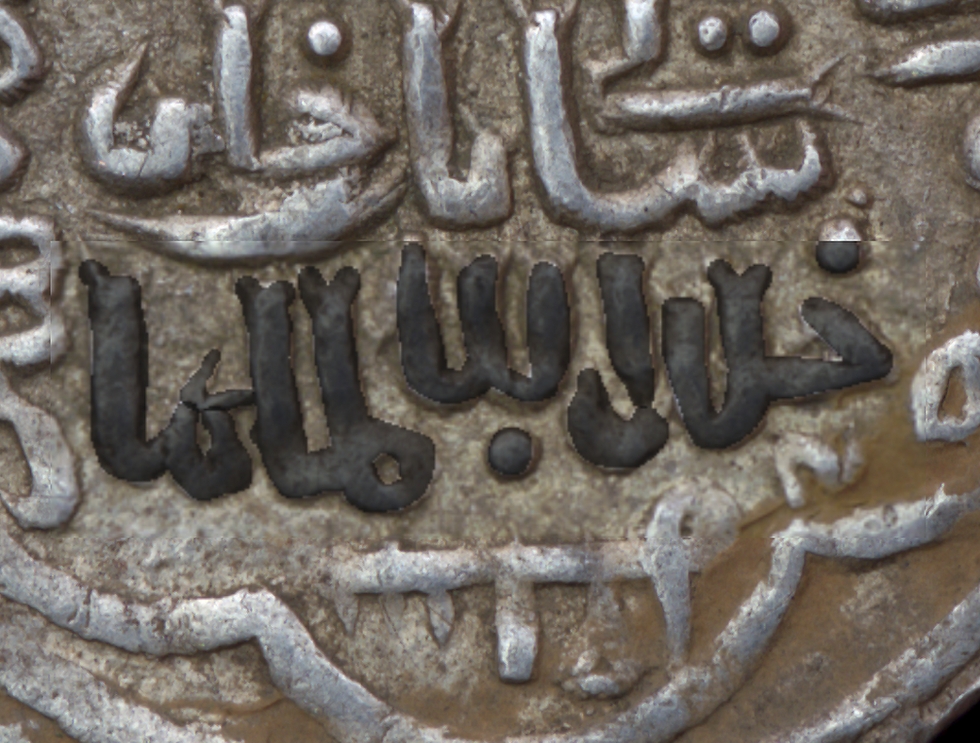
What the coin says is as deliberate as what it omits. The obverse field carries the kalima - "There is no god but God alone; He has no associate" - ringed by a margin naming the mint and year. The reverse field carries Sūrat al-Ikhlāṣ - "God is One, the Eternal; He begets not, nor is He begotten; and there is none like unto Him" - a creed read by many scholars as pointedly anti-Trinitarian, while the reverse margin gives Qur'an 9:33: God "sent His messenger with guidance and the religion of truth, that He might make it prevail over all religion." These are not decorative formulae but the standardized confession of the reformed Islamic coinage, and on a piece struck in the very year a Christian emperor was being crowned at Aachen and a truce signed with Córdoba, a legend proclaiming God's oneness over all religion is quietly eloquent.
The design itself was created by the caliph ʿAbd al-Malik's monetary reform of 77 AH (696–697), the template that al-Andalus was still faithfully reproducing more than a century later. The mint is given broadly as "al-Andalus," in practice the mint at Córdoba, the capital and effectively the only mint; gold was not struck at all. Output under al-Ḥakam I was modest and irregular beside the abundant issues of his son ʿAbd al-Raḥmān II, so dates from his reign are comparatively scarce. The coin's form is a statement of continuity of the Umayyad order.

The Year of this Coin (197 AH / 812–813 AD)
197 AH was a remarkable moment across three civilizations.
In the Abbasid east, the order Hārūn al-Rashīd had built was unravelling. To forestall a succession war he had partitioned the empire between his sons. Al-Amīn, son of an Abbasid princess, was to hold Iraq and the caliphal title; al-Maʾmūn, son of a Persian slave mother, was to hold Khurāsān with broad autonomy. When Hārūn died in 809 the arrangement collapsed into civil war. After a siege of some thirteen months, Baghdad fell to al-Maʾmūn's eastern armies in September 813, and al-Amīn was captured and executed. The victory tilted the caliphate toward its Iranian provinces and began the slow fragmentation by which the Abbasid caliph would increasingly reign over lands that governed themselves; the killing of an anointed caliph also punctured the dynasty's aura of God-given authority. The coin's year is 197 AH, which closed in late August 813; Baghdad's fall in September therefore lands just inside 198 AH.
In Francia, the aged Charlemagne, his other heirs dead, crowned his son Louis the Pious co-emperor at Aachen on 11 September 813 - and pointedly did so himself, without papal mediation, four months before his own death; the same dynasty had taken Barcelona from Córdoba in 801, keeping Frankish pressure on al-Ḥakam's frontier.
In Byzantium, catastrophe: the Bulgar khan Krum routed the imperial army at Versinikia on 22 June 813; Michael I abdicated, Leo V seized the throne, and on 17 July Krum stood before the walls of Constantinople - where the Byzantine sources, hostile witnesses, describe him performing pagan sacrifices.
In the same year [812 CE] Abulaz [al-Ḥakam I, amir of Córdoba], king of the Saracens, in Spain, hearing the fame and report of the virtues of the lord emperor Charles [Charlemagne], sent his envoys requesting to make peace with him — which the most pious emperor was unwilling to refuse, but made peace with him for three years. And that same year he wintered at Aachen and celebrated Easter there.
-Chronicon Moissiacense, entry for year 812
The Islamic east consumed by fratricide, the Frankish west executing an orderly imperial succession, Byzantium nearly broken by a steppe khan - and Córdoba, freshly at truce with Charlemagne and serenely ignoring Baghdad, striking conservative, anonymous silver.
There's an irony in that composure: within five years al-Ḥakam would face a revolt in Córdoba, right across the river from the mint. The Revolt of the Rabaḍ (202 AH / 818 AD) was the gravest internal crisis of the entire emirate: a popular uprising marched on the palace, was crushed by al-Ḥakam's guard, and the suburb was razed and ploughed under. Thousands of exiled Cordobans ultimately settled in Fez, where the "Andalusian quarter" preserves their memory. Another group seized Alexandria and later conquered Byzantine Crete, founding the Emirate of Crete and building a fortified capital called Chandax (modern Heraklion / Candia).
References
Collins, Roger. Caliphs and Kings: Spain, 796–1031. Oxford: Wiley-Blackwell, 2012.
Claszen, D., ed. Chronicon Moissiacense Maius: A Carolingian World Chronicle from Creation until the First Years of Louis the Pious. On the basis of the manuscript of the late J. M. J. G. Kats. MPhil thesis, Universiteit Leiden, 2012.
Chronicon_Moissiacense: author's AI translation 711-813 based on Kats-Claszen.
Frochoso Sánchez, Rafael. El dírham andalusí en el Emirato de Córdoba. Bibliotheca Numismática Hispana. Madrid: Real Academia de Córdoba / Real Academia de la Historia, 2009.
Kennedy, Hugh. Muslim Spain and Portugal: A Political History of al-Andalus. London: Longman, 1996.
McKitterick, Rosamond, ed. The New Cambridge Medieval History. Vol. 2, c. 700–c. 900. Cambridge: Cambridge University Press, 1995.
Miles, George C. The Coinage of the Umayyads of Spain. 2 vols. Hispanic Numismatic Series 1. New York: American Numismatic Society, 1950.
Torta, Ralph. “Al-Ḥakam I.” The Historian’s Sketchpad. Accessed June 13, 2026.
Vardanyan, Aram R. Dinars and Dirhams: Coins of the Islamic Lands - The Early Period (Part One). The Nasser D. Khalili Collection of Islamic Art, vol. XIX. London: Nour Foundation / Khalili Family Trust, 2024.
Vives y Escudero, Antonio. Monedas de las dinastías arábigo-españolas. Madrid: Establecimiento Tipográfico de Fortanet, 1893.


Sulla, I enjoyed this well researched article 😊. The gem grade dirham means nothing to me without the translated inscriptions 😉.