
The Muzaffarids


The Origins of the Muzaffarids
The Muzaffarid dynasty arose in the Yazd region of central Iran, particularly at Meybod, from a family whose earlier ancestry was traced to Khwaf in Khurasan. Its earliest known forefather, Ghiyāth al-Din Hāji, migrated westward to the Yazd region during the Mongol invasions of the 13th century. His descendants built up influence there by serving both the local Atabegs of Yazd (hereditary regional governors) and the Mongol Ilkhanid authorities (the Mongol dynasty ruling Iran, 1256 to 1335).
Ghiyāth al-Din’s grandson, Amir Sharaf al-Din Muzaffar was based around Meybod, northwest of Yazd, and he rose in Ilkhanid service, gaining a reputation for suppressing banditry and protecting the roads. Under the Ilkhan Öljeytü he became governor of Meybod. The dynasty took its name, Āl-e Muẓaffar, “the House of Muzaffar”, from him.
His son Mubariz al-Din Muhammad inherited this position in 1314 and became the true founder of Muzaffarid political power. In 1318, the Ilkhan Abu Saʿid appointed him governor of Yazd. After the Ilkhanate fragmented in the 1330s, Mubariz al-Din turned what had been a provincial governorship into an independent territorial state.
Shah Shuja was one of the sons of Mubariz al-Din Muhammad.

Shuja' "the Brave"
Shuja' literally means"Brave". This page is from a copy of the Kitab-i Nigaristan, a collection of anecdotes and historical incidents written by the historian and scholar Aḥmad b. Muḥammad Ghaffārī (1504–1567/68) of Kashan in 1551–2. This illustrated manuscript, dated 1573, was probably produced in a Shiraz workshop.
This image above tells a romanticised story of Shah Shuja'.
"One day Shah Shuja was riding in the countryside with a group of his attendants when a body of men suddenly attacked them and fighting broke out. When the king saw the enemy force, he wished to turn his horse toward them and enter the combat himself.
One of his retainers, a man renowned for courage, rode forward and prevented him. Shah Shuja said: “What do you gain by stopping me?”The man answered, in substance: “If the Shah remains alive, the kingdom and the army remain. But if harm comes to the Shah, what use are the rest of us?” He therefore took the danger upon himself and kept Shah Shuja from entering the mêlée."
- Kitab-i Nigaristan (loosely paraphrased)
The Coins

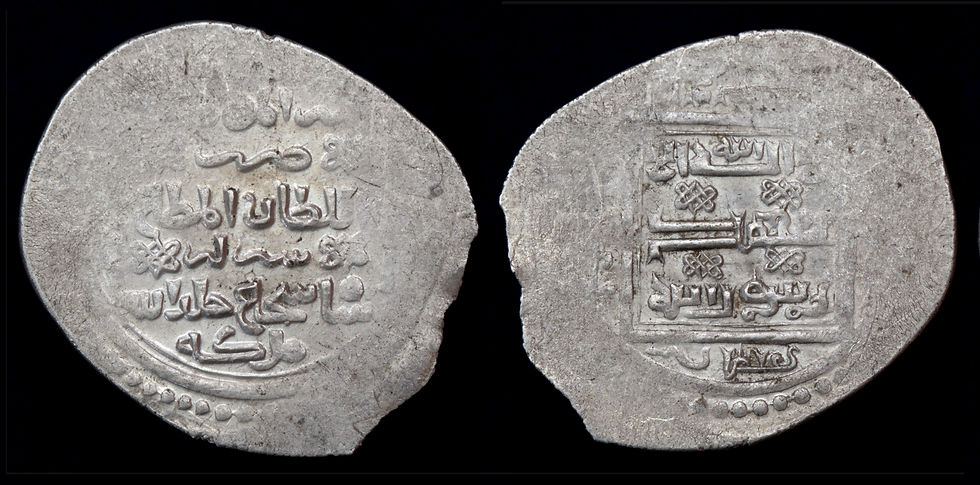
Shah Shuja's Rise to Power
Shah Shuja and his brothers depended on their father's favor. In a ruling house without fixed rules of succession by the eldest son, that favor governed everything: losing the ruler's confidence could mean losing governorships, inheritance, freedom, or life.
Mubariz al-Din had briefly occupied the Tabriz, but withdrew when the Jalayerid ruler Shaykh Uways advanced against him. During the campaign, Shah Shuja and Shah Mahmud apparently behaved in a way their father considered frivolous or militarily improper, and he treated them harshly afterward. Contemporary and near-contemporary traditions also suggest that the brothers became afraid that their father intended to diminish or displace them politically.
Shah Shuja' and his brother Shah Mahmud joined forces with Shah Sultan, Shah Sultan, a close kinsman of Mubariz al-Din and governor of Isfahan. Mubariz al-Din’s vizier, Khwaja Burhan al-Din, had accused Shah Sultan of financial misconduct. They seized and blinded Mubariz al-Din Muhammad in Ramadan 760 AH (August 1359) and imprisoned him in the fortress of Tabarak. (see: The Ta’rikh-i-Guzida)
Blinding had a particular political logic in medieval Islamic and Persian dynastic politics: it neutralized a ruler as a credible sovereign while avoiding outright parricide. The brothers subsequently divided the Muzaffarid territories among themselves, with Shah Shuja emerging as ruler of Shiraz and Fars. His brother Shah Mahmud drove him out of Shiraz in 765 AH (1363–64), and he recovered the city in 767 AH (1366).
The Blinding of Shah Shuja's son, Shibli
By the early 1380s Shuja' had reason to fear that a son might do the same to him.
In Rabiʿ I 785 AH (approximately May 1383), Shah Shuja' was on campaign. His son Sultan Shibli followed the royal army a few stages behind. At Bayda, Shibli proposed to parade his troops before his father. According to the surviving narrative, men at court exploited the situation. They told Shah Shuja that Shibli's military preparations were not innocent and that the prince was secretly allied with Amir Muzaffar al-Din Salghar-Shah Rashidi in a conspiracy against him.
Shah Shuja' believed the accusation or at least feared it sufficiently to act. He arrested both men. Salghar-Shah was imprisoned in the citadel, while Shibli was confined in the fortress of Iqlid, roughly 145 km north of Shiraz.
The chronicle says that one day Shah Shoja became drunk and, in that condition, ordered two officials, Amir Ramadan Akhtaji and Khwaja Jawhar-i Kuchak, to go to Iqlid and put out Shibli's eyes. They departed to carry out the command.
The following morning Shoja regretted what he had done. He immediately sent a mounted courier after them with orders cancelling the punishment. (see: The Ta’rikh-i-Guzida)
The messenger arrived too late.
Who tells the story?
One of the most useful narrative sources for the later Muzaffarids is the account appended by Maḥmūd Kutubī to a manuscript of Ḥamdallāh Mustawfī’s Tārīkh-i Guzīda. Mustawfī’s original Tārīkh-i Guzīda had been completed much earlier, in 730 AH / 1330 CE, before most of the Muzaffarid events discussed here. While copying the work in 823 AH / 1420 CE, Kutubī added his own independent history of the Muzaffarid dynasty, bringing the narrative down to the dynasty’s destruction in 795 AH / 1393 CE.
Edward G. Browne's abridged English translation of the Tārīkh-i Guzīda, which includes the chapter on the House of Muzaffar describes the episode. It is the source for the details about Bayda, the accusation of conspiracy, imprisonment at Iqlid, the two men sent to blind Shibli, and the mounted messenger sent the following morning.
How does the story of the Muzaffarids end?
After Shah Shuja’s death in 1384, Zayn al-ʿAbidin inherited Shiraz, but the Muzaffarid family quickly turned to fighting each other. During Timur’s first invasion of Iran, Zayn al-ʿAbidin lost control of Shiraz and later tried to regroup against Shah Mansur, his first cousin and Shah Shuja’s nephew. After defeat, he attempted to flee toward Khurasan, but was captured by the local ruler Musa Jaukar, who handed him over to Shah Mansur. Shah Mansur then had Zayn al-ʿAbidin imprisoned and blinded at Qalʿa-yi Safid.
When Timur destroyed the Muzaffarid dynasty in 1393, Shibli and his brother Zayn al-ʿAbidin, both blind, were among the very few male princes spared and were sent to Samarqand.
References
Mustawfī, Ḥamdallāh. The Ta’rikh-i-Guzida, or “Select History”. Translated by Edward G. Browne and R. A. Nicholson. 2 vols. Leiden: E. J. Brill, 1910–13.
Browne, Edward G. A Literary History of Persia. Vol. 3, The Tartar Dominion, 1265–1502. Cambridge: Cambridge University Press, 1920. Reprint, 1951. Packhum
Jackson, Peter, and Laurence Lockhart, eds. The Cambridge History of Iran. Vol. 6, The Timurid and Safavid Periods. Cambridge: Cambridge University Press, 1986. Cambridge University Press
Mustawfī, Ḥamd-Allāh. The Geographical Part of the Nuzhat-al-Qulūb. Translated by G. Le Strange. E. J. W. Gibb Memorial Series 23, pt. 2. Leiden: E. J. Brill; London: Luzac & Co., 1919.
Wing, Patrick. “Mozaffarids.” Encyclopaedia Iranica. Last updated January 26, 2017.


Comments