
India's Philosopher Queen


Ahilyabai Holkar (1725–1795) is a luminous figure in Indian history, a "Philosopher Queen" who ruled the Maratha state of Indore with a rare blend of piety and administrative genius. Born in a village in Ahmednagar, she married into the powerful Holkar dynasty but faced early tragedy, losing her husband Khanderao in battle in 1754. Khanderao Holkar was inspecting his troops in an open palanquin when he was struck and killed by a cannonball fired from the Jat artillery during the Siege of Kumbher. In the factional struggle for control over the declining Mughal throne, the siege was intended to dismantle the Jat fortifications that threatened Maratha dominance in North India.
Ahilyabai Holkar's father-in-law, Malhar Rao Holkar, prevented her from committing sati on Khanderao's pyre, urging her instead to dedicate her life to the service of the state and God. Malhar Rao Holkar, recognizing her potential, trained her in statecraft. When Malhar Rao died in 1766, her son Male Rao ascended the throne. However, his brief reign was disastrous.. He suffered from severe mental instability and fits of insanity, which reportedly manifested in cruel behavior toward his subjects. His condition deteriorated rapidly, and he died in 1767, having ruled for ~11 months.

Following the death of her son in 1767, she successfully petitioned the Peshwa to take control of the administration herself - a bold move that ushered in a thirty-year golden age. Ruling from her capital at Maheshwar (pin on the map above) on the banks of the Narmada, Ahilyabai ensured stability while the rest of the Maratha Empire fractured. She was a capable commander who personally led armies, but her true legacy lay in her benevolent governance and prolific patronage.

A devout Shaivite, she viewed herself as a trustee of the divine, signing every official decree with "Shri Shankara" ("On Behalf of Lord Shiva"). She dedicated state resources to rebuilding temples razed across the subcontinent. Most notably, she reconstructed the Kashi Vishwanath in Varanasi - originally destroyed by Aurangzeb and illustrated in the pencil drawing above - as well as the Somnath temple in Gujarat. Beyond these restorations, she established a vast network of dharamshalas (rest houses) and ghats to support pilgrims.
The Coin
Her coinage, marked with the Lingam and Bilva leaf, reflect her deep devotion.
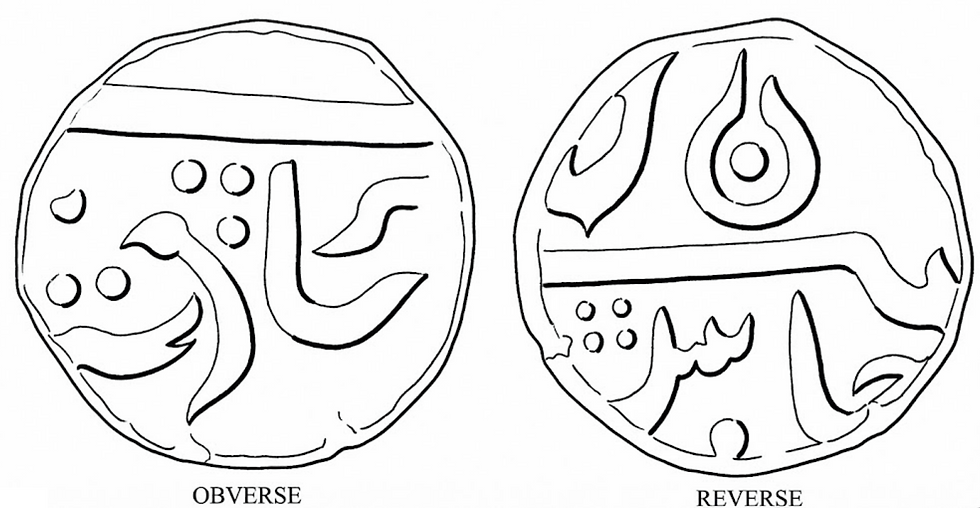
KM TYPE 53: COPPER ½ ANNA (HEAVY PAISA 12.52 g 20.5 mm)
Obv: Persian legend in Nastaliq script citing the Mughal Emperor Shah Alam II (‘Shadow of God’). The field is ornamented with rosette clusters and geometric separators. شاه عالم Transliteration: Shah Alam
Rev: Central device of the stylized Bilva leaf rising from the Lingam (sacred symbol of Shiva) prominent in upper field. Flanked by scrollwork or leaf arabesques. Below, fragments of the regnal formula ‘Julus’ (Strike). [جلوس [میمنت مانوس Transliteration: Julus Maimanat Manus Translation: "Struck in the year of the accession associated with tranquil prosperity."

Ahilyabai Holkar ruled for 28 years (1767–1795), a period widely regarded as a "Golden Age" for the Malwa region.
Why Shah Alam II?
Although the Maratha were independent of the Mughal Empire by this time, merchants and bankers across India trusted the weight and purity associated with the "Shah Alam" coinage. Even the British East India Company - who were actively fighting the Mughals - minted coins in the name of Shah Alam II until 1835. An example here: https://www.acsearch.info/search.html?id=611328.
Stability in Chaos: While the rest of India was engulfed in warfare between the Marathas, Mughals, and the rising British East India Company, Ahilyabai kept her state peaceful and prosperous. She personally led armies into battle when necessary but preferred diplomacy.
She moved the capital from Indore to Maheshwar on the banks of the Narmada River. She transformed it into a center of art, culture, and industry, famously inviting weavers from Surat to create the Maheshwari saree industry which is globally recognized as a symbol of Indian handloom heritage.

She famously rehabilitated the "criminal" tribes (like the Bhils) by giving them land and employing them as protectors of the roads, rather than hunting them down.

In a major move reflecting her enduring political and cultural clout, the government of Maharashtra recently approved renaming the district of Ahmednagar (her birthplace) to Ahilyanagar in her honor. The central government gave its nod to this change in late 2024. The international airport in Indore is named Devi Ahilya Bai Holkar Airport, and the city's university is named Devi Ahilya Vishwavidyalaya.

When Prime Minister Narendra Modi inaugurated the massive Kashi Vishwanath Corridor in 2021, he specifically paid tribute to Ahilyabai Holkar and installed a statue of her within the temple complex, cementing her status as a cultural icon. (ref)


Comments