
Joan D'Arc & John Gaunt


A "Conder token" is a little out of place on this blog, however we will make an exception as this token comes with :
some interesting history from the time of the French Revolution which drew inspiration like the American revolution from the history of the Roman Republic,
a dynastic series of coins that clearly owe key elements of their style and dynastic succession to rules that were established in ancient times and firmly entrenched in Europe by the Roman Empire,
connections to Joan of Arc & Queen Victoria
descendants of John of Gaunt include every legitimate monarch of England, Great Britain and the UK since 1399
A short side-trip to a modern monarchy and we will return to ancient coins next week!

What is a Conder token?
In the late 18th century, the British Royal Mint effectively ceased production of copper coinage (halting in 1775), leading to a desperate scarcity of small change needed for daily transactions.
The Industrial Revolution created a massive new workforce that needed to be paid in low denominations, yet employers had no official currency to distribute.
To fill the void, private companies, starting with the Parys Mine Company in 1787 began minting their own copper penny and halfpenny tokens to pay workers and facilitate local trade.

Cartwheel Pennies
The British government finally addressed the shortage in 1797 by contracting Matthew Boulton’s Soho Mint to strike official "Cartwheel" pennies and twopences, reducing the need for private alternatives.
By the early 1800s, the market was flooded with tokens of deteriorating quality and spurious "collector" varieties, leading to public fatigue and a desire for standardized currency. Parliament formally passed an Act in 1817 that declared the manufacture and circulation of private copper tokens illegal, effectively ending the Conder era by January 1818.
France under English rule
The fleur de lis - on the reverse claims the throne of France. Starting with Plantagenet King Edward III, AD 1340, English monarchs asserted themselves as the rightful kings of France. They fought the Hundred Years' War (1337–1453), in part, to enforce this claim, and were unsuccessful. From the early 16th century, the claim had no realistic prospect of fulfillment, although every English and British monarch, from Edward III to George III, styled themselves king or queen of France until 1801.
When Charles IV of France died without an heir (1328) - Edward III, his nephew and son of Charles' sister Isabella of France, claimed to be the next in line for the French throne. The French blocked him and crowned Philip VI which sparked the 100 Years War.
In 1420, after crushing the French at the Battle of Agincourt, Henry V forced the French King Charles VI to sign the Treaty of Troyes.
the French King declared his own son (the Dauphin) illegitimate.
he recognized Henry V as his heir and regent
Henry V married Charles VI’s daughter, Catherine of Valois
When Henry V died and then shortly afterward Charles the VI dies, Henry V's 9-month-old son Henry VI was crowned King of France in Paris in 1431 - the only English monarch to ever be effectively crowned King of France.

This left the dual monarchy of England and France in the hands of an infant, creating the political instability that allowed the French resistance (eventually led by Joan of Arc) to rally around Charles VI’s disinherited son, the Dauphin (later Charles VII). French soldiers loyal to the Duke of Burgundy (English allies) captured Joan. The English and their allies in France, burned Joan of Arc at the stake.
The English were not expelled immediately after Joan of Arc's death in 1431. It took another 22 years of grinding warfare, diplomatic reversals, and Charles VII creating Europe's first standing army to finally drive them out.
A Mule
The writing on the edge is PAYABLE AT CLOUGHER OR IN DUBLIN would identify a coin from Ireland - however these tokens were hastily struck in BIRMINGHAM for many locations and the workers at the mint used the dies for the Lancaster (John of Gaunt) token to stamp the image and a copper blank that had already been run through an edge-marking machine set up for the Clogher (Tyrone) order.
The vast majority of these tokens were issued by Thomas Worswick & Sons, a family of bankers and goldsmiths in Lancaster.
Why John Gaunt
This 14th-century Duke on a 1792 token is a flex of local heritage. Gaunt was the ultimate power player of medieval England. By putting him on the coin, Lancaster was asserting its status as a "Palatine" county. In England, Wales and Ireland a county palatine was an area ruled by a hereditary nobleman enjoying special authority and autonomy from the rest of a kingdom.
John of Gaunt’s son (by Blanche) was Henry Bolingbroke, who usurped the throne to become Henry IV. John Gaunt also made a claim to be King of Castille via marriage to his second wife Constance of Castile in 1371. He marreid off his first daughter to the King of Portugal - and waged a failed attack on the King of Castille. Then secretly ended his claims to Castille in exchange for payment and marriage of his second daughter to the King of Castille's son Henry.
Since his son Henry IV took the throne in 1399, every legitimate monarch of England (and later Great Britain and the United Kingdom) right down to King Charles III has been a descendant of John of Gaunt. Henry V (the hero of Agincourt) was John of Gaunt’s grandson. He is often called the "ancestor of kings" and here is how he cornered the entire market on the royal bloodline:
The Lancastrians - when Gaunt died, his exiled son came back, usurped the throne from Richard II, and became Henry IV.
The Kings: Henry IV, Henry V, Henry VI are his direct male line (Son, Grandson, Great-Grandson).
The Yorkists - the "Wars of the Roses" was fought between the House of Lancaster (Gaunt's line) and the House of York (descendants of Gaunt's younger brother, Edmund of Langley) Edward IV, Edward V, Richard III) were also descended from Gaunt. Their mother was Cecily Neville. She was the daughter of Joan Beaufort, who was John of Gaunt's daughter. So, while they fought against Gaunt's male heirs, they carried his blood through their mother.
The Tudors - when the male Lancastrian line died out with the murder of Henry VI and his son, the claim passed to the Beaufort family - Gaunt's children by his mistress-turned-wife, Katherine Swynford. Henry VII was the first Tudor. His mother was Margaret Beaufort, the great-granddaughter of John of Gaunt. When Henry VII married Elizabeth of York (daughter of Edward IV), he united two lines of Gaunt's descendants (the Beauforts and the Yorkists).
Everyone Else : Stuarts, Hanoverians, Windsors - because Henry VII and Elizabeth of York are the ancestors of every monarch that followed, the line remains unbroken.
- James I (and the Stuarts) descended from Henry VII’s daughter, Margaret.
- George I (and the Hanoverians) descended from James I’s granddaughter.
- The Windsors (Charles III) descend directly from Victoria, a Hanoverian.
The Rest of Europe :Because of Queen Victoria (a Gaunt descendant) and Christian IX of Denmark (also a descendant), all currently reigning European monarchs are descendants of John of Gaunt, including those of: Spain, Luxembourg, Netherlands, Sweden, Norway, Denmark, and Belgium.
Descendants of John of Gaunt

In this print, the Prince of Wales serves as a figure of desperate poverty and political danger. Depicted on the right side of the frame dressed in rags (red coat) - a visual testament to his notorious debts - the Prince is shown engaging in a highly controversial transaction. He is being offered a £200,000 loan by the son of the French Duc d'Orléans. This specific detail highlights a major contemporary anxiety: the fear that the British heir apparent was becoming beholden to French influence to solvency.
The contrast with the Crown The Prince’s destitute state is used to create a sharp, ironic contrast with his parents. While the Prince is forced to seek foreign money to survive, King George III and Queen Charlotte are depicted nearby, ignoring him while stuffing their pockets with a "wheelbarrow of money" delivered by Prime Minister Pitt. The composition underscores the Prince's alienation; while the Crown claims public funds (debated in Parliament just weeks prior), the Prince is left in rags, mirroring the neglect shown to the begging quadriplegic sailor at the scene's left edge.
George, Prince of Wales

Great Britain Halfpenny “Prince of Wales Token” 1795; Dalton & Hamer 962a; Provincial Token (Conder Token, Middlesex, Copper, 29 mm), Halfpenny denomination.
Obv: GEORGE PRINCE OF WALES; laureate profile bust of George, Prince of Wales (future George IV) facing right. No border; typical of London-issue Conder portrait tokens.
Rev: INDUSTRY IS THE PARENT OF SUCCESS, ICH DIEN
Edge: PAYABLE AT LONDON .+.+.+.+.+.
Ref: D&H 962a (London).
Another example of the late 18th-century boom in privately issued trade tokens due to national small-change shortages. Struck in Birmingham by William Lutwyche. The bust of the Prince of Wales celebrates the popular and politically significant heir apparent. The motto “ICH DIEN” (“I serve”): The historic heraldic motto of the Princes of Wales.
Die Maker: Roger Dixon was a well-known die sinker in Birmingham who engraved dies for many token issuers.
Minted by: William Lutwyche ran a private mint in Birmingham and was responsible for producing tons of these tokens for merchants across Britain.
The Irony on this Conder Token: The motto "INDUSTRY IS THE PARENT OF SUCCESS" is a standard moral proverb of the Industrial Revolution, promoting hard work. However its pairing with the Prince of Wales deeply ironic. The Prince (future George IV) was infamous for his laziness, gambling, heavy drinking, and massive debts (which Parliament had to pay off that very year). Placing a motto about "Industry" (hard work) next to the crest of a Prince known for idleness was likely an attempt to improve his public image during a time of political instability (i.e. the French Revolution ongoing across the channel).
Here are sixpence coins from three Hanoverian Kings George II, III, and IV. The Laureate bust of the King a tradition from the emperors of Rome. The portrait of George IIII particularly reminiscent of ancient Roman portraits.
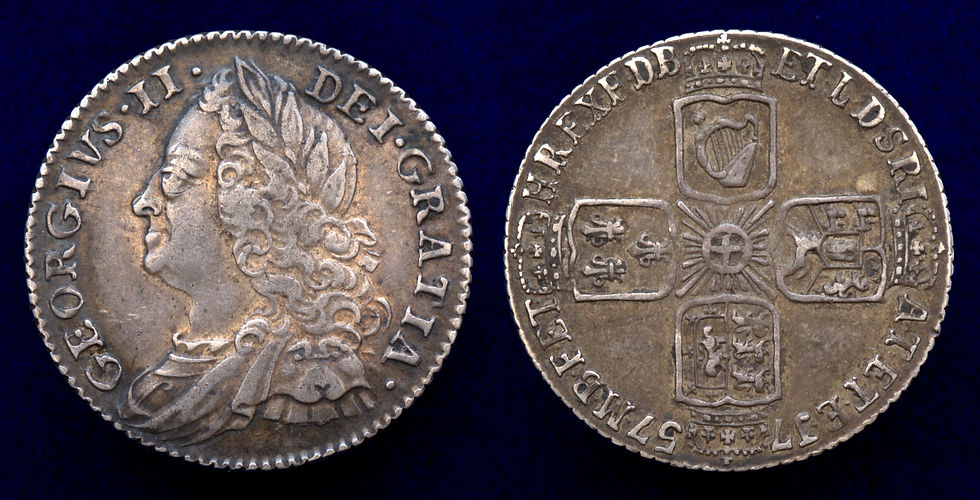


Queen Victoria was the daughter of Prince Edward, Duke of Kent, who was the fourth son of King George III. King George IV was Prince Edward's older brother. George II was her great-great-grandfather and his son, Frederick, Prince of Wales, died before he could become king. The crown passed directly from from George II to his grandson, George III.


Comments