
Interactive Cicero


Marcus Tullius Cicero (106 to 43 BC), the Roman orator, lawyer and consul of 63 BC, wrote hundreds of letters that still survive. They cover the years from 68 BC until a few months before his death on 7 December 43 BC. In them he writes about elections, lawsuits, debts, family illness, his daughter's death and the civil war between Caesar and Pompey. Many were written while those events were still happening.
The letters come down to us in several collections. This app draws on two of them. The Letters to Friends (Latin Epistulae ad Familiares) runs to sixteen books of letters to and from colleagues, clients, rivals and relatives. Scholars usually credit their collection to Tiro, Cicero's freed secretary, but no ancient source confirms this. The Letters to Atticus (Epistulae ad Atticum), also in sixteen books, are addressed to his closest friend, the wealthy equestrian Titus Pomponius Atticus. Cicero writes to him with notable frankness.

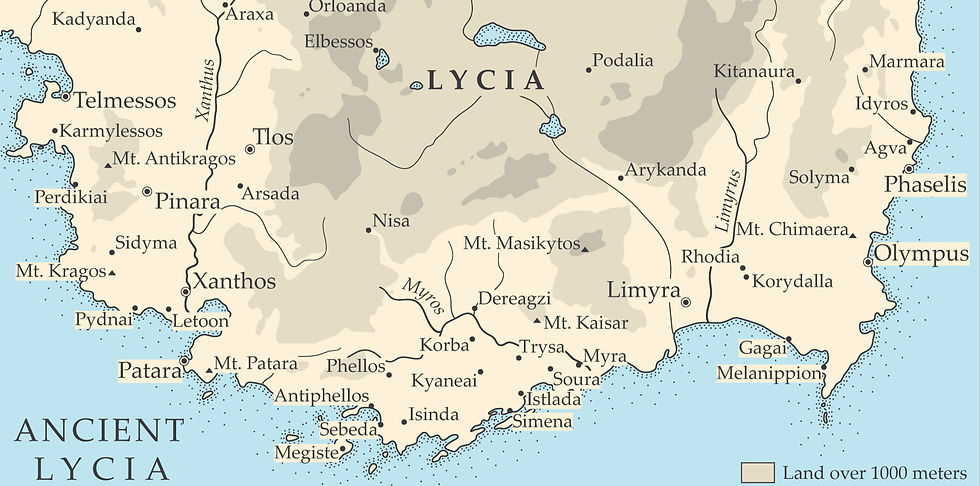
The Interactive Cicero presents these letters in the original Latin with people, places, and events highlighted and explained, and in a new English version that renders Cicero as a modern correspondent writing email. A "Sankey plot" (shown above) places each letter in time and space and links it to the events it records, so a reader can follow Cicero from Rome to his exile in Greece, his governorship in Cilicia (southern Asia Minor) and back.
The Latin source text is in the public domain.
Cicero, M. Tulli Ciceronis scripta quae manserunt omnia, pt. 3, vol. 1, ed. C. F. W. Mueller (Leipzig: B. G. Teubner, 1896), https://archive.org/details/p1scriptaquaemanse03ciceuoft.
Cicero, M. Tulli Ciceronis scripta quae manserunt omnia, pt. 3, vol. 2, ed. C. F. W. Mueller (Leipzig: B. G. Teubner, 1898), https://archive.org/details/p2scriptaquaemanse03ciceuoft.

The modern versions are interpretive renderings made with AI assistance and are offered alongside, not in place of, standard translations such as D. R. Shackleton Bailey's translation from the Loeb Classical Library.
For free public domain translations you can use:
Letters to Atticus, translated by E. O. Winstedt (Loeb, 3 volumes)
Volume I (1912): archive.org/details/letterstoatticus01ciceuoft
Volume II (1913): archive.org/details/dli.ernet.103648
Volume III (1918): archive.org/details/letterstoatticuswins03ciceuoft
Letters to His Friends, translated by W. Glynn Williams (Loeb, 3 volumes)
Volume I (1927): archive.org/details/letterstohisfrie01ciceuoft
Volume II (1928): archive.org/details/letterstohisfrie02ciceuoft
Volume III (1929): archive.org/details/letterstohisfrie03ciceuoft

And to connect an ancient coin: Publius Lentulus Spinther was a relative of Sulla, the savior of Cicero, a friend of Julius Caesar and he died an ally of Pompey the Great. As consul in 57 BCE he supported Cicero - recalling him from exile and restoring his property.
"But on the first day of January, when the widowed republic had appealed for succor as to its legal protector to the new consul, Publius Lentulus, the parent and divine restorer of my life, my fortunes, my remembrance, and my name, had no sooner made the customary religious proposal ** than he carried out his conviction that all other human measures should be postponed to one dealing with myself."
-Cicero, in a speech given upon his return from exile in 57 BCE, paragraph 10
Browse an analysis of how Cicero's use of language varied with life events.


Pub. Lentulus P. f. L. n. Spinther, AR Denarius (3.65g, 18mm, 2h), Rome, 74 BC.
Obv: Bust of Hercules right; Q•S•C behind / P•LENT•P•F•L•N
Rev: Genius of the Roman People seated facing, holding cornucopiae and sceptre, being crowned by Victory, flying left.
Ref: Crawford 397/1; Sydenham 791.
Explore the Interactive Cicero and pass on your feedback as we are working to make this more and more usable and useful for exploring and enjoying the letters of Marcus Tullius Cicero.


Comments