
Elis, Kallippos, and Rome's Civil Wars

Updated: Jul 27

The sanctuary of Olympia was a rural religious precinct sacred to Zeus Olympios, set in a grove called the Altis beside the river Alpheios in the territory of Elis, in the western Peloponnese. It was a walled enclosure of temples, altars, treasuries, and athletic facilities, with no resident civic population beyond priests and caretakers. The city of Elis, some 40 km to the northwest, administered the sanctuary and the games for most of antiquity. As always there is a Sulla connection. Sulla plundered the sanctuary's treasures in 86 BC to pay his armies during the First Mithridatic War.
"And since he [Sulla] needed much money also for the war, he diverted to his uses the sacred treasures of Hellas, partly from Epidaurus, and partly from Olympia, sending for the most beautiful and most precious of the offerings there." -Plutarch, Lives, Sulla 12.3The sanctuary was famed for the Olympic Games, held every four years from a traditional date of 776 BC as part of the festival of the Olympian Zeus, drawing competitors and pilgrims from the whole Greek world under a sacred truce. It was also the home of the colossal gold and ivory statue of Zeus by the sculptor Pheidias, completed around 435 BC inside the Temple of Zeus and counted among the seven wonders of the ancient world.
Pausanias, writing in the second century AD, devotes two full books to the sanctuary and remarks that "many are the sights to be seen in Greece, and many are the wonders to be heard; but on nothing does Heaven bestow more care than on the Eleian games and the sanctuary at Olympia" (Pausanias 5.10.1).
The Coin
This coin is a silver hemidrachm, a half drachm also called a triobol (three obols), struck at Elis in the northwestern Peloponnese.
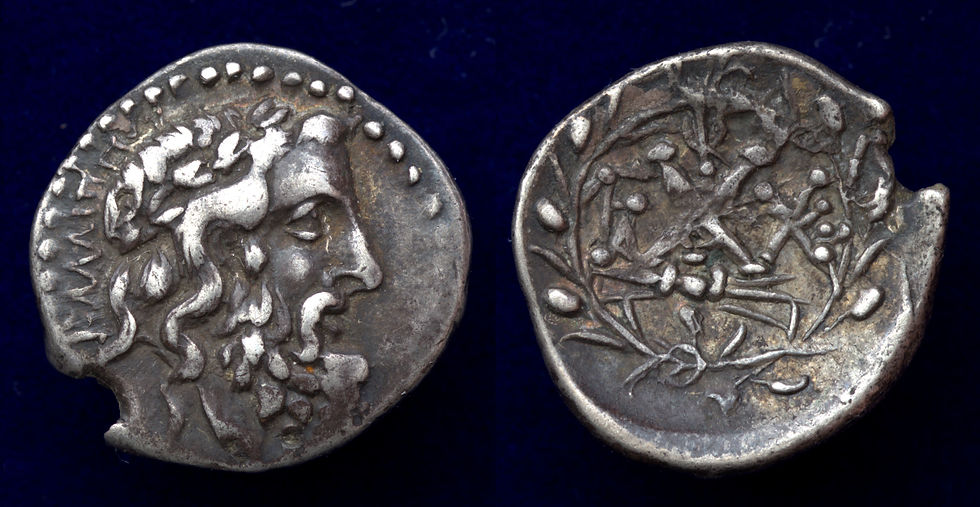
Achaia, Achaian League type, Elis, circa 50-30 BC, AR Triobol / Hemidrachm (2.25 g, 8h), Kallippos, magistrate.
Obv: Laureate head of Zeus Amarios right; KALLIPPOU above
Rev: AX monogram; Φ above, FA monogram to left, XE monogram to right, thunderbolt below; all within wreath.
Ref: Clerk 273; BCD Peloponnesos 691; SNG Copenhagen 298.


Elean coinage had carried Olympian imagery since the fifth century BC, much of it struck for the festival crowds themselves. At 2.25 grams it sits squarely in the weight range of the type.
The obverse carries the laureate head of Zeus Amarios (also spelled Homarios), "Zeus the Uniter," with the magistrate's name beside it in the genitive: KAΛΛIΠΠOY, "of Kallippos," the official responsible for the issue. Kallippos is known only through this coinage. This is the federal Zeus, whose sanctuary near Aigion, on the Gulf of Corinth, was the meeting place of the Achaian League, the confederation of Peloponnesian cities that for a century and a half gave the Greek south its political shape. Polybios, the League's own historian, called that sanctuary the place where the members gathered to deliberate. Scholars debate the epithet, glossing it as "god of the assembly" or "he who unites," but on the coin the meaning is plain: this is the god of a shared political life.
The reverse compresses a constitution into a centimeter of silver. Inside a laurel wreath sits the League's monogram, AX: alpha and chi, the first letters of Achaion, "of the Achaians." Below it is a thunderbolt, the weapon of Zeus and a long-standing badge of Elean coinage. The letters FA, begins with digamma, an archaic sign for the w sound, abbreviating the Eleans' own name, Faleioi. The League supplied the standard: weight, fineness, design, and the ΑΧ badge. The cities supplied the silver and did the striking, in episodic batches driven by demand, federal at first, Roman at the end. Local officials signed every emission, as monograms through most of the series, and on the last issues as names written out in full, which is where Kallippos stands.
Polybios wrote in the second century BC that the League's members shared "the same laws, weights, measures, and coinage, as well as the same magistrates, senate, and courts of justice," so that the whole Peloponnese "falls short of being a single city only in the fact of its inhabitants not being enclosed by one wall" (Polybios 2.37). In the League's heyday, the half century after 191 BC when every city of the Peloponnese was enrolled, member cities struck thousands of these Zeus triobols, each setting its own ethnic and magistrate within the shared federal frame.
The Surprise Date
Rome destroyed the League as an independent military power in 146 BC. The Achaian War ended with the sack of Corinth, and the federation Polybios had praised was dissolved. Pausanias (Pausanias 7.16.9–10) says the Romans soon allowed the leagues to reconvene, and an Achaian koinon existed in diminished form into the imperial period. League type coins were still being struck a century later, between about 50 and 30 BC, when the Peloponnese was under Roman control. Why? Between 49 and 31 BC Rome's civil wars were repeatedly decided on Greek soil: Pharsalos in 48, Philippi in 42, Actium in 31.
In 48 BC, before the decisive battle of Pharsalos in which Julius Caesar's veteran army destroyed the much larger force of Pompey the Great, Pompey spent a year drawing on the Greek east for everything an army needs. Achaia, the Roman name for southern and central Greece, provided both money and men. Caesar records that he "had gathered a large fleet from Asia and the Cyclades, from Corcyra, Athens, Pontus, Bithynia, Syria, Cilicia, Phoenice, and Egypt," had "requisitioned a large sum of money from Asia, Syria, and all the kings, potentates, and tetrarchs, and from the free communities of Achaia," and had drafted men from "Thessaly, Boeotia, Achaia, and Epirus" into his legions, besides collecting "a very large quantity of corn from Thessaly, Asia, Egypt, Crete, Cyrene" (Caesar, Civil War 3.3–3.5).

In the buildup to Actium in 31 BC, Antony's needs fell directly on Greek backs. Plutarch, drawing on family memory, records that his own great-grandfather Nikarchos was forced, with his fellow citizens, to carry grain on their shoulders down to the sea at Antikyra, on the north shore of the Corinthian Gulf, for Antony's fleet, "and their pace was quickened by the whip." They had been measured out for a second load when word came that Antony was defeated, and that, Plutarch says, was the city's salvation (Plutarch, Antony 68).
It was a hard century, but Elis still administered the great sanctuary of Zeus at Olympia. The Games went on, though the century had been hard. The thunderbolt beneath the League's monogram was, among other things, the weapon of that Olympian Zeus, a reminder that the god on these coins still had a living sanctuary down the road.
Long after the end of the federation, these coins were most likely minted for the Roman military or minted for payment to Rome. Roman armies and fleets did not pay or supply themselves in denarii alone; in the Peloponnese they needed silver that local recruits, merchants, and farmers would trust on sight. A triobol bearing the head of Zeus Amarios and the League's monogram was exactly that: old, familiar, local money. The revived federal types can be read as an instrument of Roman war finance. The case relies on chronology, hoards, and the military demands visible in the literary evidence.
Recent scholarship dates the final issues of these triobols from Elis to the Roman civil wars, ending around the time of Actium, a chronology built on hoards that close in the 30s BC. Their production most likely answered the demands of Mark Antony. Antony himself wintered at Patrai in 32/31 BC, roughly 80 km from the city of Elis, while his fleet lay mostly in the Ambracian Gulf and his army around Actium.
After the war, Octavian, the future Augustus, reorganized Greece, and in 27 BC Achaia became a Roman province; silver of this kind was never struck there again. The Kallippos triobols thus stand among the last civic silver issued of mainland Greece, bearing the head of Zeus Amarios, patron god of the long dissolved Achaian League, on issues struck while the Roman Republic waged civil wars.
References
Benner, Steve M. Achaian League Coinage of the 3rd through 1st Centuries B.C.E. Classical Numismatic Studies 7. Lancaster, PA: Classical Numismatic Group, 2008.
Crawford, Michael H. Coinage and Money under the Roman Republic: Italy and the Mediterranean Economy. London: Methuen, 1985.
Grandjean, Catherine, Maryse Blet-Lemarquand, and Eleni Papaefthymiou. "The Silver Coinages of Achaian and Aitolian Federal States." In Proceedings of the XVI International Numismatic Congress, 11–16.09.2022, Warsaw, vol. 1, Greek Numismatics, edited by Jarosław Bodzek, Aleksander Bursche, and Anna Zapolska, 283–96. Warsaw Studies in Archaeology. Turnhout: Brepols, 2025.
Thompson, Margaret. The Agrinion Hoard. Numismatic Notes and Monographs 159. New York: American Numismatic Society, 1968.
Walker, Alan S. LHS Numismatik Auction 96: Coins of Peloponnesos. The BCD Collection. Zurich: LHS Numismatik AG, 2006.
Warren, Jennifer A. W. "Towards a Resolution of the Achaian League Silver Coinage Controversy: Some Observations on Methodology." In Essays in Honour of Robert Carson and Kenneth Jenkins, edited by Martin Price, Andrew Burnett, and Roger Bland, 87–99. London: Spink, 1993.
Warren, Jennifer A. W. "The Achaian League Silver Coinage Controversy Resolved: A Summary." Numismatic Chronicle 159 (1999): 99–109.


Comments