
Hindu Kush: Panjhir Silver

These two silver discs come from the same mountains and from the same silver bearing province and were struck at most twenty years apart.
The coins
The first coin names a Samanid amir who was dead when at least one of its dies was cut.

This Mansur I bin Nuh piece has no obverse. A workman set two reverse dies, one in the anvil and one in his hand, and struck a disc that carries reverse legends on both faces, one of Album type 1465 and one of type 1465A.
Album 1465A is a posthumous multiple dirham of Mansur I, dated in the trade to AD 976 to 978. Numismatists call such a mispaired coin a mule. This one therefore pairs a lifetime reverse with a posthumous one..

The second coin names his son, Nuh II (Nuh bin Mansur) as overloard, and was struck by a governor who may have been in office during the striking of both coins.

The mine
Panjhir, the modern Panjshir, was the chief silver mining center of Badakhshan province. Ma'din is Arabic for a mine. Michael Mitchiner, cataloguing this series, reports that the mint name appears in full as al-Ma'dan Panjhir and in shortened form as al-Ma'dan, "literally the mining town". The two forms belong to one mint (Mitchiner 1975, 6).
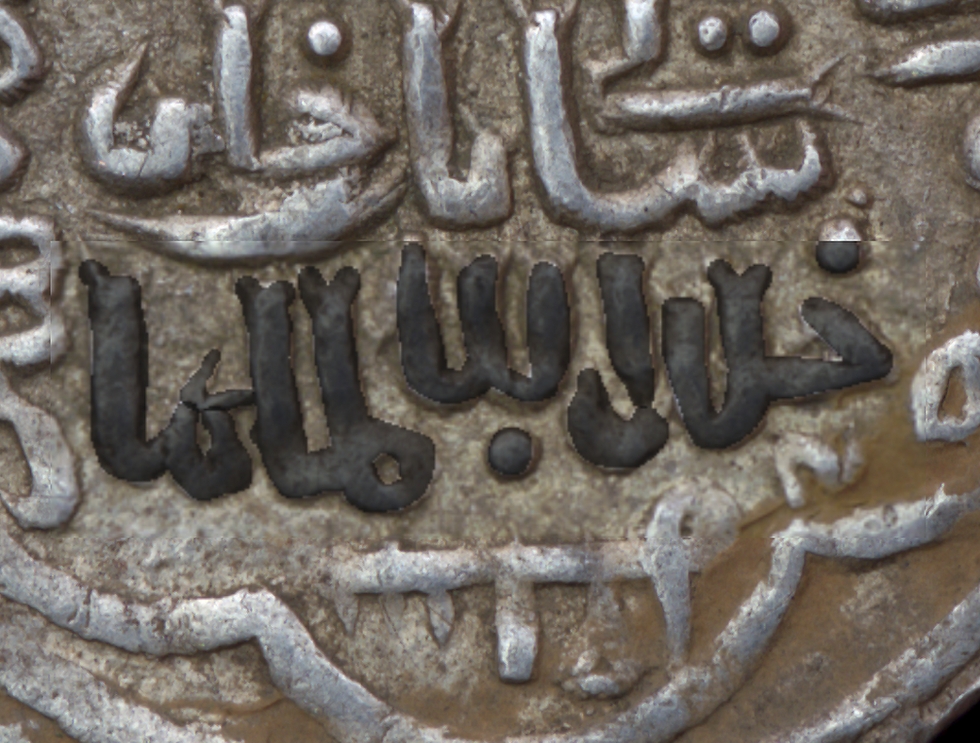
The mint signature on the first coin names the mine. The signature on the second, Kurat Badakhshan, names the district: kura is the Arabic administrative term for a district or canton. Both signatures point at the source of the metal rather than at a town with a treasury.
The mint struck ordinary dirhams until AH 329 and multiple dirhams from AH 330 or 331, and for the following sixty years the multiple dirham was the only coinage struck in Badakhshan province (Mitchiner 1975, 5 to 6).

The region where these coins were struck
Andarab, also written Andaraba, sits on a river in what is now Baghlan province in northern Afghanistan. Ibn Hawqal, writing in AD 977, put it nine days' journey for a caravan from Balkh, the great city of the northern plain.
From Andarab the road climbed south over the Khawak pass, dropped into the valley of the Panjhir river, and followed that river down to the Kabul valley. This was one of the two main routes across the Hindu Kush toward Kabul and India. The two great mining centers of Afghanistan were Jariaba, the Jariyana of the Hudud al-'Alam, three days' journey from Andarab, and Panjhir, one day further (Bosworth 1985). Panjhir is the mine named on the first coin. Banjhir is the Arabic form of the Persian name. Andarab, Parwan, and Panjhir each kept its own mint, and each mint named a different line of governors on its coins (Mitchiner 1975, 1 to 2).
ANDARAB, a borough amid mountains. It is a place with much cultivation, (producing) much grain. It possesses two rivers. Here dirhams are struck from the silver extracted from the mines of Panjhir and Jariyana. Its king is called Shahr-salir (*salér ?).
The Hudud al-'Alam, The Regions of the World, 23.77, trans. V. Minorsky (1937)
The Hudud al-'Alam, an anonymous Persian geography of AH 372, AD 982, sets the places side by side along the Hindu Kush chain. The geography was compiled during Nuh II's reign, in the years when the second of these coins was struck.
Bullion or four-dirham Coin
These coins weigh about four times as much as ordinary dirhams and are about twice the diameter (Mitchiner 1975, 6). The mints of the upper Oxus struck them with dies little larger than those cut for ordinary dirhams. The hammer drove a small design into the middle of a wide, thin disc, and the outer field took little or no impression. Weak strikes and blank margins are normal in the series.
Mitchiner weighed roughly 400 multiple dirhams. Those from Badakhshan cluster at 12g with half the recorded weights inside 1.5g of that figure, and the extremes run from 6g to 21g. Coins of the same issue can differ twofold (Mitchiner 1975, 6 to 7).
Mitchiner argues that a mint would not tolerate such variation in a coin with intrinsic value, so the multiple dirhams passed as tokens, most likely tariffed at four dirhams (Mitchiner 1975, 7). The competing hypothesis is that these were bullion discs, marked as good silver by an authority and passed by weight in each transaction.
Mansur I
Abu Salih Mansur b. Nuh ruled Transoxiana and Khurasan from AH 350 to 365, AD 961 to 976. Bosworth gives his style as Amir-e Sadid, "The Righteous, Just Amir".
His brother 'Abd al-Malik I died suddenly in Shawwal 350, November 961. The army commanders under the chamberlain Fa'iq Khassa gave allegiance to Mansur at Bukhara on 19 Shawwal 350, 1 December 961, on Narshakhi's account (Bosworth 2002, citing Narshakhi 115 to 116).
Bosworth reads Mansur's reign as the last in which the Samanid state held together. Ibn Hawqal, who was in Bukhara during the reign, praised the amir and admired an army supported on a sound and regular financial system.
In AH 361, AD 971 to 972, the Buyids agreed to pay Bukhara an annual tribute, and a daughter of the Buyid 'Adud al-Dawla married Mansur's son Nuh. The sum is reported three ways: 200,000 dinars in Gardizi, 150,000 Nishapuri dirhams in Narshakhi, 150,000 dinars in Ibn al-Athir (Bosworth 2002). Bosworth presents the arrangement as a détente negotiated between the two viziers, Abu Ja'far 'Utbi for the Samanids and Ibn al-'Amid for the Buyids, rather than as an indemnity extracted by force.
Mansur's reign also left a monument of Persian prose. In AH 352, AD 963, he ordered a Persian version of al-Tabari's Arabic annals. The work is conventionally attributed to his vizier Abu 'Ali Bal'ami and known as the Tarikhnama or Tarikh-i Bal'ami.
Mansur died on 11 Shawwal 365, 13 June 976, on the authority of 'Utbi and Gardizi. Narshakhi gives 16 Muharram 365, 25 September 975 (Bosworth 2002). His son Nuh succeeded him.
Kurat Badakhshan and al-Harith b. Harb
Mitchiner's reconstruction places al-Harith b. Harb as governor of Badakhshan province for the Samanids from about AH 354 to 384, AD 965 to 994, and makes him probably a brother of Maktum b. Harb, who governed Tokharestan (Mitchiner 1975, 3 to 4). On that account al-Harith held the district under Mansur I and under Nuh II, and his name appears on Ma'din Panjhir coins of both reigns.
Tokharestan and its mint at Andaraba passed from Harb b. Sahlan to his son Maktum to his grandson Sahlan b. Maktum until AH 378, while Badakhshan had al-Harith. Auction descriptions that place al-Harith in the Andaraba succession conflate the two.
Apart from his coins, al-Harith is apparently unrecorded.
The Samanid collapse
Nuh b. Mansur reigned from 13 June 976 to 23 July 997. Historians generally call him Nuh II; Album's checklist and the sale listings keyed to it number him Nuh III. His state came apart during the reign. The Karakhanids, a Turkic dynasty pressing from the northeast, took Isfijab in 990, then Ferghana and the silver-mining district of Ilaq.

Harun Bughra Khan entered Bukhara in the late spring of 992 and Nuh fled his capital. Bughra Khan fell ill, withdrew, and died on the road home, and Nuh returned that summer. Against the rebel alliance of Fa'iq and the governor of Khurasan Abu 'Ali Simjuri he then called in Sebüktigin of Ghazna, and paid for the rescue with the governorship of Khurasan for Sebüktigin's son Mahmud after their victory in 994 (Frye 1975).
Mahmud threw off Samanid allegiance in AH 389, AD 999, recognized the caliph al-Qadir, and took the title Yamin al-Dawla (Mitchiner 1975, 4). The Karakhanids took Bukhara in the same year. A claimant, Isma'il al-Muntasir, fought on until 1005.
The multiple dirham coinage ends with Mahmud. Mitchiner records its penultimate issue in AH 389 and one issue later than that (Mitchiner 1975, 1, 4).
Hoards and provenance
The al-Harith piece comes from the James A. Lock Collection, which CNG has been dispersing across its Islamic sales; more of it appeared in Islamic Auction 13 in April 2026.
Multiple dirhams were rare until 1967, when a hoard was found somewhere in Afghanistan. Album puts it at more than 30,000 multiple dirhams of the Samanids, Ghaznavids, and Banijurids, weighing over 200 kilograms, roughly 440 pounds (Album 2011, 3). The material moved through Kabul into the Western trade, and Michael Mitchiner's 1973 catalogue was written from that flood; his 1975 summary of the same material counts 764 coins of 118 issues from 13 mints (Mitchiner 1975, table of issues).

References
Hudud al-'Alam, "The Regions of the World": A Persian Geography 372 A.H./982 A.D. Translated and explained by V. Minorsky. London: Oxford University Press, 1937. 2nd ed., edited by C. E. Bosworth. London: Luzac, 1970.
Ibn Hawqal. Kitab surat al-ard. Edited by M. J. de Goeje. Leiden: Brill, 1967. Translated by J. H. Kramers and G. Wiet as Configuration de la Terre. 2 vols. Beirut: Commission Internationale pour la Traduction des Chefs-d'Oeuvre; Paris: Maisonneuve et Larose, 1964.
Narshakhi, Abu Bakr Muhammad ibn Ja'far. The History of Bukhara. Translated by Richard N. Frye. Cambridge, MA: Mediaeval Academy of America, 1954.
Album, Stephen. A Checklist of Islamic Coins. 3rd ed. Santa Rosa, CA: Stephen Album Rare Coins, 2011.
Allan, James W. Persian Metal Technology, 700 to 1300 A.D. London: Ithaca Press, 1979.
Bosworth, C. E. "Alptigin." Encyclopaedia Iranica I/9 (1989): 898.
Bosworth, C. E. "Andarab." Encyclopaedia Iranica II/1 (1985): 10.
Bosworth, C. E. "Mansur b. Nuh." Encyclopaedia Iranica, 2002.
Bosworth, C. E. The New Islamic Dynasties: A Chronological and Genealogical Manual. Edinburgh: Edinburgh University Press, 2004.
Frye, Richard N. "The Samanids", in The Cambridge History of Iran, vol. 4, From the Arab Invasion to the Saljuqs, edited by Richard N. Frye, 136 to 161. Cambridge: Cambridge University Press, 1975.
Mitchiner, Michael. The Multiple Dirhems of Medieval Afghanistan. London: Hawkins Publications, 1973.
Mitchiner, Michael. "Multiple Dirhems of the Samanid-Ghaznavid Period from North-East Afghanistan." Oriental Numismatic Society Information Sheet 5. June 1975.
Rezakhani, Khodadad. "The Samanids." The History Page. Iranologie.com, April 11, 2014.
Spink, Michael. "Silver." Encyclopaedia Iranica, online edition, 2015.

Comments