
The Battle of Milvian Bridge

Updated: Mar 1

Today's follis of Constantine from Heraclea was struck in the immediate aftermath of the Battle of the Milvian Bridge, the victory of 28 October 312 that made Constantine master of the western empire. The coin struck after Constantine’s most famous Christian victory still invokes Jupiter as IOVI CONSERVATORI AVGG. Nothing on the reverse announces a Christian emperor, Jupiter still appears as "conservator" i.e. protector of the Augusti.
An Unusual Portrait
This specimen is striking because Constantine appears bearded. That is unusual. In official portraiture, Constantine’s image is a clean-shaven type. This clean shaven look recalling the much earlier times of Augustus through Trajan. However, engravers from this particular officina (workshop) did not usually engrave coins for Constantine. Because they were used to doing portraits of Maximinus and Licinius (who were bearded) it seems that on this coin, out of habit, they included a beard on Constantine too.

Constantine I the Great (307/10-337), Follis (3.65g, 22mm), Heraclea, struck 313
Obv: IMP C FL VAL CONSTANTINVS P F AVG, laureate head right
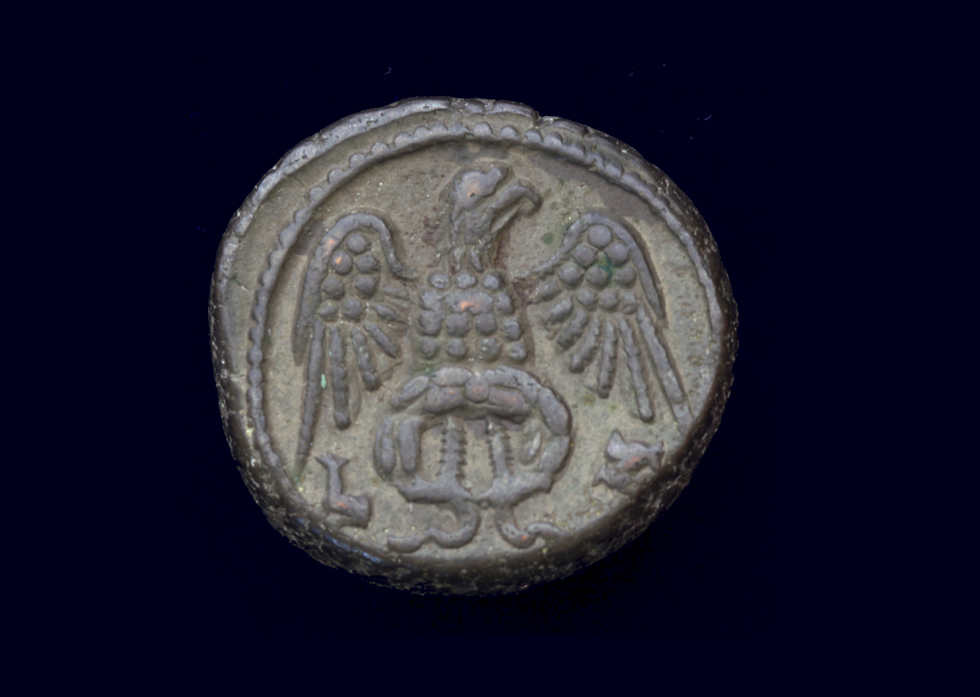
Rev: IOVI CONSERVATORI AVGG, Jupiter standing facing, head left, holding Victory on globe and sceptre; at feet to left, eagle, Γ in right field, and SMHT in exergue.
Ref: RIC VI Heraclea 75
Note: This coin issued by Licinius who controlled about 5-8 eastern mints at this time including Heraclea.
Here is the official portrait of Constantine from another officina: By the time the coin above was issued, his official image is youthful, smooth-cheeked, and classicizing (hearkening back to the time of clean shaven Julian emperors). Wright calls him the first emperor in a long succession of stubbled soldier-emperors to present himself clean-shaven. This new face deliberately set him apart from the Tetrarchs and the barracks-emperor tradition.

312 and After
On 28 October 312, Constantine defeated Maxentius at the Milvian Bridge. A few months later, Constantine met Licinius at Milan, cementing a partnership with Licinius through his marriage to Constantia, Constantine’s half-sister. February 313 Constantine and Licinius issued the "Edict of Milan" granting religious tolerance throughout the empire. Constantine and Licinius oscillated between an uneasy co-rule and open conflict, fighting wars in 314 and again in 324.
30 April 313 - Licinius defeated Maximinus Daia at the Battle of Tzirallum (in Thrace). Maximinus fled, retreating through Anatolia, and died later that year in Tarsus. Sources vary on the cause - illness, poison, or suicide are all proposed.
18 September 324 - Constantine decisively defeated Licinius at the Battle of Chrysopolis, near Chalcedon in Bithynia. Licinius surrendered and was initially spared, but was executed- most likely by hanging - around 325, accused of conspiring against Constantine.
A follis struck at Heraclea in 313 sits in that unstable interval: one civil war ended, another not yet begun, and the empire temporarily shared between two uneasy partners.
This coin of Licinius, issued 321–324, was so debased - containing barely 0.12% silver - that its official exchange value of 12½ denarii needed to be stated explicitly on the coin, since there was no meaningful intrinsic silver content to serve as an implicit guarantee of value. Constantine demonetized it immediately upon defeating Licinius in 324. The crude portrait also pointing to the deteriorating political situation.

Licinius I, AD 308-324, Heraclea, Follis Æ, 3.23g 20mm, issuied 321-324
Obv: IMP C VAL LICIN LICINIVS P F AVG, radiate, draped and cuirassed bust right
Rev: IOVI CONSERVATORI, Jupiter standing left, holding sceptre and victory on globe, eagle standing left before, head upturned, with wreath in beak, bound captive seated right behind, X-IIΓ in left field, SMHA in exergue
Ref: RIC VII Heraclea 52
Note: the Γ (in X-IIΓ) is an episemon standing for 1/2 denarius - the meaning of this notation as a whole (X-IIΓ) is that the coins is valued at 12.5 denarii, and 1/96 lb (theoretically 3.41g at 327g per pound). Also note that while the sign resembles gamma, it may be an archaic form of the letter μ (Mu).

Constantine's Vision
According to ancient sources - notably Lactantius and Eusebius of Caesarea - Constantine experienced some form of divine sign before facing his rival Maxentius. Lactantius describes a dream in which Constantine was instructed to mark his soldiers' shields with the Chi-Rho symbol (☧), the first two letters of "Christ" in Greek. Eusebius gives a more dramatic account, claiming Constantine and his army saw a cross of light in the sky with the words "In this sign, win" (in hoc signo vinces).
Constantine ordered his troops to paint the Chi-Rho on their shields and standards (the labarum). Whether this was a genuine religious conversion or a shrewd political calculation or both, it gave his army a powerful rallying symbol going into battle. He won decisively at the Milvian Bridge, and Maxentius drowned in the Tiber.
The Sign Explained?

Could a planatary alignment explain Constantine's vision and reinforce the more dramatic version of the story? DiMaio, Zeuge, and Zotov note that a planetary event on October 27, 312 could provide an explanation. Shortly after sunset in the southwest, the planets Mars, Saturn, Jupiter, and Venus were visible close together in almost a straight line in the constellations Capricorn and Sagittarius producing a Chi-Rho symbol in the sky.

A perhaps easier to support theory is that Constantine saw a solar halo also called a subdog) which looks a lot like contemporary crosses. (an example here).
Which Bridge Failed?
Ancient narratives preserve multiple different explanations of Maxentius’ fall: a broken bridge in retreat, a bridge of boats, or a trap-bridge with removable fastenings.
Lactantius says the bridge behind Maxentius was broken and that the crush of retreating men drove him into the Tiber.
"The bridge in his rear was broken down. At sight of that the battle grew hotter. The hand of the Lord prevailed, and the forces of Maxentius were routed. He fled towards the broken bridge; but the multitude pressing on him, he was driven headlong into the Tiber."
-Lacantius, Mort. Pers., 44.9
Aurelius Victor places Maxentius on a bridge of boats a little above the Milvian Bridge.
"Maxentius, while engaged against Constantine, hastening to enter from the side a bridge of boats constructed a little above the Milvian Bridge, was plunged into the depth when his horse slipped; his body, swallowed up by the weight of his armor, was barely recovered."
-Aurelius Victor, Epitome, 40.7
Zosimus gives the most elaborate version, describing a temporary bridge designed as a trap, with iron fastenings meant to be withdrawn when Constantine’s troops reached the center - only for the structure to fail amid Maxentius’ own retreat.
[2.15.3] Both being thus prepared, Maxentius threw a bridge over the Tiber, which was not of one entire piece, but divided into two parts, the centre of the bridge being made to fasten with irons, which might be drawn out upon occasion.
[2.15.4] He gave orders to the workmen, that as soon as they saw the army of Constantine upon the juncture of the bridge, they should draw out the iron fastenings, that the enemy who stood upon it might fall into the river.
-Zosimus, New History, 2.15.2-3
The Arch of Constantine is used as definitive authority in support of "cut before the battle", and even the monument often treated as decisive evidence is itself debated. While that prevailing argument is that the arch combines reused second-century spolia with Constantinian reliefs, Brian Rose has argued may derive from a Diocletianic monument that was later adapted for Constantine.
"This article proposes that nearly all of the sculpted frieze of the Arch of Constantine in Rome, generally regarded as Constantinian, derives from a triumphal monument of Diocletian commissioned shortly after his Vicennalia in 303 CE."
-Brian Rose
I like Eusebius' description of Maxentius' fall: "he dug a pit and opened it and fell into the hole which he had made".
"when he [Maxentius] fled before the power of God which was with Constantine, and passed through the river which lay in his way, over which he had formed a bridge with boats, and thus prepared the means of his own destruction. In regard to him one might say, he dug a pit and opened it and fell into the hole which he had made; his labor shall turn upon his own head, and his unrighteousness shall fall upon his own crown."
-Eusebius, Church History, 9.9.5-6
The one secure fact is the death of Maxentius in the river. The engineering of the disaster was already disputed in antiquity.
The Battle in Art
In the Vatican’s Hall of Constantine, Raphael’s design, executed by Giulio Romano after Raphael’s death, presents the scene as both military victory and the triumph of Christianity over paganism; Maxentius is shown on the verge of drowning in the Tiber, and the landscape is rendered with deliberate topographical specificity. This painting shows and intact bridge, perhaps illustrating the separate "bridge of boats" option:

An etching from Audran appears to show the bridge breaking in the moment (or rigged to fail in the moment).

Conclusion
Struck in the months after Constantine’s victory at the Milvian Bridge, this coin still proclaims IOVI CONSERVATORI AVGG, placing Jupiter at the center of imperial protection. The Tiber had already claimed Maxentius; the settlement with Licinius was in place, if uneasy. By this date, Constantine’s official portrait was already clean-shaven, and other officinae at Heraclea were issuing him that way. Yet this piece shows a bearded Constantine - an anomaly likely attributable to a workshop more accustomed to engraving Licinius and other bearded Tetrarchs. The divergence appears to be local - a reminder that imperial image was transmitted through human hands.
References
DiMaio, Michael, et al. “‘Ambigutitas Constantiniana’ : The Caeleste Signum Dei" of Constantine the Great.” Byzantion, vol. 58, no. 2, 1988, pp. 333–60.
Rose, CB. Reconsidering the frieze on the Arch of Constantine, Journal of Roman Archaeology , Volume 34 , Issue 1 , June 2021 , pp. 175 - 210.
Wigg-Wolf, David. “An Issue of Follis Fractions with Denominational Marks by Constantine I at Rome". In: H.-Chr. Noeske / H. Schubert (Eds), Die Münze: Bild - Botschaft - Bedeutung. Festschrift Fur Maria R.-Alföldi (Frankfurt Am Main / New York / Paris 1991) pp. 410-422.
Bagnall, Roger S., and Gilles Bransbourg. "The Constantinian Monetary Revolution." ISAW Papers 14 (2019). Institute for the Study of the Ancient World, New York University.
Latimer, Amber Lee. "Decoding Symbolic Signification in Late Antiquity: An Analysis of the Adoption of the ‘Constantinian’ Monogram in the Fourth Century." PhD diss., University of Alberta, 2022.
Wright, David H. "The True Face of Constantine the Great." Dumbarton Oaks Papers 41 (1987): 493–507.
Bruun, Patrick. "Notes on the Transmission of Imperial Images in Late Antiquity." In Studia Romana in Honorem Petri Krarup Septuagenarii, edited by Karen Ascani et al., 122–131. Odense: Odense University Press, 1976.

Comments