
Messalina

Updated: Jan 24

The life of Valeria Messalina, the third wife of Emperor Claudius, has inspired numerous books, plays, operas, and films due to her reputation for political intrigue, alleged promiscuity, and dramatic downfall.
The Coin
By Year 6 of Claudius, the Alexandrian tetradrachm had stabilized as a billon currency (an alloy of silver and base metal, typically copper). While theoretically a silver denomination, the actual silver content in this period hovered around 15–20%. It is fascinating to observe the variance in surface appearance - this one more silver in appearance.

Roman Provincial, Egypt, Alexandria, Claudius with Messalina, AD 41-54, BI Tetradrachm (24.5mm, 12.61g, 12h), RY 6 = 45/6.
Obv: ΤΙ ΚΛΑΥΔΙ ΚΑΙΣ ΣΕΒΑ ΓΕΡΜΑΝΙ ΑΥΤΟΚ, laureate head of Claudius to right; before, L ς (date, regnal year 6).
Rev: MEΣΣAΛINA KAIΣ ΣEBAΣ, Messalina, veiled, standing left, leaning on column, holding two children and grain ears.
Ref: Dattari (Savio) 130. Emmett 74.6. K&G 12.54. RPC I 5164. Light toning. Very fine.

Messalina as Demeter: Holding the grain ears (stachys), Messalina is visually assimilated to Demeter (Ceres) or Euthenia, positioning her as the guarantor of the harvest.
The Imperial Heirs: The two small figures in her hand are Britannicus (born 41 AD, roughly 4–5 years old) and Octavia (born ~39/40 AD). Messalina represented as the Genetrix (Mother) of the dynasty.
The Lituus: The curved augural staff to the left is a symbol of the Pontifex Maximus (the Emperor). Its placement on Messalina’s side of the coin is highly unusual, likely still associated with Claudius and serving as a "paternal seal of approval" supporting the dynastic message of the reverse.
The Governor: Egypt was the emperor's personal province. This coin was minted during the term Gaius Julius Postumus (c. 45–47 AD) as Praefectus Aegypti.
The "Augusta" Anomaly: The inscription ΣΕΒΑΣ (Sebaste) is the Greek equivalent of the Latin Augusta. While the Roman Senate never officially granted Messalina this title, the Greek East (and specifically Alexandria) frequently accorded imperial wives honors that were constitutionally withheld in Rome.
Birth
Messalina was born around AD 17–20. She was related to emperors Augustus and Tiberius through her mother, Domitia Lepida. Domitia Lepida was the daughter of Antonia Major (the niece of Emperor Augustus) and Lucius Domitius Ahenobarbus.
Marriage to Claudius
She wed (when she was about 18-22 years old) to the future emperor Claudius (her second cousin once removed, he was close to 50 years old) around AD 38 or 39. When Claudius unexpectedly became emperor in AD 41 (following Caligula’s assassination), Messalina found herself empress at a relatively young age. Generally Claudius is portrayed as weak by the ancient historians. Suetonius describes him hiding behind curtains on the day he was named emperor:
"Having spent the greater part of his life under these and like circumstances, he became emperor in his fiftieth year by a remarkable freak of fortune. When the assassins of Gaius (caligula) shut out the crowd under pretence that the emperor wished to be alone, Claudius was ousted with the rest and withdrew to an apartment called the Hermaeum; and a little later, in great terror at the news of the murder, he stole away to a balcony hard by and hid among the curtains which hung before the door. As he cowered there, a common soldier, who was prowling about at random, saw his feet, intending to ask who he was, pulled him out and recognized him; and when Claudius fell at his feet in terror, he hailed him as emperor."
-Suetonius, Life of Claudius 10.1
Claudius as Ruler
Four ancient quotes on Claudius' rule - with Josephus as the outlier in portraying him as a just and merciful ruler.
Suetonius
"His mother Antonia often called him "a monster of a man, not finished but merely begun by Dame Nature"; and if she accused anyone of dullness, she used to say that he was "a bigger fool than her son Claudius." His grandmother Augusta always treated him with the utmost contempt, very rarely speaking to him; and when she admonished him, she did so in short, harsh letters, or through messengers. When his sister Livilla heard that he would one day be emperor, she openly and loudly prayed that the Roman people might be spared so cruel and undeserved a fortune." (Suetonius, The Twelve Caesars, Claudius 21.3)Cassius Dio
"It was not these infirmities, however, that caused the deterioration in Claudius so much as it was the freedmen and the women with whom he associated; for he, more conspicuously than any of his peers, was ruled by slaves and by women." (Cassius Dio, Roman History 60.2)Josephus
"Upon the petition of king Agrippa and king Herod, who are persons very dear to me, that I would grant the same rights and privileges should be preserved to the Jews which are in all the Roman empire, which I have granted to those of Alexandria, I very willingly comply therewith; and this grant I make not only for the sake of the petitioners, but as judging those Jews for whom I have been petitioned worthy of such a favor, on account of their fidelity and friendship to the Romans. I think it also very just that no Grecian city should be deprived of such rights and privileges, since they were preserved to them under the great Augustus.." (Josephus, Jewish Antiquities 19.288-289)Tacitus
"Then came a revolution in the State, and everything was under the control of a woman (Agrippina), who did not, like Messalina, insult Rome by loose manners. It was a stringent, and, so to say, masculine despotism; there was sternness and generally arrogance in public, no sort of immodesty at home, unless it conduced to power. A boundless greed of wealth was veiled under the pretext that riches were being accumulated as a prop to the throne.." (Tacitus, Annals 12.7)Messalina's Children
She bore two children by Claudius - Britannicus and Claudia Octavia are thought to be the two children depicted in her hand on my coin.
Britannicus (b. AD 41) – briefly heir to the throne before being replaced by Nero.
Claudia Octavia (b. AD 39/40) – later married the emperor Nero.
Messalina's Fall
The coin was issued at the peak of Messalina’s public image. 45/46 AD: she was celebrated as the "Goddess of Abundance" and mother of the heir.
Not long after, 48 AD: following her attempted coup with Gaius Silius (marriage to him while the emperor was in Ostia), she is summarily executed after hesitating to kill herself.
Tacitus reads (11.26) describes her attempt to replace her husband with Gaius Silius, whom she married while Claudius was traveling in Ostia. Presumably an attempted coup. Tacitus describes the end of Messalina (she was around 28-31 years old when she died).
"Then for the first time she understood her fate and put her hand to a dagger. In her terror she was applying it ineffectually to her throat and breast, when a blow from the tribune drove it through her. Her body was given up to her mother. Claudius was still at the banquet when they told him that Messalina was dead, without mentioning whether it was by her own or another's hand. Nor did he ask the question, but called for the cup and finished his repast as usual. During the days which followed he showed no sign of hatred or joy or anger or sadness, in a word, of any human emotion, either when he looked on her triumphant accusers or on her weeping children. The Senate assisted his forgetfulness by decreeing that her name and her statues should be removed from all places, public or private."
-Tacitus, Annals 11.38
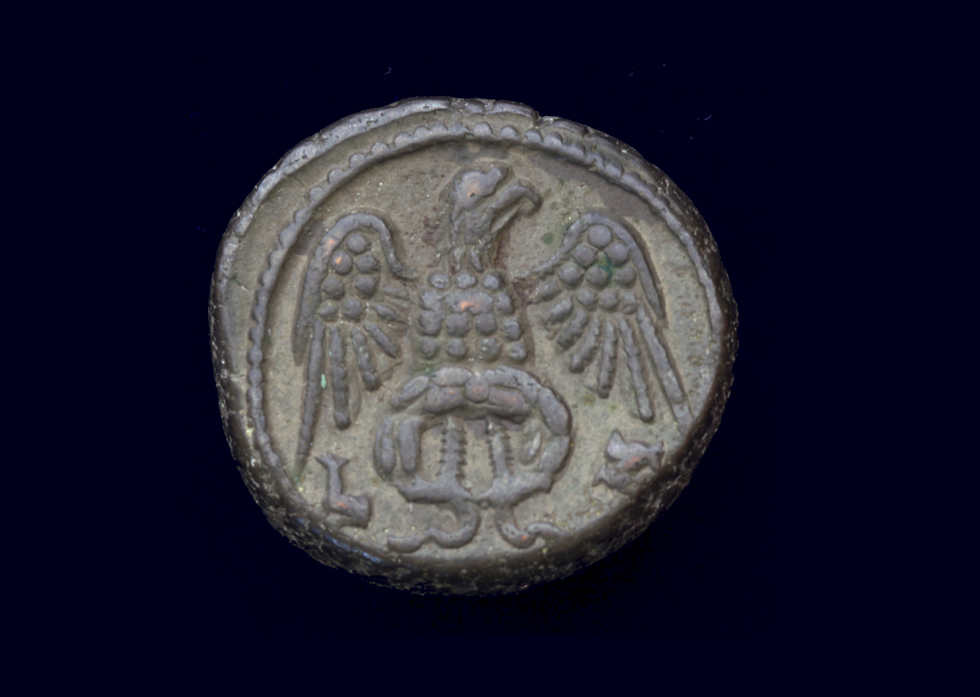
The fall of Valeria Messalina opened the door for Claudius’s marriage to Agrippina the Younger, whose son (Nero) ultimately became emperor. Here is another Alexandrian Tetradrachm from the 10th year of Nero's reign (RY 10 = AD 63/4). with the god Serapis on the reverse.

Legacy in Literature

From antiquity onward, the life of Messalina has been transmitted primarily through hostile literary sources (notably Tacitus, Suetonius, and Juvenal), which established a durable narrative of sexual excess and political intrigue. Her portrayal is repeatedly adapted in early modern drama, opera, and later historical fiction and scholarship, with Messalina functioning less as a historical actor than as a moralized example of cultural anxieties about female power, sexuality, and imperial authority.
Nathanael Richards’ The Tragedy of Messallina depicts her as a monstrous political-sexual threat and echos contemporary English court politics, including polemical allusion against the (Catholic) queen consort of Charles I, Henrietta Maria.
A ballet written in the 19th century by Luigi Danesi based on the life of Valeria Messalina, makes a spectacle of her alleged promiscuity and political intrigues. The ballet's libretto was inspired by a verismo play of the same name by Pietro Cossa. The color poster from an performance in Paris around 1885 that didn't get great reviews. This libretto (available at archive.org) is from a performance at the Teatro Vittorio Emanuele in Turin during the Autumn Season of 1898.
An alternative modern view on Roman empresses can be found in Joan Smith's "Unfortunately, She Was a Nymphomaniac" (2024) covering the broader topic of ancient Rome's approach to imperial women.
For a provincial coin thought to depict Nero and Britannicus at a time when Rome was divided about succession - see this post: Mark Antony's Great-Great-Grandson.


Comments